Facts
The petitioner filed a petition under Section 528 of the Bharatiya Nagarik Suraksha Sanhita (BNSS) challenging an order dated 17.06.2026 passed by the XVII Additional Sessions Judge, Bhopal.
Source reference: para. 1In the underlying trial (S.T. No. 327/2022), the trial court had previously dismissed an application to call a DNA expert on 05.08.2025.
Source reference: para. 2However, at the stage of final arguments, the court noticed the DNA report and passed a fresh order to summon the DNA expert as a witness.
Source reference: para. 3The petitioner contended that this order violated the bar against a criminal court reviewing its own judgment under Section 403 of the BNSS (formerly Section 362 of the Cr.P.C.).
Source reference: para. 2Issues
1. Whether the trial court’s order to summon a DNA expert at the stage of final arguments, after previously dismissing a similar application, constitutes an impermissible review of its own order under Section 403 of the BNSS/Section 362 of the Cr.P.C.
Source reference: para. 2, 82. Whether the summoning of a scientific expert is essential for a "just decision" under the discretionary and mandatory powers of Section 348 of the BNSS/Section 311 of the Cr.P.C.
Source reference: para. 5, 8Law Applied
The court applied Section 348 of the BNSS (corresponding to Section 311 of the Cr.P.C.), which grants courts the power to summon or recall any witness if their evidence is essential for a just decision.
Source reference: para. 5Mohanlal Shamji Soni v. Union of India, which established that the determinative factor for summoning a witness is the "essentiality" of the evidence.
Source reference: para. 5Rajaram Prasad Yadav v. State of Bihar was cited to emphasize that this power must be used to achieve justice and not to fill lacunae.
Source reference: para. 6Natasha Singh v. CBI reinforced that the object is to ensure all relevant evidence is before the court for proper adjudication.
Source reference: para. 7The court also distinguished this statutory power from the bar on "review" found in Section 403 of the BNSS/Section 362 of the Cr.P.C.
Source reference: para. 8Reasoning
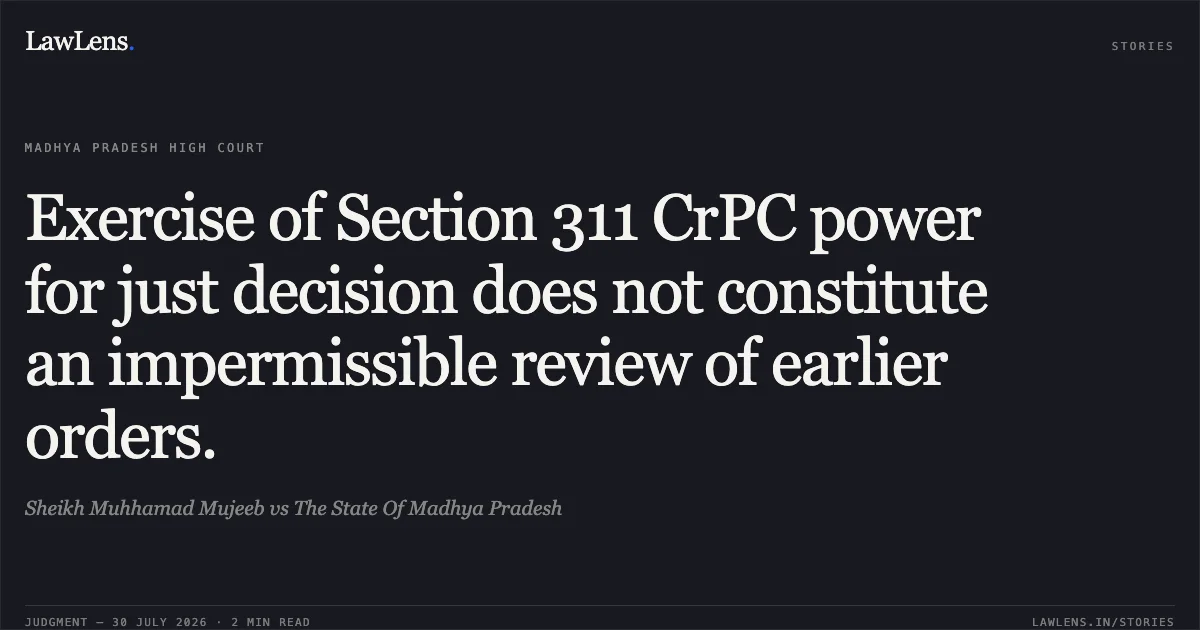
The High Court reasoned that Section 348 of the BNSS/Section 311 of the Cr.P.C. is a "continuing power" available until the conclusion of the trial.
Source reference: para. 8It held that the trial court did not "review" its 2025 order in a judicial sense; rather, it exercised a statutory duty because, upon hearing final arguments, it found the DNA report—a crucial piece of scientific evidence—required expert clarification for a just decision.
Source reference: para. 8The Court noted that since both parties were granted the opportunity to examine the expert, the principles of natural justice were satisfied and no prejudice was caused.
Source reference: para. 8It concluded that the rejection of an earlier application does not strip a court of its jurisdiction to later summon a witness under Section 311 if the evidence becomes necessary as the trial progresses.
Source reference: para. 8Holding
The High Court held that the trial court committed no jurisdictional error or legal infirmity as the power under Section 311 of the Cr.P.C. operates in a different field than the prohibition of review.
The summoning of the DNA expert was deemed necessary for the discovery of truth and a just decision.
Source reference: para. 9Consequently, the petition was dismissed.
Source reference: para. 10Acts & Sections Cited
5 provisions across 2 statutes referred to in this judgment. Each provision opens on LawLens.
Bharatiya Nagarik Suraksha Sanhita, 20233
Code of Criminal Procedure, 19732
Original Court PDF
Sheikh Muhhamad MujeebvsThe State Of Madhya Pradesh
Click to open original judgment
Original judgment, available to read, download and summarize on LawLens.in


