Facts
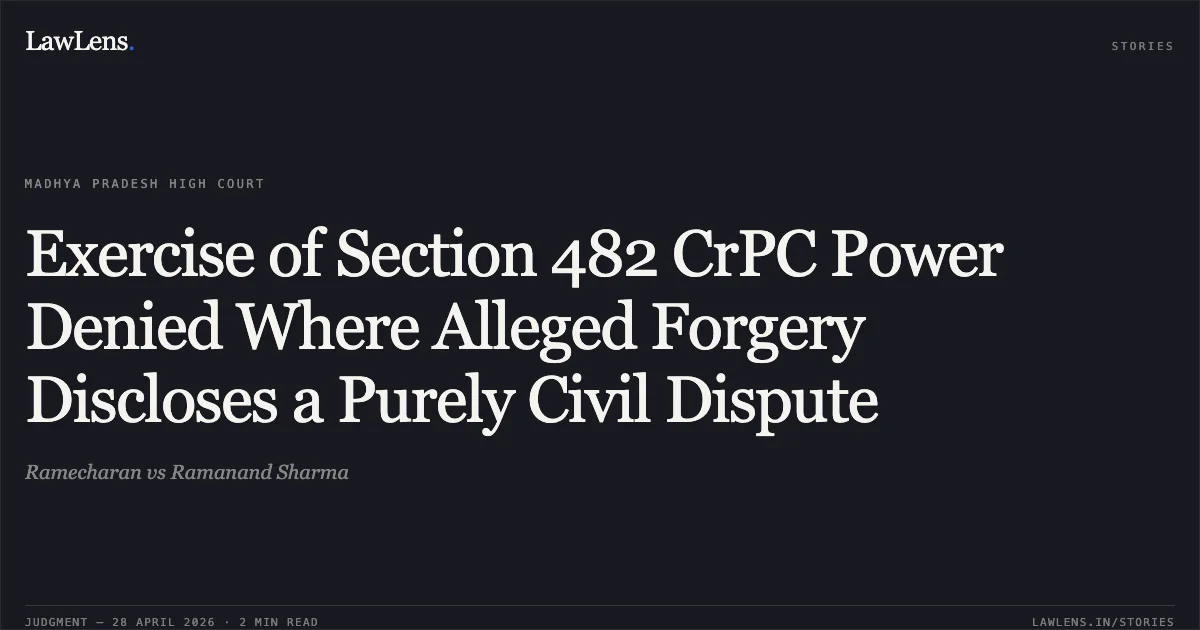
The applicant (complainant) filed a private complaint alleging that his father purchased 0.277 hectares of land in 1980, but in 1991–92, the respondents conspired to delete his father's name from revenue records and substitute their own through forged documents.
Source reference: para. 2The Judicial Magistrate First Class (JMFC), Sidhi, discharged the respondents on 23.07.2015.
Source reference: para. 1, 3The applicant’s revision petition was subsequently dismissed by the Second Additional Sessions Judge, Sidhi, on 25.05.2016, affirming the discharge.
Source reference: para. 1, 3The applicant then moved the High Court under Section 482 of the CrPC to quash these orders.
Source reference: para. 1Issues
1. Whether the concurrent findings of the lower courts in discharging the respondents under Section 467 read with Section 109 of the IPC were perverse or illegal.
Source reference: para. 10, 132. Whether the dispute between the parties is primarily of a civil nature, thereby precluding criminal prosecution for forgery.
Source reference: para. 10, 14Law Applied
Section 482 of the Code of Criminal Procedure (CrPC), 1973, which grants inherent powers to the High Court to prevent abuse of the process of law, noting that such interference is limited to cases of perversity or jurisdictional error.
Source reference: para. 12, 13The court applied the principle that while only a prima facie case is required, an accused is entitled to discharge if the material on record, even taken at face value, does not disclose the commission of an offense.
Source reference: para. 5, 11Sections 467 (forgery of valuable security) and 109 (abetment) of the Indian Penal Code (IPC).
Source reference: para. 1Reasoning
The High Court observed that during the pre-charge evidence stage, the complainant failed to produce witnesses other than himself despite repeated opportunities over 15 years.
Source reference: para. 8Crucially, the court highlighted the complainant’s own admission during cross-examination that the consideration amount for the original land transaction had been returned.
Source reference: para. 9This admission undermined the foundation of the forgery claim, as it suggested the deletion of the name from revenue records was not necessarily fraudulent.
Source reference: para. 9The court reasoned that the dispute was essentially a civil matter concerning title and possession of land rather than a criminal act of forgery.
Source reference: para. 10, 14Since the applicant failed to demonstrate any patent illegality or miscarriage of justice in the lower courts' concurrent findings, the court determined that exercising inherent jurisdiction to overturn a discharge based on a factual admission was unwarranted.
Source reference: para. 12, 13Holding
The High Court answered both issues in the negative, holding that the lower courts’ orders did not suffer from jurisdictional errors or perversity.
The Court held that the applicant was attempting to "give a criminal colour to what is essentially a civil dispute".
Source reference: para. 14Consequently, the petition under Section 482 CrPC was dismissed, and the orders of the JMFC and the Sessions Court discharging the respondents were affirmed.
Source reference: para. 15Acts & Sections Cited
3 provisions across 2 statutes referred to in this judgment. Each provision opens on LawLens.
Code of Criminal Procedure, 19731
Indian Penal Code, 18602
Original Court PDF
RamecharanvsRamanand Sharma
Click to open original judgment
Original judgment, available to read, download and summarize on LawLens.in