Facts
The applicant, Ritesh Rawal, joined the Central Industrial Security Force (CISF) as a Constable on August 20, 2001.
Source reference: para. 6He was sent on deputation to the National Investigation Agency (NIA) in 2009 and was subsequently absorbed into the NIA on October 13, 2014, in the same pay scale.
Source reference: para. 6, 12The applicant seeks to have his past service in the CISF counted as regular service for the purpose of seniority and promotions (specifically to the posts of Head Constable and Assistant Sub-Inspector) within the NIA.
Source reference: para. 5Despite submitting representations in August 2023 and December 2025, the respondents failed to pass any orders.
Source reference: para. 3, 7The applicant approached the Tribunal seeking a direction to the respondents to consider his past service and convene a review DPC.
Source reference: para. 5Issues
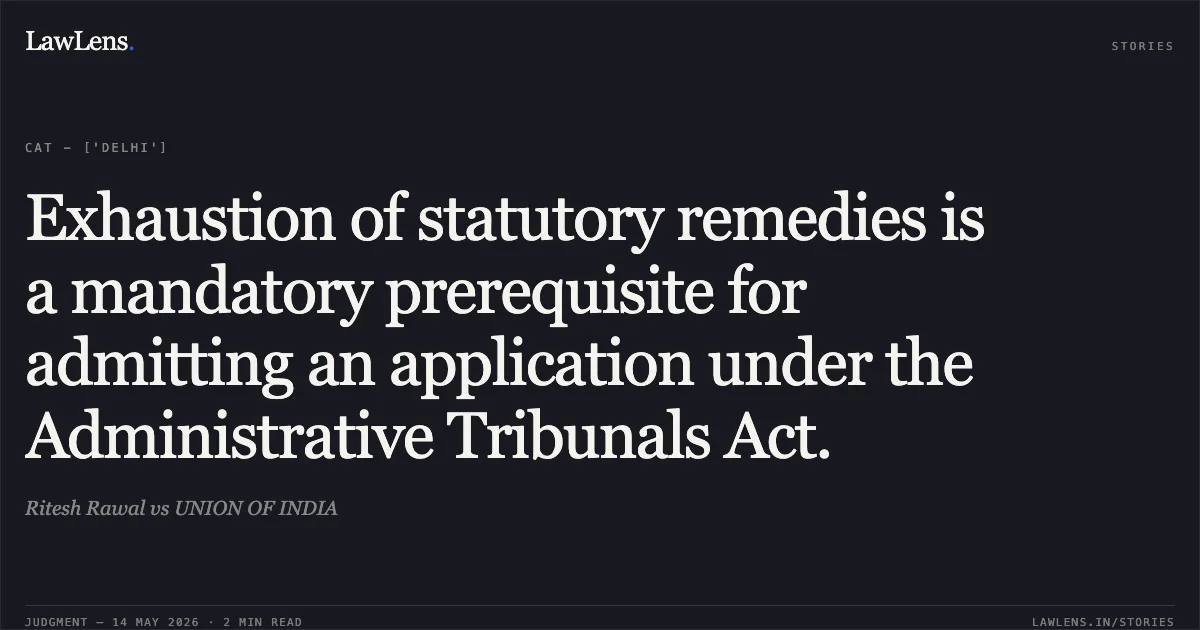
1. Whether the application is maintainable or premature under the Administrative Tribunals Act, 1985, given the pending representations.
Source reference: para. 152. Whether the remedy of filing a representation is an efficacious and mandatory exhaustion of departmental remedies before approaching the Tribunal.
Source reference: para. 15Law Applied
Section 20 of the Administrative Tribunals Act, 1985, which mandates that the Tribunal shall not ordinarily admit an application unless all available departmental remedies/representations have been exhausted.
Source reference: para. 16, 17Under Section 20(2)(b), a person is deemed to have exhausted remedies if six months have passed since a representation was made and no final order was passed.
Source reference: para. 16K. Madhavan vs Union of India (1987) regarding service reckoning.
Source reference: para. 8Tribunal precedents such as Meer Singh v. Union of India and Devl Dutt Sharma v. Union of India, which established the "counter-obligation" of authorities to decide representations to avoid unnecessary litigation.
Source reference: para. 19-21Reasoning
The Tribunal analyzed the statutory bar under Section 20 of the Act, noting that the applicant had filed a representation on December 9, 2025, which remained pending.
Source reference: para. 14While the Registry initially objected to the OA as premature, the Bench overruled the objection to provide an OA number but maintained that the statutory scheme requires the executive to first decide on grievances.
Source reference: para. 4, 18The Court observed that while the applicant cited several precedents (Jasveer Singh and K. Madhavan) to argue for the counting of analogous service, the core procedural requirement of allowing the Department to act had not been satisfied.
Source reference: para. 8, 23Aligning with similar orders passed in Vijay Kumar Singh v. NIA and Sanjeev Kumar v. NIA, the Tribunal reasoned that directing a time-bound decision on the pending representation would meet the ends of justice without the Tribunal prematurely adjudicating the merits of the service claim.
Source reference: para. 22-24Holding
The Tribunal held that the OA was premature as departmental remedies were not fully exhausted.
The Tribunal directed the Competent Authority/NIA to consider and decide the applicant’s pending representation dated December 9, 2025, by passing a reasoned and speaking order within four weeks.
Source reference: para. 24The Original Application was disposed of at the admission stage with liberty to the applicant to approach the Tribunal if still aggrieved following the decision.
Source reference: para. 19, 26Acts & Sections Cited
2 provisions across 1 statute referred to in this judgment. Each provision opens on LawLens.
Administrative Tribunals Act, 19852
Original Court PDF
Ritesh RawalvsUNION OF INDIA
Click to open original judgment
Original judgment, available to read, download and summarize on LawLens.in