Facts
The Applicant, originally a Head Constable in the Arunachal Pradesh Police (APP), was promoted to Assistant Sub-Inspector (ASI) on April 28, 2011.
Source reference: para. 3He was sent on deputation to the National Investigation Agency (NIA) in February 2014 and was subsequently absorbed into the NIA as an ASI on June 28, 2017.
Source reference: para. 3, 9The Applicant sought to have his past service in the APP counted toward his eligibility for promotion to the post of Sub-Inspector and Inspector in the NIA.
Source reference: para. 2Although he was promoted to Sub-Inspector in the NIA on January 1, 2023, he contended he was entitled to an earlier promotion date (Vacancy Year 2018) by reckoning his prior service.
Source reference: para. 3, 10He submitted representations to the NIA on May 31, 2023, and November 28, 2025, which remained pending without decision.
Source reference: para. 11Issues
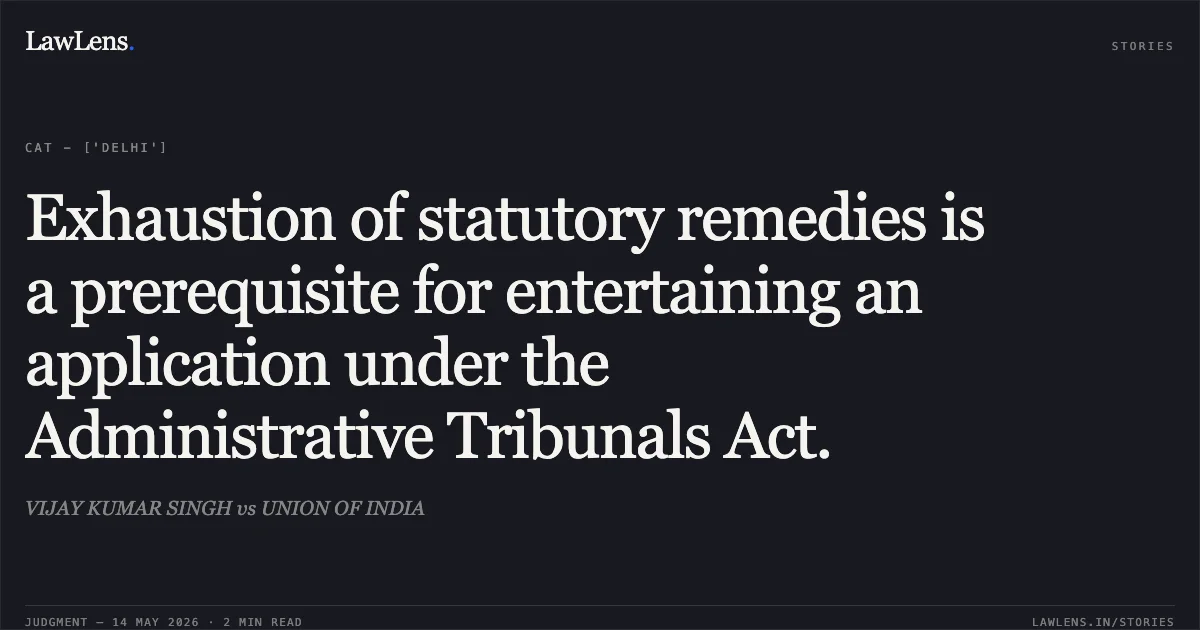
1. Whether the application is maintainable before the Tribunal when the Applicant’s departmental representations regarding his grievance are still pending consideration by the competent authority.
Source reference: para. 122. Whether the period of service rendered in an analogous post in the parent cadre (APP) should be counted for eligibility for promotion within the NIA.
Source reference: para. 3, 5Law Applied
Section 20 of the Administrative Tribunals Act, 1985, which mandates that a Tribunal shall not ordinarily admit an application unless all available departmental remedies have been exhausted.
Source reference: para. 13-15The principle that while an employee must exhaust remedies, there is a "counter obligation" on the authority to decide such representations to avoid unnecessary litigation, as held in Paramjit Kaur v. Union of India and Devl Dutt Sharma v. Union of India.
Source reference: para. 17-18The precedent in K. Madhavan v. Union of India (1987) regarding the counting of service in analogous posts for promotion eligibility.
Source reference: para. 5Reasoning
The Tribunal observed that the Applicant had already invoked departmental remedies by filing representations in 2023 and 2025, which were still pending before Respondent No. 2 (NIA).
Source reference: para. 11It reasoned that under Section 20 of the Act, the application was technically "premature" because the statutory six-month period following the latest representation (November 2025) had not expired, nor had a final order been passed.
Source reference: para. 14, 20However, following the consistency established in similar cases against the NIA—such as Dinesh Chandra Sati v. NIA and M.S. Pillai v. NIA—the Tribunal found that the interests of justice and parity required a direction to the authorities to perform their "counter obligation" of deciding the pending grievance through a reasoned order rather than dismissing the case outright.
Source reference: para. 19-21Holding
The Tribunal held that the application was premature but, to ensure the exhaustion of remedies, directed the Competent Authority (NIA) to decide the Applicant’s pending representations dated August 31, 2023, and November 28, 2025, within four weeks.
The Authority must pass a reasoned and speaking order in accordance with the law without being influenced by the Tribunal’s observations on the merits. The OA was disposed of at the admission stage with no order as to costs.
Source reference: para. 21-24Acts & Sections Cited
2 provisions across 1 statute referred to in this judgment. Each provision opens on LawLens.
Administrative Tribunals Act, 19852
Original Court PDF
VIJAY KUMAR SINGHvsUNION OF INDIA
Click to open original judgment
Original judgment, available to read, download and summarize on LawLens.in