Facts
On 01.12.1983, a victim named Vinod was fatally stabbed on a DTC bus (route 431) after he and his companions (PWs 5, 6, 7, and 11) protested against three men misbehaving with the women in their group.
Source reference: p. 3-4The prosecution alleged that while three accused (Balvinder, Charanjit, and Shyam Lal) were at the front of the bus, the Appellant (Mukesh Kumar) entered from the rear and exhorted them by shouting "Maro Sale Ko".
Source reference: p. 3-4The Appellant was arrested on 27.12.1983 following a tip-off and subsequently refused to participate in a Test Identification Parade (TIP), claiming he had already been shown to the witnesses.
Source reference: p. 4-5The Trial Court convicted him under Section 302 read with Section 34 of the IPC, sentencing him to life imprisonment.
Source reference: p. 1-2The Appellant challenged the conviction, citing material contradictions in witness testimonies and a flawed identification process.
Source reference: p. 9-10Issues
1. Whether the Appellant’s refusal to participate in the Test Identification Parade (TIP) warranted an adverse inference against him.
Source reference: p. 132. Whether the dock identification of the Appellant by the eye-witnesses was reliable despite allegations of them seeing the accused prior to the TIP.
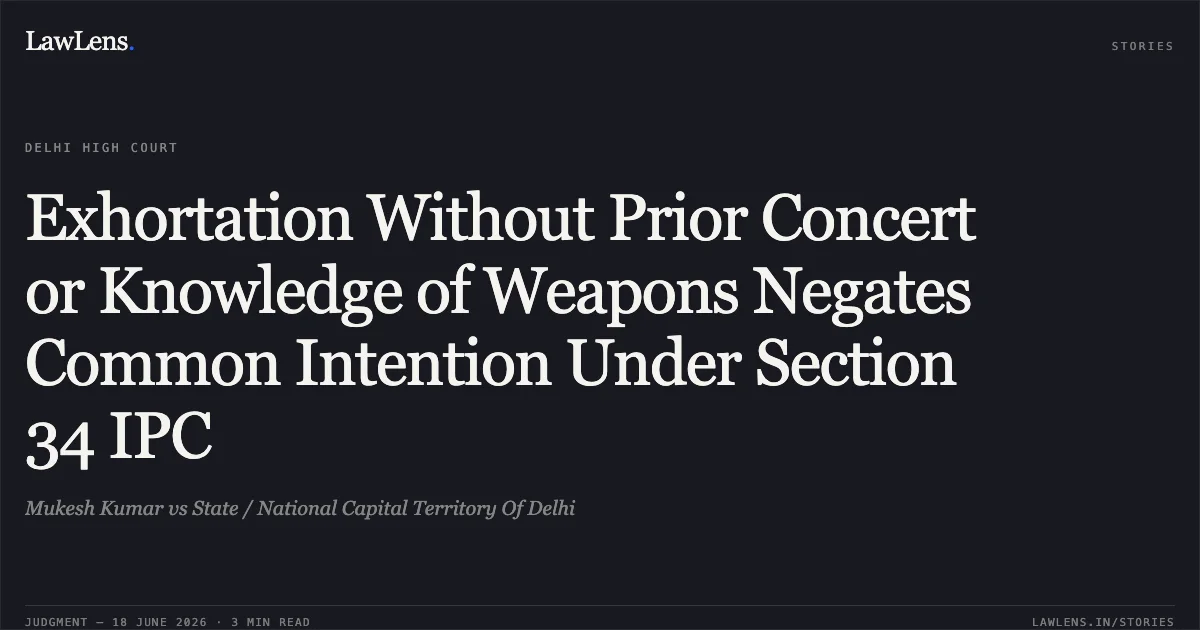
Source reference: p. 103. Whether the alleged act of exhortation (“Maro Sale Ko”) and the Appellant's presence were sufficient to establish "common intention" under Section 34 IPC for the offence of murder.
Source reference: p. 19-20Law Applied
Section 34 of the IPC, which requires establishing a "common intention" through a pre-arranged plan or a simultaneous conscious mind to bring about a particular criminal result.
Source reference: p. 20-23The court relied on Gireesan Nair v. State of Kerala and Raj Kumar @ Bheema v. State of NCT of Delhi, establishing that if an accused is shown to witnesses prior to a TIP, both the TIP and subsequent dock identification are inadmissible or fundamentally flawed.
Source reference: p. 13-14The court applied the principle from Jainul Haque v. State of Bihar, noting that "exhortation" is a weak piece of evidence and requires clear, cogent, and reliable proof.
Source reference: p. 25-26The court cited Matadin v. State of Maharashtra, which held that the words "Maro Sale Ko" do not necessarily imply an intention to kill but may signify an intent to beat.
Source reference: p. 26-27Reasoning
The court found the identification process highly suspect, observing that witnesses (PW-6 and PW-11) admittedly saw the accused in court with "unmuffled faces" prior to the TIP date, and the order sheets on the day of the TIP recorded the accused were in "open face".
Source reference: p. 15-17Regarding common intention, the court noted there was no prior enmity and no evidence that the Appellant knew his co-accused carried knives.
Source reference: p. 28The court reasoned that in a spontaneous scuffle arising from misbehavior, the vague exhortation "Maro Sale Ko" could at most indicate an intent to cause hurt, not murder, especially since the Appellant was acquitted of Section 307/34 charges involving other victims in the same incident.
Source reference: p. 29Holding
The High Court held that the refusal to participate in the TIP did not justify an adverse inference because the accused had been previously shown to witnesses.
The court concluded that the prosecution failed to prove either the Appellant's identity beyond doubt or the existence of a common intention to commit murder.
Source reference: p. 29The Court set aside the Judgment dated 10.08.2004 and the Sentencing Order dated 19.08.2004, acquitting the Appellant of all charges and discharging his bonds.
Source reference: p. 29-30Acts & Sections Cited
3 provisions across 3 statutes referred to in this judgment. Linked provisions open on LawLens.
Indian Penal Code, 18601
Code of Criminal Procedure, 19731
Arms Act, 19591
Original Court PDF
Mukesh KumarvsState / National Capital Territory Of Delhi
Click to open original judgment
Original judgment, available to read, download and summarize on LawLens.in