Facts
The Appellant, a shopkeeper, was convicted by the Special Judge (CBI) for conspiring with B.P. Rautre (a bank clerk) to defraud the Central Bank of India, Saraipali Branch.
Source reference: p. 1-2The prosecution alleged that in April 1992, Rautre forged transfer vouchers to move ₹15,000 from two third-party accounts into the Appellant’s account, which the Appellant then withdrew using a pre-signed form.
Source reference: p. 2While Rautre allegedly defrauded a total of ₹3,22,000 across multiple accounts, only the ₹15,000 transaction involved the Appellant.
Source reference: p. 5, 17Rautre absconded and was never tried; the Appellant claimed he signed a blank form at Rautre's request without knowledge of the fraud or receiving any proceeds.
Source reference: p. 4, 15Issues
1. Whether the prosecution proved the charge of criminal conspiracy under Section 120-B of the IPC against the Appellant beyond a reasonable doubt.
Source reference: p. 6, para. 102. Whether the mere act of signing a withdrawal form used for fraudulent transfers, absent direct evidence of a meeting of minds, is sufficient to sustain a conviction under the Prevention of Corruption Act and the IPC.
Source reference: p. 15, 18Law Applied
The Court applied Section 120-A (definition) and 120-B (punishment) of the IPC regarding criminal conspiracy, emphasizing that the "unlawful agreement" is the sine qua non of the offence.
Source reference: para. 14, 20It relied on Ram Narayan Popli v. CBI (2003), establishing that while conspiracy is often proven via circumstantial evidence, there must be a "meeting of minds" resulting in a conscious decision.
Source reference: para. 19The Court further invoked K.R. Purushothaman v. State of Kerala (2005) to hold that suspicion cannot substitute legal proof.
Source reference: para. 20Sharad Birdhichand Sarda v. State of Maharashtra (1984), which mandates that a chain of circumstantial evidence must be so complete as to exclude every hypothesis of innocence.
Source reference: para. 26Reasoning
The Court observed that the Appellant's conviction rested entirely on the theory of conspiracy as he was not a public servant.
Source reference: para. 21It noted that the internal auditor (PW-7) found numerous blank pre-signed forms in the absconding co-accused’s room, supporting the Appellant’s defense that Rautre manipulated his account.
Source reference: para. 7-8The Court highlighted a critical gap: while Rautre defrauded ₹3,22,000 from various accounts, the prosecution failed to link the Appellant to the remaining ₹3,12,000, suggesting the Appellant was not part of a broader "common design".
Source reference: para. 24, 27The Court reasoned that the Banker-Customer relationship made the Appellant’s explanation—that he trusted the clerk with a signed form—plausible.
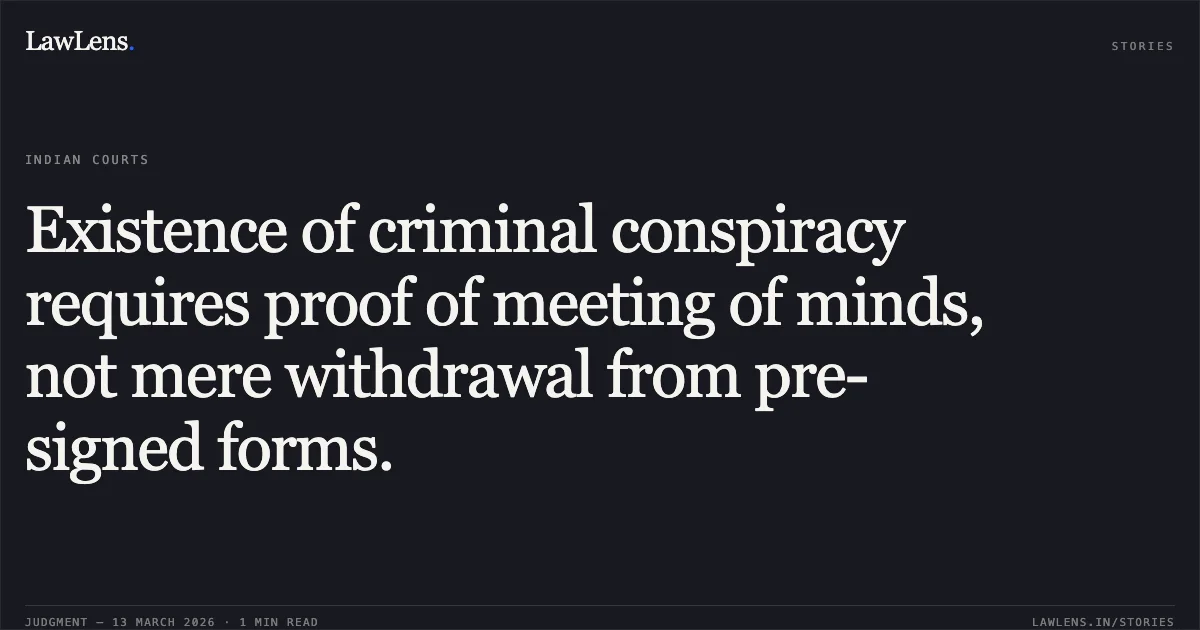
Source reference: para. 23Since the prosecution failed to prove a "prior consensus" or "meeting of minds" beyond the single suspicious withdrawal, the chain of circumstances was deemed incomplete.
Source reference: para. 25, 28Holding
The High Court allowed the appeal, holding that the prosecution failed to establish the essential ingredients of criminal conspiracy beyond a reasonable doubt.
The Court set aside the judgments of conviction and sentences under Sections 420, 468, 471, 477-A, all read with 120-B of the IPC, and Section 13(1)(d) read with 13(2) of the Prevention of Corruption Act.
Source reference: para. 30The Appellant was acquitted of all charges and his bail bonds were discharged.
Source reference: para. 30Acts & Sections Cited
5 provisions across 3 statutes referred to in this judgment. Each provision opens on LawLens.
Indian Penal Code, 18603
Prevention of Corruption Act, 19881
Code of Criminal Procedure, 19731
Original Court PDF
Deendayal Agrawal v. State of Madhya Pradesh (through C.B.I.) 2026:CGHC:11754
Click to open original judgment
Original judgment, available to read, download and summarize on LawLens.in