Facts
The petitioner, proprietor of M/s. Purbashree Printing House, was charge-sheeted in connection with C.M.’s Vigilance Cell P.S. Case No. 09/2017.
Source reference: p. 3The FIR, lodged by the Labour Commissioner, alleged criminal breach of trust, cheating, and misappropriation of government funds involving his predecessors and the petitioner.
Source reference: p. 3Allegations included irregularities in the tender process: a Notice Inviting Tender (NIT) was issued without specifying quantities or rates.
Source reference: p. 3No tender evaluation committee was formed, and the petitioner allegedly filed multiple tenders under different house names to fix the process.
Source reference: p. 3, 7It was further alleged that the petitioner was paid approximately ₹64.89 Crores, an amount significantly higher than the market rates quoted by the Government Printing Press.
Source reference: p. 5The petitioner sought quashing of the charge sheet under Section 482 CrPC, arguing a lack of evidence regarding a "prior meeting of minds".
Source reference: p. 4Issues
1. Whether the charge sheet filed against the petitioner discloses a prima facie case of criminal conspiracy and misappropriation of public funds sufficient to proceed with trial.
Source reference: p. 62. Whether the inherent powers of the High Court under Section 482 of the CrPC should be exercised to quash the proceedings at the charge-sheet stage.
Source reference: p. 6-7Law Applied
Section 482 of the CrPC regarding the inherent powers of the High Court to prevent abuse of the process of law.
Source reference: p. 3, 6State of Haryana v. Bhajan Lal (1992), which dictate that proceedings should only be quashed if the allegations, even if taken at face value, do not constitute a prima facie offence.
Source reference: p. 6-7Ram Sharan Chaturvedi v. State of M.P. (2022), which emphasizes that the principal ingredient of Section 120-B IPC is an agreement to commit an offence, which must be proved through direct or circumstantial evidence.
Source reference: p. 4-5Reasoning
The Court analyzed the surrounding circumstances of the tender process to determine the existence of a prima facie case. It noted that the NIT lacked essential details like quantity and value, and the absence of a formal evaluation committee suggested procedural bypasses.
Source reference: p. 3The Court observed the massive discrepancy between the payments made to the petitioner and the standard government rates—specifically, a perceived illegal "squeezing out" of over ₹64 Crores from the exchequer.
Source reference: p. 5-6While the petitioner argued that there was no "meeting of minds" proved, the Court reasoned that the allegation of the petitioner filing alternative tenders under different names to support his own bid suggested collusive conduct.
Source reference: p. 7Applying the Bhajan Lal criteria, the Court found that the allegations were not "absurd" or "inherently improbable" but rather presented substantive questions of fact that must be deliberated upon during a full trial.
Source reference: p. 7Holding
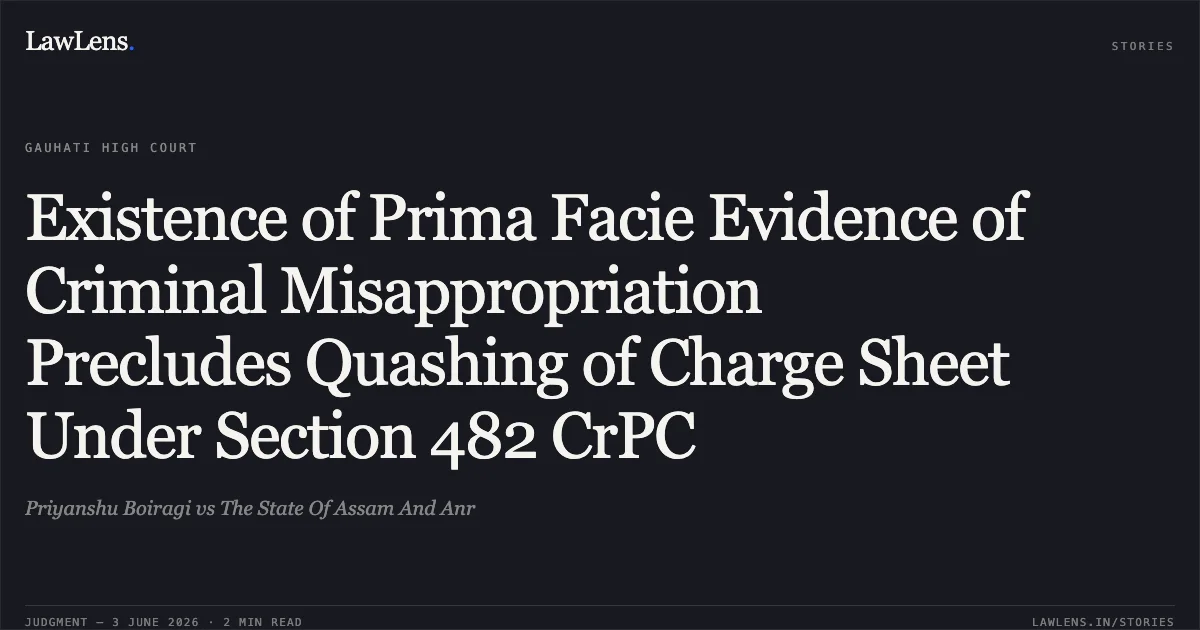
The Gauhati High Court found that there are sufficient materials to establish a prima facie criminal case against the petitioner.
The Court held that the trial court is the appropriate forum to deliberate upon these allegations and that exercise of inherent power under Section 482 CrPC to quash the charge sheet is not warranted. The petition was dismissed.
Source reference: p. 7Acts & Sections Cited
3 provisions across 1 statute referred to in this judgment. Each provision opens on LawLens.
Code of Criminal Procedure, 19733
Original Court PDF
Priyanshu BoiragivsThe State Of Assam And Anr
Click to open original judgment
Original judgment, available to read, download and summarize on LawLens.in