Facts
The petitioner’s father, a Male Health Supervisor at the Community Health Centre, Katgodi, District Korea, died in harness on 22.09.2023.
Source reference: para. 1–2The petitioner thereafter applied for compassionate appointment, but his claim was rejected by orders dated 05.11.2024 and 20.05.2025, with the appellate order dated 03.02.2025, on the ground that his elder brother was already employed in government service.
Source reference: para. 1–2The petitioner contended that his elder brother was married, residing separately, and not financially supporting the family, which allegedly continued to suffer financial hardship.
Source reference: para. 3–6The State defended the rejection on the basis of the applicable compassionate appointment policy, which treated the existence of a government-employed family member as a disqualification.
Source reference: para. 3–6Issues
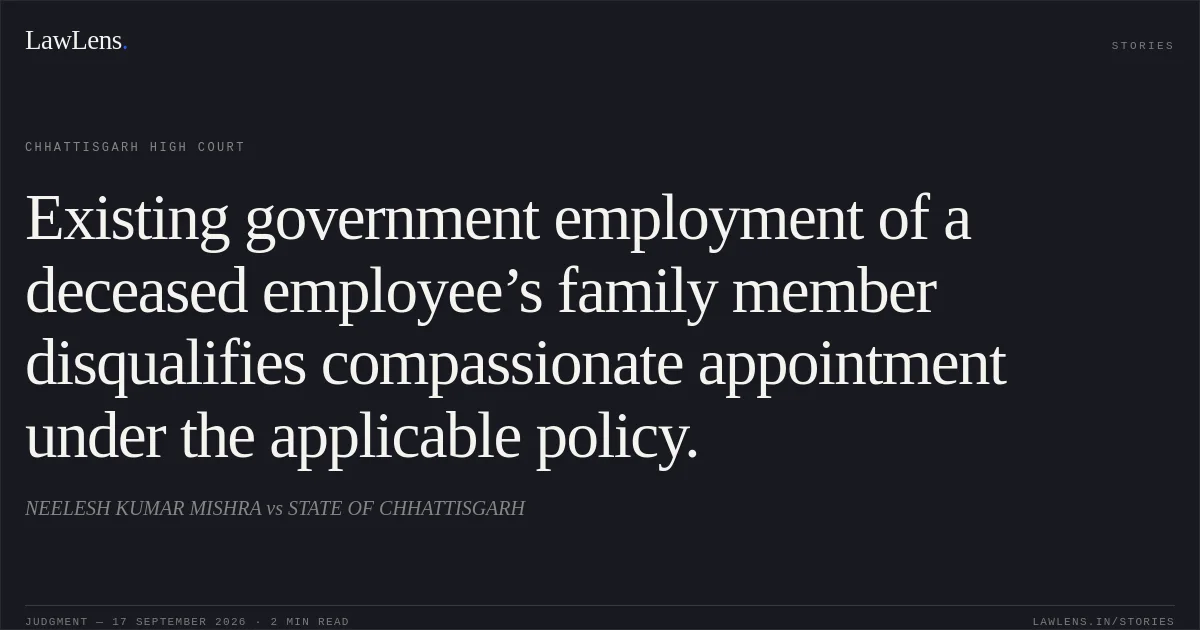
Whether the petitioner was entitled to compassionate appointment despite his elder brother being employed in government service.
Source reference: para. 1–3Whether the Court could direct relaxation of the applicable compassionate appointment policy on the ground that the elder brother lived separately and did not financially support the petitioner’s family.
Source reference: para. 6–8Whether the impugned orders disclosed any jurisdictional error, arbitrariness, or illegality warranting interference under Article 226 of the Constitution.
Source reference: para. 9Law Applied
Compassionate appointment is an exception to the ordinary rule of public employment and is intended to provide immediate financial assistance to the family of a deceased government employee facing sudden financial crisis.
Source reference: para. 7The competent authority must apply the compassionate appointment policy prevailing at the relevant time, including any prescribed disqualification arising from the presence of a family member already employed in government service.
Source reference: para. 5–6The Court exercising jurisdiction under Article 226 cannot direct relaxation of such a policy merely on equitable considerations.
Source reference: para. 6Relying on State of Chhattisgarh & Ors. v. Umesh Thakur, WA No. 236 of 2022, decided on 07.07.2023, and the Full Bench decision referred to therein, the Court held that no inquiry is warranted into whether a government-employed family member is actually providing financial support to another family member seeking compassionate appointment.
Source reference: para. 8Reasoning
The authorities considered the petitioner’s application under the policy applicable at the relevant time and found him ineligible because his elder brother was already in government service.
Source reference: para. 5–6The Court held that the brother’s separate residence, marital status, or alleged failure to provide financial assistance could not overcome the express policy disqualification.
Source reference: para. 8In view of the rule reiterated in Umesh Thakur, the authorities were not required to undertake an individualized inquiry into the brother’s actual financial contribution to the family.
Source reference: para. 8Since the policy had been correctly applied, and compassionate appointment could not be granted merely on equitable grounds contrary to that policy, no jurisdictional error, arbitrariness, or illegality was established.
Source reference: para. 6, 9Holding
The Court answered the issues against the petitioner.
It held that the petitioner was ineligible for compassionate appointment under the applicable policy because his elder brother was already employed in government service, irrespective of whether the brother lived separately or financially supported the family.
Source reference: para. 6, 8Finding no ground for interference under Article 226, the Court dismissed the writ petition at the motion stage, without granting any relief.
Source reference: para. 9–10Original Court PDF
NEELESH KUMAR MISHRAvsSTATE OF CHHATTISGARH
Click to open original judgment
Original judgment, available to read, download and summarize on LawLens.in
![Relief is made contingent on the Supreme Court’s eventual determination in the analogous pending case.. Ashok Tolani vs REVENUE. CAT - ['Jaipur']. LawLens](/stories/thumbnails/relief-is-made-contingent-on-the-supreme-courts-eventual-determination-in-the-analogous-pe-0a05b6600e0644cf9facfda571d15955.webp)