Facts
The petitioners, who were accused in Crime No. 97/2015 of Malavalli Town Police Station, faced charges under Sections 406, 408, 417, 429, 465, 468 and 477A of the Indian Penal Code.
Source reference: para. 2After investigation, the police filed a charge sheet alleging that the petitioners had misused their positions and acted in concert in relation to the distribution of ration to labour beneficiaries
Source reference: para. 2–4The Magistrate took cognizance and summoned them
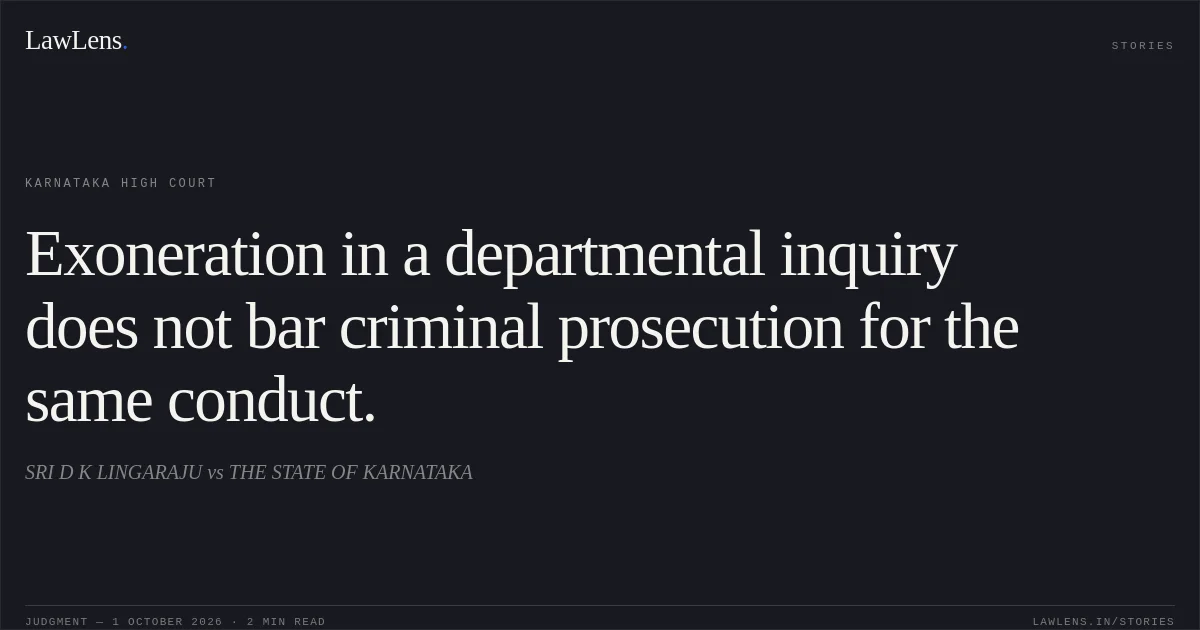
Source reference: para. 5The petitioners sought to quash the FIR/charge sheet and the cognizance order, contending that they had been exonerated in a departmental inquiry and that the criminal case therefore violated the protection against double jeopardy
Source reference: para. 6–7Issues
Whether exoneration in a departmental inquiry bars continuation of the criminal prosecution under Section 300 of the Code of Criminal Procedure and Article 20(3) of the Constitution, as invoked by the petitioners
Source reference: para. 6–10Whether the FIR/charge sheet and the Magistrate’s order taking cognizance should be quashed on that basis
Source reference: para. 2, 5–8, 12Law Applied
Section 300 of the Code of Criminal Procedure bars a second trial for the same offence, or certain offences arising from the same facts, where the accused has already been tried by a competent criminal court and convicted or acquitted
Source reference: para. 9The Court held that this bar does not extend to a departmental inquiry: exoneration in such an inquiry does not, by itself, preclude a criminal prosecution
Source reference: para. 10–12In reaching that conclusion, the Court relied on Karnataka Lokayuktha, Bagalkote District, Bagalkote v. Chandrashekar and another, 2026 SCC OnLine SC 13
Source reference: para. 11The petitioners also invoked Article 20(3) of the Constitution
Source reference: para. 2, 7Reasoning
The petitioners’ prior exoneration occurred in a departmental inquiry, not in a trial before a competent criminal court resulting in acquittal or conviction. It therefore did not satisfy the conditions for the bar under Section 300 CrPC
Source reference: para. 9–12The charge sheet also set out allegations and individual overt acts against the accused
Source reference: para. 4Applying the Supreme Court precedent cited, the Court concluded that the departmental outcome did not justify quashing the criminal proceedings
Source reference: para. 11–12Holding
The High Court dismissed the writ petition and declined to quash the FIR/charge sheet or the cognizance order
It clarified that dismissal would not prevent the petitioners from pursuing remedies before the Trial Court, including filing a discharge application.
Source reference: para. 13(ii)Acts & Sections Cited
13 provisions across 3 statutes referred to in this judgment. Each provision opens on LawLens.
Code of Criminal Procedure, 19736
Indian Penal Code, 18606
General Clauses Act, 18971
Original Court PDF
SRI D K LINGARAJUvsTHE STATE OF KARNATAKA
Click to open original judgment
Original judgment, available to read, download and summarize on LawLens.in