Facts
The petitioner, a lawyer and social activist, alleged financial irregularities regarding a 2021 decision by the then Deputy Commissioner of Mysuru, Smt. Rohini Sindhuri, to ban plastic and distribute eco-friendly cloth bags.
Source reference: para 3.1It was alleged that bags retailing at ₹13 were procured at an inflated wholesale rate of ₹52 per unit, causing a loss of approximately ₹7.55 Crores to the state exchequer.
Source reference: para 3.3The Anti-Corruption Bureau (ACB) sought approval under Section 17A of the Prevention of Corruption Act ("the Act") in 2021, which the Government declined in 2022.
Source reference: para 3.4After a Coordinate Bench quashed that refusal in 2025 (WP No. 2805/2025) and remitted the matter for fresh consideration, the Government issued a second refusal on 26-05-2025.
Source reference: para 3.4The Government’s primary justification for the second refusal was the officer’s intervening exoneration in a departmental enquiry (DE) concluded on 11-04-2025.
Source reference: para 8, 11Issues
Whether exoneration in a departmental proceeding legitimately constitutes a foundation for refusing approval to investigate under Section 17A of the Prevention of Corruption Act, 1988.
Source reference: para 9Whether the Government's order was a mechanical exercise of power lacking the "application of mind" previously mandated by the Court.
Source reference: para 11, 15Law Applied
Section 17A of the Prevention of Corruption Act, 1988, which mandates prior approval for investigations into decisions taken by public servants in the discharge of official duties.
Source reference: para 14The Supreme Court precedent in Karnataka Lokayukta Bagalkote District v. Chandrashekar (2026 SCC OnLine SC 13), which establishes that departmental and criminal proceedings are independent, governed by different standards of proof (preponderance of probabilities vs. beyond reasonable doubt), and adjudicated by different entities.
Source reference: para 12The doctrine from Ajay Kumar Tyagi, holding that exoneration in a departmental proceeding does not ipso facto terminate or bar a criminal prosecution.
Source reference: para 12Reasoning
The Court observed that the impugned order was "verbatim similar" to the previously quashed order, save for the mention of the departmental exoneration.
Source reference: para 11It reasoned that a departmental inquiry satisfies the employer regarding misconduct, whereas criminal prosecution addresses the "criminality of the act," which is a distinct legal regime.
Source reference: para 12The Court found that the allegations were not speculative but supported by documents showing procurement at four times the market rate and diversion of welfare funds.
Source reference: para 13, 15The Court critiqued the Enquiry Officer’s report for exceeding its brief by offering subjective praise for the officer’s "morale" rather than objective findings.
Source reference: para 8It concluded that Section 17A is intended as a shield for bonafide decisions, not a "protective cloak" or sanctuary to stifle legitimate investigation into prima facie corruption.
Source reference: para 14Since the Government failed to conduct a meaningful re-evaluation despite a prior remand, the Court found the refusal to be a mechanical exercise of power.
Source reference: para 15-16Holding
The Court allowed the Writ Petition and quashed the order dated 26-05-2025.
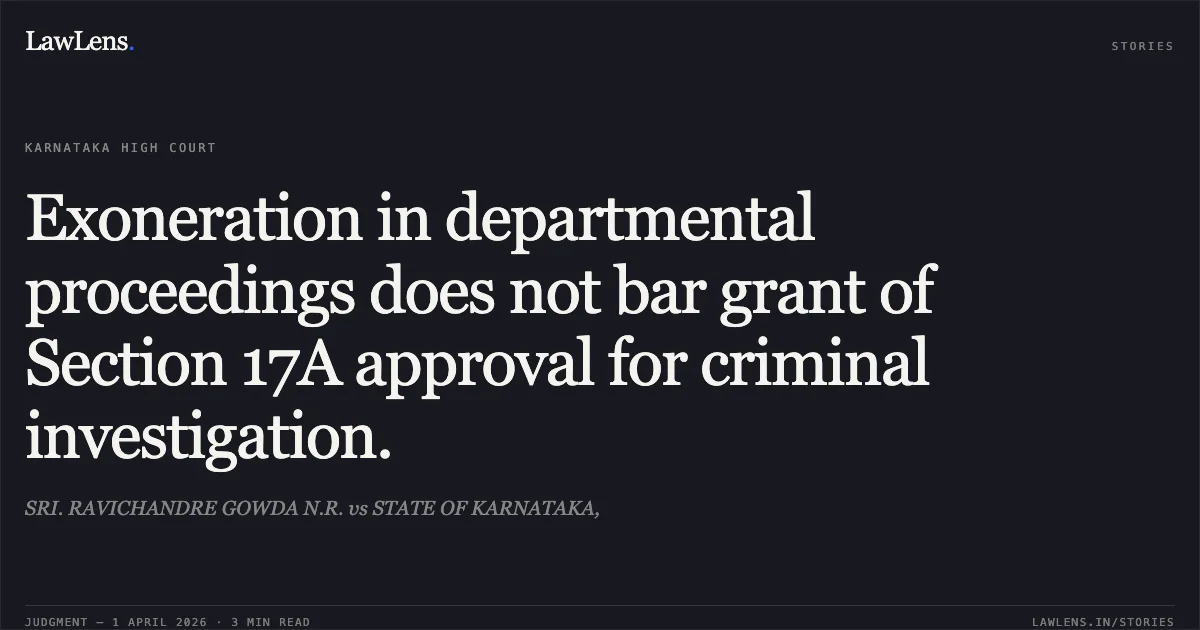
It held that departmental exoneration cannot insulate a public servant from the threshold scrutiny of a criminal investigation under the Act.
Source reference: para 10, 15Finding that a further remand to the Government would be "unnecessary and unwarranted" given the prior history of the case, the Court issued a mandamus directing the State Government (Respondent No. 1) to grant the necessary approval under Section 17A within four weeks to facilitate the registration of an FIR and subsequent investigation.
Source reference: para 16-17Acts & Sections Cited
5 provisions across 4 statutes referred to in this judgment. Each provision opens on LawLens.
Bharatiya Nagarik Suraksha Sanhita, 20231
Code of Criminal Procedure, 19732
KARNATAKA MUNICIPALITIES ACT, 19641
KARNATAKA TRANSPARENCY IN PUBLIC PROCUREMENTS ACT, 19991
Original Court PDF
SRI. RAVICHANDRE GOWDA N.R.vsSTATE OF KARNATAKA,
Click to open original judgment
Original judgment, available to read, download and summarize on LawLens.in


