Facts
The appellant, a senior anaesthetist at Dhanalakshmi Hospital, Kannur, was part of a surgical team for a piles operation on May 29, 2002.
Source reference: para. 3Following the surgery, the patient’s health deteriorated, and he expired on May 30, 2002, due to "acute coronary insufficiency".
Source reference: para. 3The prosecution alleged the appellant was negligent for orally instructing a nurse (Accused No. 3) to administer a post-operative analgesic injection instead of doing it personally, leading to the drug failing to enter the epidural space.
Source reference: para. 3A second charge-sheet was filed following an expert panel report.
Source reference: para. 5The appellant sought discharge under Section 239 CrPC, which was rejected by the Magistrate and the Revisional Court.
Source reference: para. 2The High Court of Kerala subsequently dismissed a Section 482 petition, directing the appellant to raise contentions during trial.
Source reference: para. 6, 17Notably, in parallel civil proceedings, the District Consumer Forum exonerated the appellant on merits, a finding not challenged by the deceased’s family.
Source reference: para. 7, 21Issues
1. Whether the criminal prosecution for medical negligence under Section 304-A IPC can be sustained when the accused has been exonerated on merits in parallel civil/adjudication proceedings on the same facts?
Source reference: para. 11, 222. Whether the appellant’s act of providing oral instructions for post-operative pain management while off-duty constitutes "gross negligence" or a "rash and negligent act" under the standard laid down for medical professionals?
Source reference: para. 9, 24Law Applied
The Court primarily applied Section 304-A of the Indian Penal Code (IPC) regarding causing death by negligence.
Source reference: para. 4Jacob Mathew v. State of Punjab, which established that for medical professionals, negligence must be "gross" or of a very high degree, requiring a "rash or negligent act" that no prudent professional would have committed.
Source reference: para. 9, 26Principles from Radheyshyam Kejriwal v. State of West Bengal, Videocon Industries Ltd. v. State of Maharashtra, and Prem Raj v. Poonamma Menon, which hold that criminal prosecution cannot continue if the accused is exonerated on merits in civil proceedings on identical facts.
Source reference: para. 11, 22, 23Reasoning
The Court observed that the appellant had completed her shift and ensured the patient was stable before leaving; thus, advising a correct medication (Sensorcaine) via telephone to on-duty staff for an SOS call does not constitute criminal recklessness.
Source reference: para. 19, 20, 25The Court noted a lack of causa causans, as the proximate cause of death was a pre-existing 80% coronary blockage, making the alleged procedural error by the nurse too remote to attract Section 304-A against the anaesthetist.
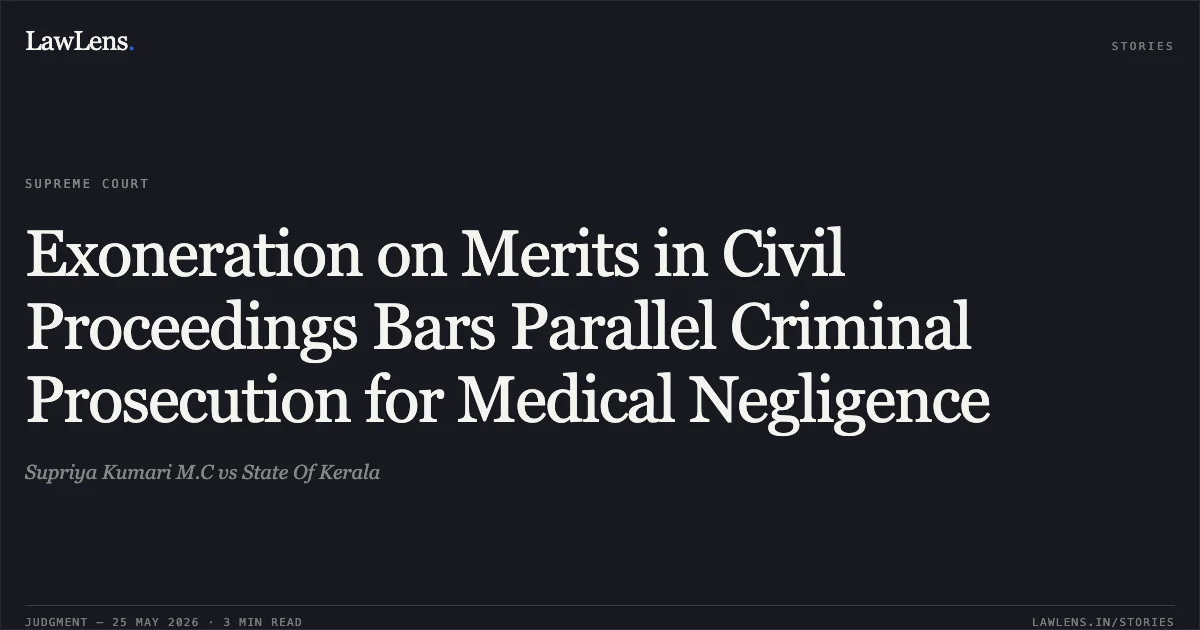
Source reference: para. 28The Court found that the Consumer Forum had already exonerated the appellant on merits, determining she had not even given the alleged instructions.
Source reference: para. 21Following Radheyshyam Kejriwal, since the civil exoneration was on merits and not technical grounds, the criminal proceedings became an abuse of process.
Source reference: para. 22-23The Court identified procedural flaws in the investigation, noting the expert panel lacked an anaesthestist, violating the "peer specialist" spirit of the Jacob Mathew guidelines.
Source reference: para. 27Holding
The Supreme Court answered both issues in the negative, holding that the continuation of criminal proceedings was a gross abuse of the process of law.
The Court allowed the appeal, quashed the High Court’s order and the proceedings in C.C. No. 501/2008 before the JMFC Kannur, and discharged the appellant from all allegations.
Source reference: para. 29The Court reiterated that a higher standard of proof in criminal law, coupled with a prior civil exoneration on merits, necessitates the termination of criminal trials to prevent harassment of medical professionals.
Source reference: para. 22, 27Acts & Sections Cited
2 provisions across 2 statutes referred to in this judgment. Linked provisions open on LawLens.
Code of Criminal Procedure, 19731
Indian Penal Code, 18601
Original Court PDF
Supriya Kumari M.CvsState Of Kerala
Click to open original judgment
Original judgment, available to read, download and summarize on LawLens.in