Facts
The petitioner, a Medical Officer, was nominated as the Drawing and Dispersing Officer (DDO) at the Primary Health Centre (PHC), Sadar Block, Gopalganj, in April 2021
Source reference: para. 3An FIR was lodged alleging that a peon, Manish Julius, had been drawing salary since November 2018 without performing duties by fabricating attendance records in conspiracy with former officials, including the petitioner
Source reference: para. 4Notably, the alleged fraud began two years before the petitioner joined the PHC
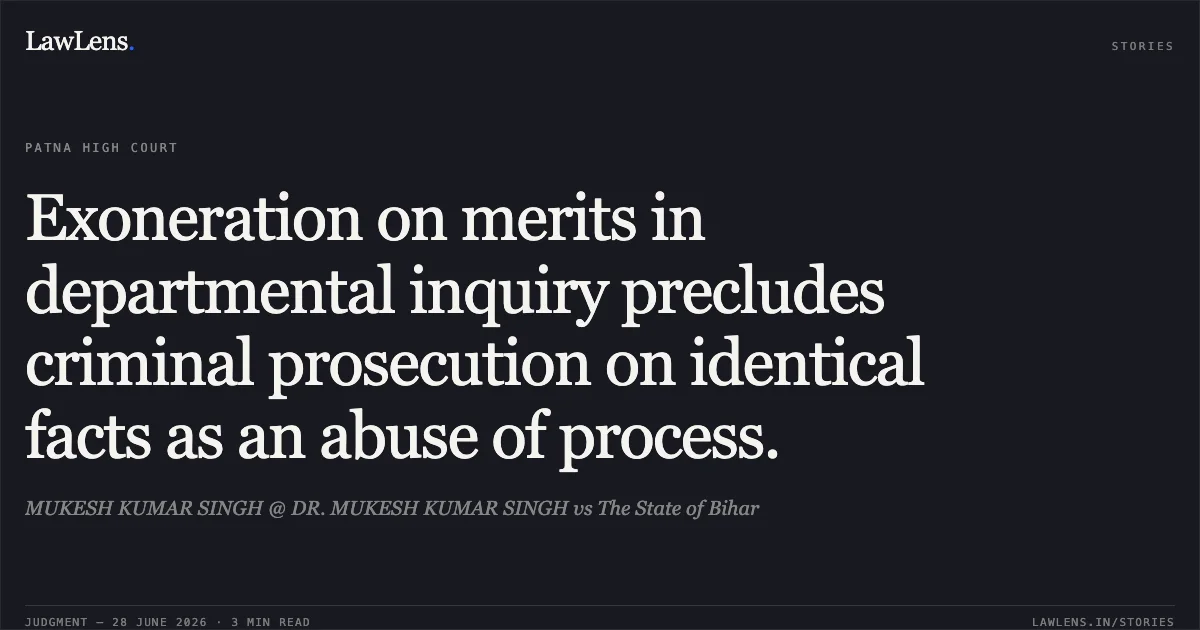
Source reference: para. 5A prior departmental inquiry by the Regional Additional Director had already exonerated the petitioner on merits, finding that the responsibility for attendance verification lay with the ANM and Mukhiya, while the petitioner merely signed bills processed through official channels
Source reference: para. 8Despite this exoneration, the FIR was lodged nine months later on the same facts
Source reference: para. 9Issues
1. Whether the FIR and criminal proceedings should be quashed under Section 482 of the CrPC if the allegations, taken at face value, do not constitute a prima facie offence
Source reference: para. 102. Whether a criminal prosecution can continue on the same set of facts where the accused has been exonerated on merits in a departmental inquiry
Source reference: para. 12Law Applied
The court applied the inherent powers of the High Court under Section 482 of the Code of Criminal Procedure, 1973
Source reference: para. 2It relied on the landmark guidelines in State of Haryana v. Bhajan Lal (1992), specifically Categories 1 and 7, regarding the quashing of proceedings that fail to disclose an offence or are maliciously instituted
Source reference: para. 10The court further applied the essential ingredients of Section 409 IPC (Criminal Breach of Trust) as defined in N. Raghavender v. State of Andhra Pradesh (2021), emphasizing the necessity of mens rea and dishonest misappropriation
Source reference: para. 11Crucially, it followed Ashoo Surendranath Tewari v. CBI (2020) and Radheshyam Kejriwal v. State of West Bengal (2011), which establish that criminal prosecution cannot continue if an accused is exonerated on merits in departmental proceedings on identical facts
Source reference: para. 12-13Reasoning
The court found a fundamental contradiction in the FIR, noting the petitioner was not even posted at the PHC when the alleged fraud originated in 2018
Source reference: para. 5The analysis revealed no evidence of mens rea or "meeting of minds" required for conspiracy under Section 120-B, as the petitioner merely followed an existing institutional channel for salary disbursement
Source reference: para. 14The court observed that the petitioner did not fabricate records nor receive any diverted funds; he signed bills based on documents supplied by subordinates
Source reference: para. 11, 14Applying the Ashoo Surendranath Tewari precedent, the court reasoned that since the petitioner was exonerated in a departmental inquiry—which operates on a lower standard of proof—allowing a criminal trial on the same facts would be an abuse of process
Source reference: para. 13The court also noted the suspicious omission of the primary beneficiary (the peon) from the FIR and concluded that the prosecution was an attempt to relitigate a settled matter for the purpose of harassment
Source reference: para. 7, 15Holding
The court answered both issues in the affirmative, holding that the continuation of the proceedings was an abuse of the process of law
The petition was allowed, and Gopalganj Town P.S. Case No. 186 of 2023, along with all consequential proceedings pending before the Chief Judicial Magistrate, Gopalganj, was quashed insofar as it concerned the petitioner
Source reference: para. 17Acts & Sections Cited
4 provisions across 2 statutes referred to in this judgment. Each provision opens on LawLens.
Code of Criminal Procedure, 19731
Indian Penal Code, 18603
Original Court PDF
MUKESH KUMAR SINGH @ DR. MUKESH KUMAR SINGHvsThe State of Bihar
Click to open original judgment
Original judgment, available to read, download and summarize on LawLens.in