Facts
The Petitioner, a 32-year-old unemployed male, suffers from "Palmoplantar Keratoderma," a hereditary skin disorder characterized by the thickening of skin on palms and soles, leading to faint or absent thumb impressions
Source reference: para 2, 8Between 2016 and 2022, the Petitioner faced significant delays and prejudice during Railway Recruitment Board examinations because digital instruments failed to detect his thumb impressions
Source reference: para 2He submitted a representation on November 1, 2022, requesting the government to notify his condition as a "specified disability" under the Rights of Persons with Disabilities (RPwD) Act, 2016
Source reference: para 2The Union of India’s High-Powered Inter-Departmental Committee examined the request on August 20, 2025, but recommended against its inclusion, noting that most cases involve minor limitations and severe cases are already covered under "locomotor disability"
Source reference: para 4, 7Issues
1. Whether the Court can issue a Writ of Mandamus directing the State to notify Palmoplantar Keratoderma as a "Specified Disability" under Section 2(zc) and the Schedule of the RPwD Act, 2016
Source reference: para 1, 122. Whether a person with a medical condition not listed as a "specified disability" can still be recognized as a "person with disability" under Section 2(s) of the RPwD Act
Source reference: para 13, 15Law Applied
The court applied Section 2(zc) and the Schedule of the RPwD Act, 2016 regarding "specified disabilities" and Section 2(s) which defines a "person with disability" based on long-term impairments and societal barriers.
Source reference: para 5, 13Courts should not sit in appeal over expert decisions, as held in Basavaiah & Anr. v. H.L. Ramesh & Ors.
Source reference: para 10Judicial interference is limited to cases of illegality or perversity as per State of U.P. v. Johri Mal.
Source reference: para 11The definition under Section 2(s) is broad and not restricted by the "benchmark" or "specified" disability quantifications of the Act, as clarified in Vikash Kumar v. UPSC.
Source reference: para 14Reasoning
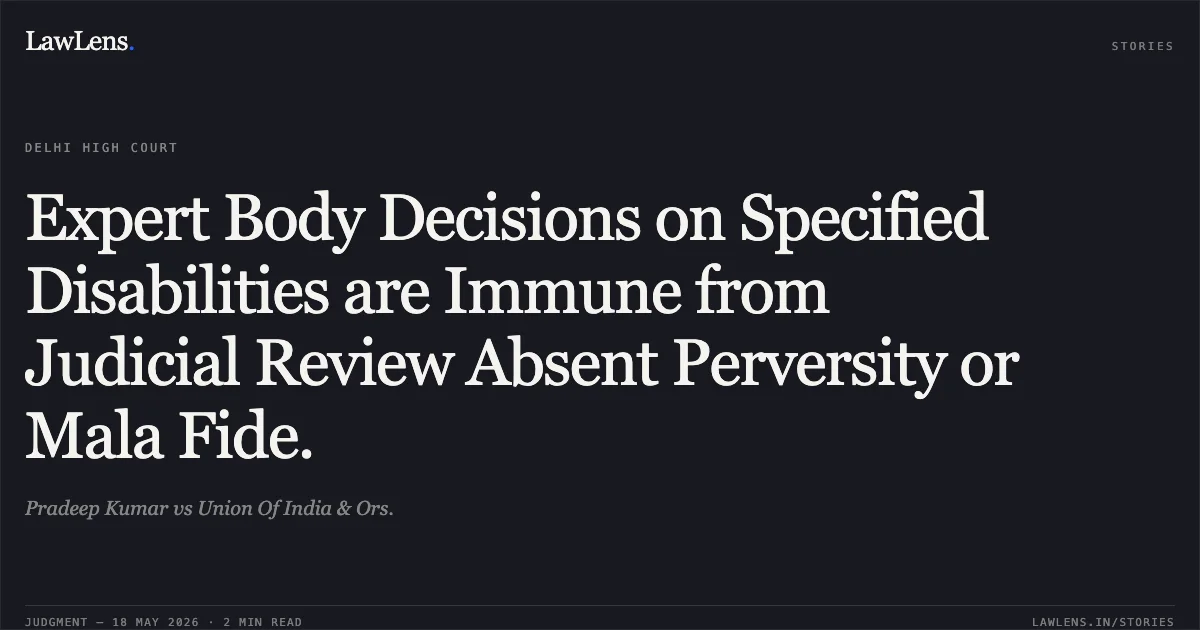
The Court observed that the High-Powered Inter-Departmental Committee—comprising technical experts from AIIMS, ICMR, and DGHS—had duly considered the Petitioner's condition and provided a reasoned recommendation against its inclusion as a "specified disability"
Source reference: para 6, 7Since the Committee followed due process and focused on medical literature and functional limitations, the Court held that judicial intervention was unwarranted as the decision was neither arbitrary nor mala fide
Source reference: para 9, 12The Court distinguished between a "specified disability" (Section 2(zc)) and the broader definition of a "person with disability" (Section 2(s)). It reasoned that since the Petitioner faced significant "barriers" (e.g., biometric failures) hindering his participation in employment, his status under Section 2(s) must be independently assessed by a medical board rather than dismissed based on the Schedule
Source reference: para 13, 15Holding
The Court rejected the prayer to notify Palmoplantar Keratoderma as a "specified disability" but held that the Petitioner may still qualify as a "person with disability" under Section 2(s).
The Court directed the Director of AIIMS, New Delhi, to constitute a Medical Board within 30 days to examine the Petitioner and issue an appropriate disability certificate; further, if the Petitioner applies for recruitment, his condition must be adjusted as per prevailing rules.
Source reference: para 16, 17, 19, 20Acts & Sections Cited
2 provisions across 1 statute referred to in this judgment. Each provision opens on LawLens.
Original Court PDF
Pradeep KumarvsUnion Of India & Ors.
Click to open original judgment
Original judgment, available to read, download and summarize on LawLens.in