Facts
The applicants were recruited as Assistant Loco Pilots (ALPs) in the East Central Railway and North Eastern Railway pursuant to Centralized Employment Notice (CEN) No. 01/2014
Source reference: p. 8-9After serving for several years and receiving promotions, the Railway Recruitment Board (RRB) and Vigilance Organisation initiated investigations into the 2014 recruitment
Source reference: p. 10, 13Based on forensic reports from the Government Examiner of Questioned Documents (GEQD) and Finger Print Expert reports, the respondents alleged that the applicants had resorted to impersonation in the written examination, as their handwriting and thumb impressions on OMR sheets allegedly did not match their standard samples
Source reference: p. 11, 13Consequently, the applicants were issued charge-sheets under Rule 9 of the Railway Servants (Discipline and Appeal) Rules, 1968
Source reference: p. 10, 16Following inquiries where the forensic experts were reportedly not produced for cross-examination and original documents were allegedly withheld, the Disciplinary Authorities removed the applicants from service
Source reference: p. 11-12, 17The applicants challenged these removal and subsequent appellate orders
Source reference: p. 12Issues
1. Whether the departmental inquiry proceedings were vitiated due to the non-production of forensic/fingerprint experts and the denial of the right to cross-examination
Source reference: p. 19-202. Whether the findings of the Inquiry Officer, based primarily on untested forensic reports, satisfy the principles of natural justice and the requirements of Rule 9 of the Railway Servants (Discipline and Appeal) Rules, 1968
Source reference: p. 20, 30Law Applied
The Court primarily applied the Railway Servants (Discipline and Appeal) Rules, 1968, particularly Rule 9, which outlines the mandatory procedure for imposing major penalties
Source reference: p. 10The Court applied the principle that while the standard of proof in departmental inquiries is "preponderance of probabilities" rather than "proof beyond reasonable doubt," the inquiry must still adhere to the Principles of Natural Justice
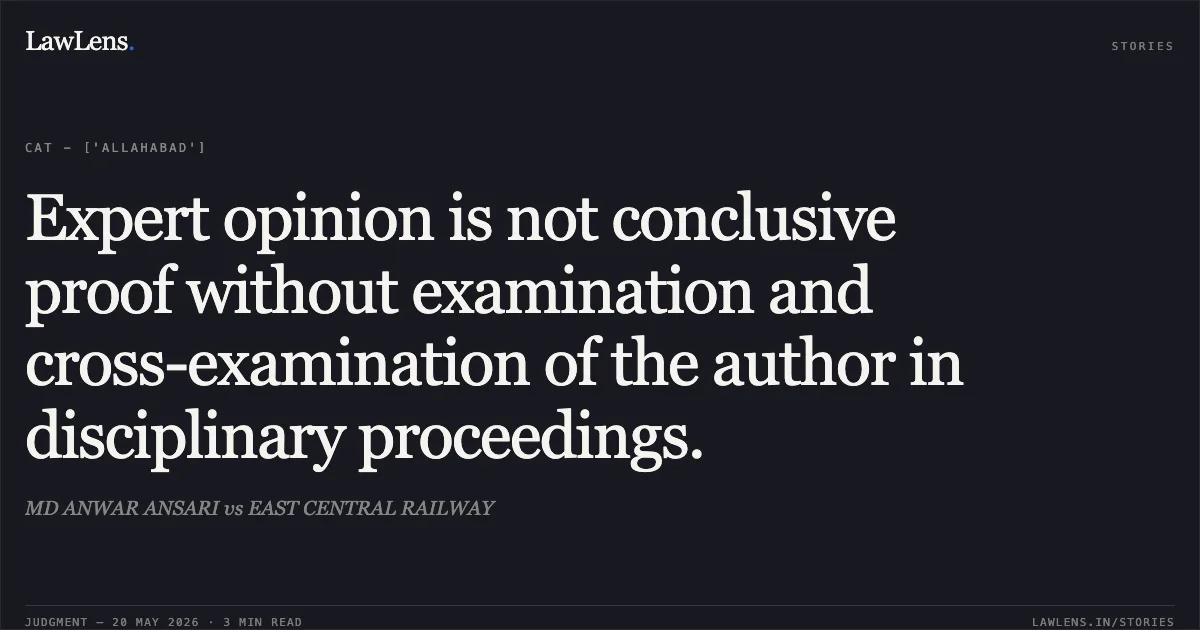
Source reference: p. 23, 30The Court relied on the precedent set in Sanjeev Kumar v. Union of India (OA No. 330/915/2021), established that an expert report is merely opinion evidence and not conclusive proof unless the author is examined and subjected to cross-examination
Source reference: p. 25The Court followed the procedural directions upheld by the Allahabad High Court and the Hon'ble Supreme Court in Union of India vs. Amit Kumar & Ors, which mandates reinstatement or suspension for the limited purpose of conducting a fresh inquiry when the original process is found to be procedurally flawed
Source reference: p. 26-27, 29-30Reasoning
The Tribunal reasoned that although the charge of impersonation is a grave matter involving the sanctity of public recruitment, the respondents failed to follow a fair procedure.
Source reference: p. 23The Court observed that the disciplinary authorities leaned entirely on forensic and fingerprint reports without examining the authors of those reports during the inquiry, thus treating "opinion evidence" as "conclusive proof"
Source reference: p. 19, 25, 30By failing to produce the experts for cross-examination and not supplying the original relied-upon documents to the applicants, the respondents violated the mandatory procedural safeguards of Rule 9
Source reference: p. 20, 31The Court emphasized that a major penalty like removal cannot be sustained on the basis of untested scientific reports where the delinquent was deprived of a meaningful opportunity to defend
Source reference: p. 25, 30Aligning with previous judgments by the Patna and Allahabad High Courts in identical recruitment matters, the Tribunal concluded that the inquiries were procedurally vitiated from the stage where natural justice was denied
Source reference: p. 28-31Holding
The Tribunal partially allowed the Original Applications, quashing and setting aside the impugned punishment and appellate orders
The Tribunal held that the inquiry proceedings were legally unsustainable due to procedural infirmities and granted the respondents liberty to conduct a de novo inquiry from the stage of the defect, strictly adhering to the 1968 Rules and natural justice principles
Source reference: p. 31The respondents were directed to decide on the applicants' status (reinstatement or suspension) in the interim, with the regularization of the intervening period and back wages to be contingent upon the outcome of the fresh inquiry, which is to be completed within six months
Source reference: p. 32Acts & Sections Cited
1 provisions across 1 statute referred to in this judgment. Each provision opens on LawLens.
Administrative Tribunals Act, 19851
Original Court PDF
MD ANWAR ANSARIvsEAST CENTRAL RAILWAY
Click to open original judgment
Original judgment, available to read, download and summarize on LawLens.in