Facts
The petitioner was appointed as a Sub-Engineer (Zila Level) on a contractual basis on 04.10.2012 and was subsequently transferred from Tikamgarh to Bhind on 22.09.2018.
Source reference: para. 2His contractual engagement was extended periodically, including for the year 2024–2025.
Source reference: para. 2After receiving show-cause notices dated 08.01.2024 and 16.01.2025, and submitting replies, the petitioner’s contractual engagement was not extended for 2025–2026 by order dated 15.10.2025.
Source reference: para. 2; para. 5The order stated that, in the absence of a recommendation by the Collector, the contracts of certain contractual employees, including the petitioner, would not be renewed.
Source reference: para. 2; para. 5The petitioner challenged the non-renewal order, contending that it was stigmatic, non-speaking, and issued without a regular departmental inquiry under Clause 7.2 of the MGNREGA policy.
Source reference: para. 2; para. 3His departmental appeal was rejected on 24.03.2026.
Source reference: para. 2Issues
1. Whether the petitioner, whose contractual period had expired, could claim a legal right to renewal, reappointment, or reinstatement in service?
Source reference: paras. 6, 9–102. Whether the order declining extension of the petitioner’s contractual engagement was stigmatic or punitive, thereby requiring a regular departmental inquiry?
Source reference: paras. 2–3, 153. Whether the High Court could issue a writ of mandamus directing the State to extend the petitioner’s contractual tenure or continue him in service?
Source reference: paras. 9–14Law Applied
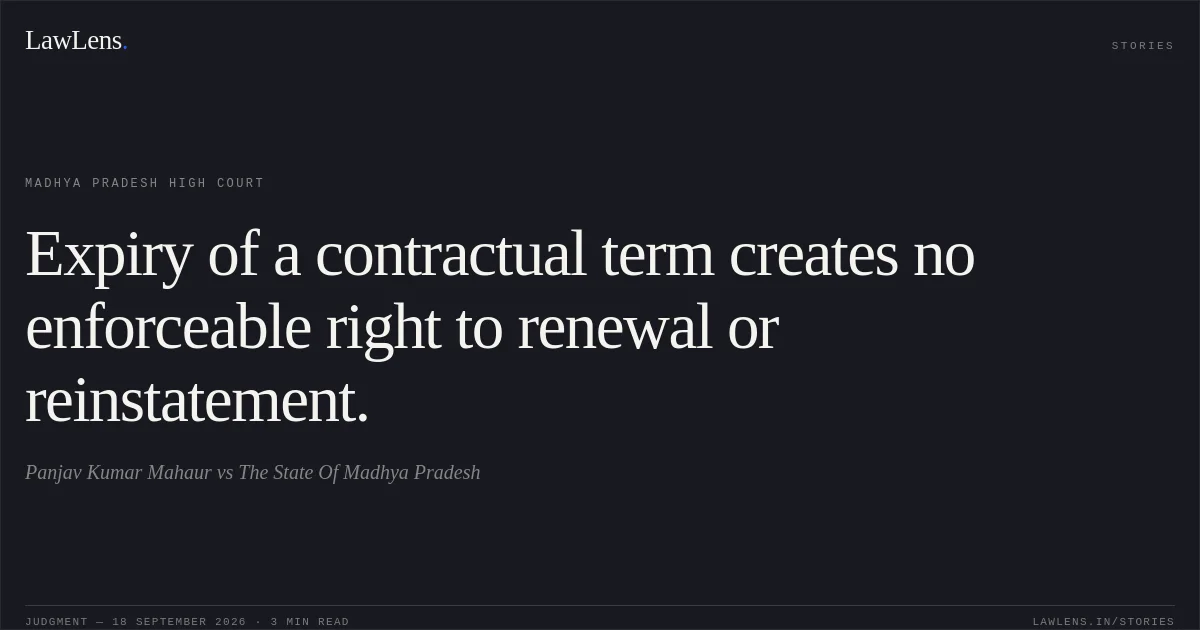
The Court applied Article 226 of the Constitution and the settled principle that a contractual employee has no vested or enforceable right to renewal, reappointment, regularisation, or continuation merely because the contract was extended repeatedly or the employee served for several years.
Source reference: paras. 9, 13–14Relying on Brijendra Gupta v. State of M.P., the Court held that repeated extension of a contractual term does not create a right to continued employment.
Source reference: no citationIt also relied on Prem Chand Yadav v. Madhya Pradesh Madhya Kshetra Vidyut Vitaran Co. Ltd., which held that, after expiry of the contractual period, the employer cannot be compelled to continue the employee because extension remains the employer’s prerogative.
Source reference: para. 8The Court further relied on Secretary, State of Karnataka v. Uma Devi, (2006) 4 SCC 1, for the proposition that long contractual service does not create a right to regularisation or continuation in the absence of a legally enforceable policy or statutory provision.
Source reference: para. 12Clause 1.3 of the MGNREGA Contract Employees’ New Service Conditions Instructions, 2025, was understood as permitting renewal on the basis of satisfactory annual performance but not creating an automatic right to renewal.
Source reference: para. 11The Court also applied the distinction between a punitive, stigmatic termination and a simpliciter decision not to renew a fixed-term contract.
Source reference: para. 15Reasoning
The Court held that the petitioner’s contractual term had come to an end and that renewal was conditional, not automatic.
Source reference: paras. 9–14Although the petitioner had served since 2012 and had received successive extensions, neither the length of service nor prior renewals created an enforceable right to continuation.
Source reference: paras. 9–14The applicable instructions contemplated a one-year contractual tenure, which automatically ended on expiry, subject to the competent authority’s discretion to renew where the prescribed conditions were satisfied.
Source reference: para. 10The order dated 15.10.2025 merely recorded the decision not to extend the contracts and did not contain any adverse allegation or finding of misconduct against the petitioner; it was therefore simpliciter and non-stigmatic.
Source reference: para. 15Consequently, a regular departmental inquiry was not necessary for the non-renewal of the contract.
Source reference: para. 15The Court nevertheless directed that any blameworthy observations contained in the appellate order should not be treated as findings of misconduct, disqualification, or adverse entries against the petitioner in future employment.
Source reference: para. 15Holding
The Court answered the issues against the petitioner.
It held that, after expiry of the contractual period, the petitioner had no enforceable right to renewal, reappointment, reinstatement, or consequential benefits, and that the employer could not be compelled by mandamus to extend the contract.
Source reference: paras. 9–14, 16The non-renewal order dated 15.10.2025 was treated as a simpliciter decision without stigma and did not require a regular departmental inquiry.
Source reference: para. 15The writ petition was accordingly dismissed as devoid of merit.
Source reference: no citationHowever, adverse observations in the appellate order were directed not to be treated as findings of misconduct or as a disqualification or adverse entry in relation to the petitioner’s future employment.
Source reference: paras. 15, 17Original Court PDF
Panjav Kumar MahaurvsThe State Of Madhya Pradesh
Click to open original judgment
Original judgment, available to read, download and summarize on LawLens.in