Facts
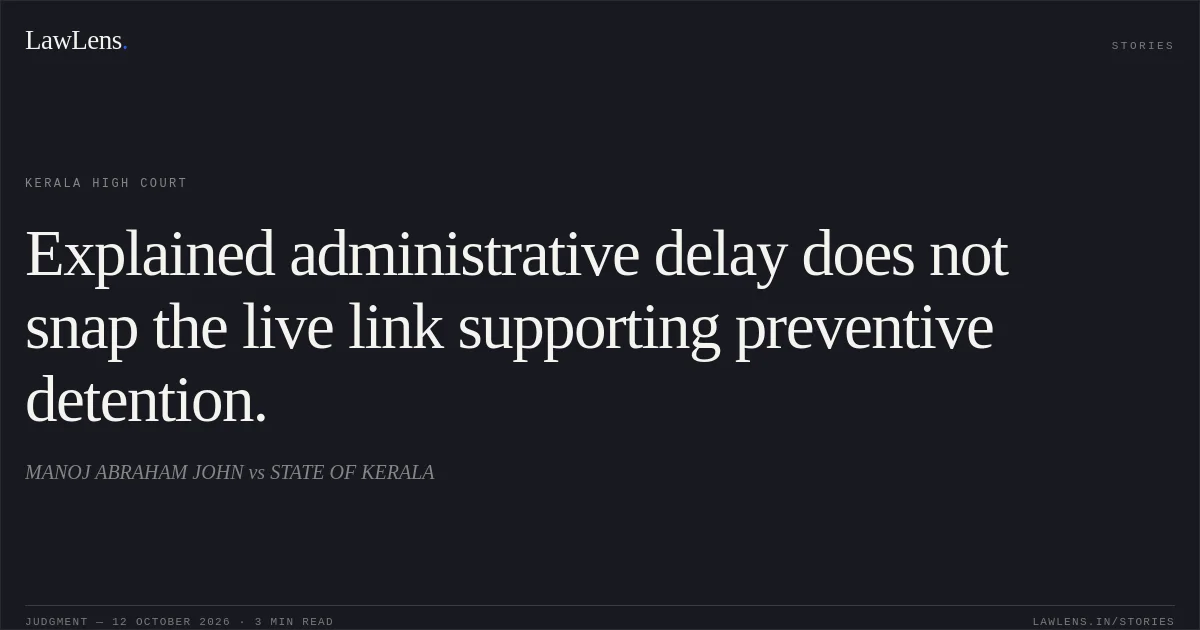
The petitioner, the detenue’s brother, challenged an order dated 28 April 2026 directing preventive detention under Section 3(1) of the Prevention of Illicit Traffic in Narcotic Drugs and Psychotropic Substances Act (PITNDPS Act).
Source reference: pp. 3–4The order relied on seven criminal cases; the last concerned an incident on 12 December 2025. The detenue was arrested that day and granted bail on 9 February 2026, the same day the Deputy Excise Commissioner submitted the detention proposal. The proposal was placed before the screening committee on 27 March 2026; its report reached the Government on 6 April 2026, and the detention order followed on 28 April 2026.
Source reference: pp. 3–4, 21–22The petitioner also challenged the Government’s order dated 22 June 2026 continuing detention for one year under Section 11, arguing that the period was fixed without sufficient reasons.
Source reference: p. 5Issues
Whether the delay between the last prejudicial activity and the detention order was unexplained and had snapped the live link between them.
Source reference: pp. 5, 21–25Whether the order continuing detention for one year under Section 11 was invalid for want of sufficient reasons or application of mind.
Source reference: pp. 5, 25–26Law Applied
Section 3(1) of the PITNDPS Act authorises preventive detention, while Section 11 governs its continuation.
Source reference: pp. 3, 5The Court applied the principle that delay in passing a detention order is not automatically fatal: whether it is inordinate or unexplained, and whether the live and proximate link with the prejudicial activity remains, depends on the circumstances of the case.
Source reference: pp. 17–20, 22–25It relied on *T.A. Abdul Rahman v. State of Kerala*, *Licil Antony v. State of Kerala*, *Bhawarlal Ganeshmalji v. State of Tamil Nadu* and *Adishwar Jain v. Union of India*, as discussed in *Shifna K v. State of Kerala*, for the requirement that substantial delay be satisfactorily explained.
Source reference: pp. 6–9It also considered *Frances Coralie Mullin v. W.C. Khambra* and *L.M.S. Ummu Saleema v. B.B. Gujaral*, which recognise that time taken must be assessed in context and that no rigid time rule applies.
Source reference: pp. 9–17*Rahila Nazeer v. State of Kerala* and *A.K. Gopi v. State of Kerala* likewise support a fact-specific assessment of delay.
Source reference: pp. 17–22Reasoning
The Court accepted that the time before submission of the sponsoring report was reasonably attributable to collecting records relating to seven Excise cases dating from 2021 onwards.
Source reference: pp. 22–25It distinguished *Suneera T v. State of Kerala*, noting that these cases were registered by the Excise Department, not the Police Department, and that the police’s iCoPS system did not contain pre-2023 records; obtaining the relevant Excise records therefore took time.
Source reference: pp. 22–25The time taken after the proposal reached the Government was also explained by the screening committee’s consideration and the empowered officer’s scrutiny of the proposal and accompanying documents.
Source reference: pp. 21–25On the continuation order, the Court noted that the Government had considered the sponsoring report and the Advisory Board’s report and had recorded that it acted with application of mind; it therefore rejected the challenge to the one-year period.
Source reference: pp. 25–26Holding
The Court held that the delay was sufficiently explained and did not vitiate the detention order; it also found no merit in the challenge to the one-year continuation order under Section 11.
The writ petition was dismissed.
Source reference: p. 26Acts & Sections Cited
3 provisions across 2 statutes referred to in this judgment. Each provision opens on LawLens.
Prevention of Illicit Traffic in Narcotic Drugs and Psychotropic Substances Act, 19882
Narcotic Drugs and Psychotropic Substances Act, 19851
Original Court PDF
MANOJ ABRAHAM JOHNvsSTATE OF KERALA
Click to open original judgment
Original judgment, available to read, download and summarize on LawLens.in