Facts
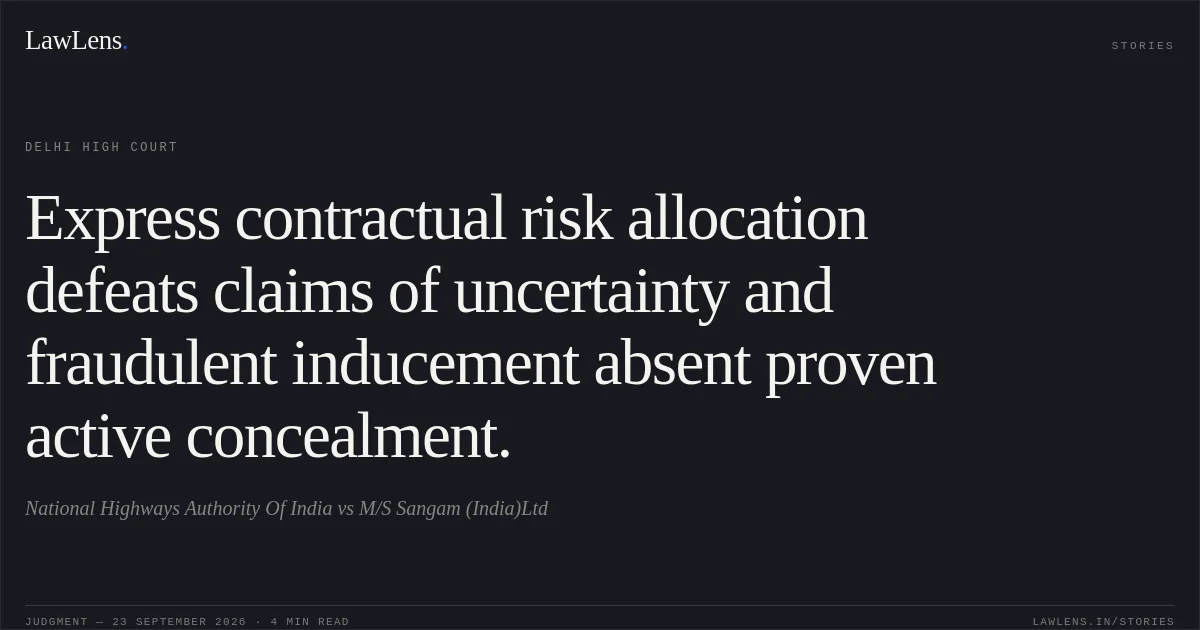
The National Highways Authority of India (“NHAI”) invited tenders for collection of user fee at the Usaka/Chamari Toll Plaza on specified stretches of NH-25 and NH-2, with an Annual Potential Collection of approximately ₹47.09 crores.
Source reference: paras. 6–8M/s Sangam (India) Ltd. submitted a bid of ₹62.10 crores, which was accepted. It furnished a bank guarantee and performance security aggregating ₹10.35 crores, and the contract was executed on 7 March 2013 for two years commencing 9 March 2013.
Source reference: para. 9A 1.7-kilometre stretch near Kalpi remained incomplete. A Central Government notification dated 26 February 2013, incorporated into the contract, provided for collection based on 66.813 kilometres until completion of the Kalpi stretch and 68.513 kilometres thereafter.
Source reference: paras. 10–12NHAI alleged that Sangam failed to remit the stipulated weekly amounts, terminated the contract, debarred Sangam for two years, and appropriated the bank guarantee and performance security.
Source reference: para. 14Sangam invoked arbitration, alleging fraud, misrepresentation, concealment, breach of statutory and contractual duties, and commercial impossibility.
Source reference: paras. 15–16The sole Arbitrator held the contract void for uncertainty and voidable for misrepresentation and conscious omission, found the termination and debarment arbitrary, and directed NHAI to refund ₹10.35 crores and pay ₹332.05 lakhs towards alleged excess remittances, with interest.
Source reference: paras. 21–24NHAI challenged the award under Section 34 of the Arbitration and Conciliation Act, 1996.
Source reference: para. 1Issues
Whether the contract was void for uncertainty because the Kalpi stretch was incomplete and the entire 68.513-kilometre stretch was not available for toll collection.
Source reference: paras. 62–66Whether NHAI fraudulently misrepresented or actively concealed material facts concerning the Kalpi stretch, its likely completion, traffic conditions, and highway maintenance, thereby rendering the contract voidable.
Source reference: paras. 67–76Whether the contractual allocation of site, traffic, diversion, and revenue risks could be displaced by the Respondent’s inability to achieve the anticipated toll collections.
Source reference: paras. 77–81Whether the Arbitrator could invalidate NHAI’s termination, debarment, and appropriation of the performance security despite the contractual provisions governing remittance defaults, termination, and arbitrability.
Source reference: paras. 82–87Whether the impugned award suffered from an infirmity going to the root of the dispute warranting interference under Section 34.
Source reference: paras. 88–93Law Applied
The Court applied Section 34 of the Arbitration and Conciliation Act, 1996, under the pre-2015 Amendment regime, holding that an arbitral award may be set aside where it is contrary to the fundamental policy of Indian law or is patently illegal, provided the illegality goes to the root of the matter, as explained in ONGC Ltd. v. Saw Pipes Ltd., (2003) 5 SCC 705.
Source reference: paras. 40–42Under Sections 17, 18 and 19 of the Indian Contract Act, 1872, fraud requires deception, including active concealment of a material fact known or believed to exist; misrepresentation may arise from an untrue assertion honestly believed to be true or from a breach of duty causing prejudice; and the exception concerning ordinary diligence does not protect active concealment.
Source reference: paras. 45–54Fraud must be specifically pleaded and proved to a high standard, as recognised in Naresh Kumar Sinha v. State of Bihar, 2025 SCC OnLine SC 2339, Kohli Housing & Development (P) Ltd. v. Convenience Enterprises (P) Ltd., 2009 SCC OnLine Del 1136, and Mithoolal Nayak v. LIC, AIR 1962 SC 814.
Source reference: paras. 48–51The Court also applied the contractual provisions requiring bidders to inspect the site, accept risks concerning site conditions, traffic and inaccuracies in bidding information, make their own revenue assessment, and continue remittances during disputes; it further relied on the principle that courts cannot rewrite or disregard an express contractual risk allocation.
Source reference: paras. 59–61, 76, 81, 90–93Reasoning
The Court held that the contract was not uncertain because the notification and Clause 3 expressly prescribed the toll-able length before and after completion of the Kalpi stretch, thereby providing an operative mechanism for the interim period.
Source reference: paras. 62–66The internal memo indicating that completion might be delayed did not establish any specific false representation or active concealment by NHAI. The RFP expressly required bidders to inspect the site, assess traffic and surrounding conditions, accept risks arising from inaccurate or incomplete information, and acknowledge that NHAI did not guarantee revenue.
Source reference: paras. 68–76Sangam’s reduced profitability and inability to achieve its expected collections therefore constituted commercial risk rather than fraud, uncertainty, or a basis to suspend its fixed remittance obligations.
Source reference: paras. 77–81The Arbitrator’s reasoning also failed to give effect to the notification permitting toll collection over 66.813 kilometres, the contractual requirement of continued remittance during disputes, and Clauses 19 and 26 governing default, termination, recovery from security, and non-arbitrability of specified disputes.
Source reference: paras. 80–86Since the findings that the contract was void or voidable and that NHAI had committed a fundamental breach were unsustainable, the consequential findings concerning termination, debarment, forfeiture, restitution and interest could not stand.
Source reference: paras. 84–87Holding
The Court allowed NHAI’s Section 34 petition and set aside the arbitral award to the extent that it declared the contract dated 7 March 2013 void or voidable, held NHAI liable for the underlying contractual breaches, invalidated the termination and debarment orders, directed refund of the ₹10.35-crore bank guarantee and performance security, awarded ₹332.05 lakhs towards restitution, and granted consequential interest.
The Court concluded that the Arbitrator had disregarded the RFP, notification, and contractual risk-allocation provisions and had effectively rewritten the parties’ bargain, constituting an infirmity going to the root of the dispute.
Source reference: paras. 89–93There was no order as to costs, and pending applications were disposed of.
Source reference: para. 96Acts & Sections Cited
4 provisions across 2 statutes referred to in this judgment. Each provision opens on LawLens.
Arbitration and Conciliation Act, 19961
Indian Contract Act, 18723
Original Court PDF
National Highways Authority Of IndiavsM/S Sangam (India)Ltd
Click to open original judgment
Original judgment, available to read, download and summarize on LawLens.in