Facts
The parties entered into a contract for the supply of railway wagons, governed by the Indian Railways General Conditions of Contract (GCC).
Source reference: para 7After the Railway Board short-closed the contract and forfeited a bank guarantee in March 2023, Titagarh Rail Systems Ltd (TRSL) invoked arbitration.
Source reference: para 8-10In its notices dated May 29, 2023, and August 11, 2023, TRSL explicitly stated it did not waive the provisions of Section 12(5) of the Arbitration and Conciliation Act, 1996.
Source reference: para 10-11TRSL initially filed a Section 11 petition but withdrew it after the parties agreed to a "Fast Track Procedure".
Source reference: para 12-13Following a circular dated December 12, 2018, the Railway Board provided a panel of four serving railway officers.
Source reference: para 14TRSL shortlisted two, and the Board appointed Shri Randhir Sahay (Executive Director, Finance) as the Sole Arbitrator.
Source reference: para 15-16The arbitrator rendered an award in favor of TRSL.
Source reference: para 17Both parties challenged the award under Section 34; the Single Judge set aside the award on the ground that the arbitrator, being a serving employee, was ineligible under Section 12(5) read with the Seventh Schedule.
Source reference: para 1-2, 21TRSL appealed the setting aside of the award.
Source reference: para 3Issues
1. Whether the parties had "expressly waived" the ineligibility of the arbitrator under the proviso to Section 12(5) of the 1996 Act by choosing him from a panel of serving officers and adopting the "Fast Track" procedure.
Source reference: para 5-62. Whether an agreement to waive the applicability of Section 12(5) can be inferred through the conduct of the parties or the invocation of a specific contractual arbitral procedure.
Source reference: para 23, 27Law Applied
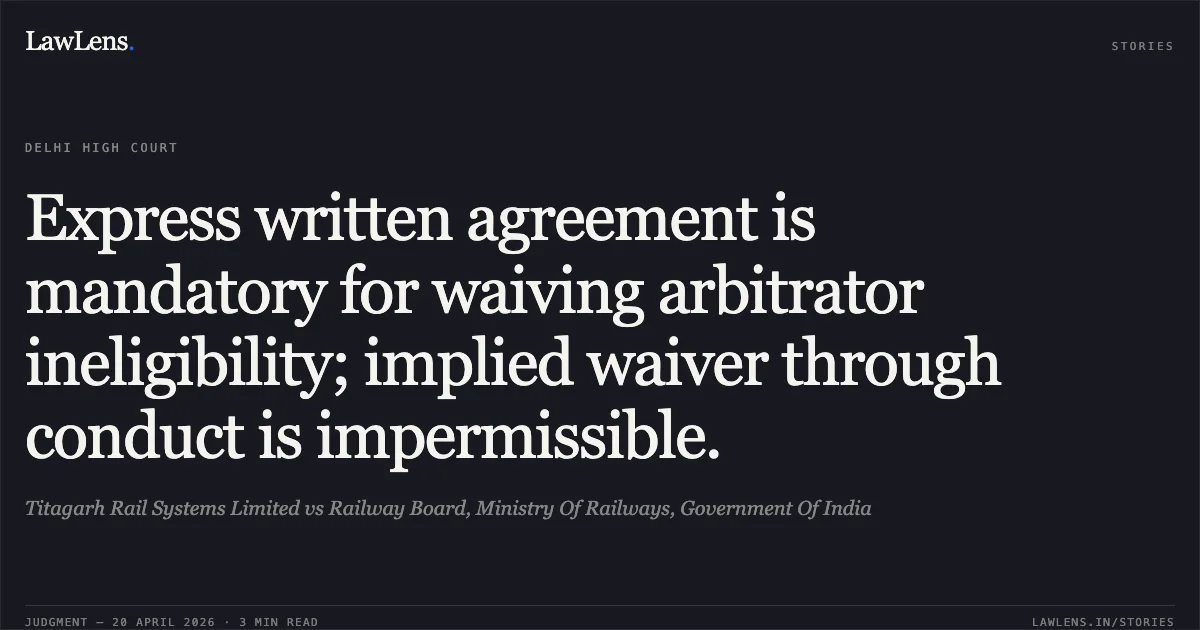
The court applied Section 12(5) of the Arbitration & Conciliation Act, 1996, which stipulates that any person whose relationship with the parties falls under the categories specified in the Seventh Schedule (including being an employee) is ineligible to be an arbitrator, unless the parties waive this ineligibility by an "express agreement in writing" subsequent to disputes arising.
Source reference: para 2, fn 4The court relied on the Supreme Court's decision in Bhadra International (India) (P) Ltd. v. Airport Authority of India (2026 SCC OnLine SC 7), which held that waiver cannot be implied, inferred by conduct, or derived from procedural participation; it requires a conscious, unequivocal, written manifestation of intent to relinquish the right to object.
Source reference: para 25, 75-85It further referenced Bharat Broadband Network Ltd v. United Telecons Ltd (2019) 5 SCC 755, clarifying that "express agreement" refers to words rather than conduct.
Source reference: para 87Reasoning
The court rejected the appellant's contention that selecting an arbitrator from a panel of serving officers—pursuant to a contractual clause that applies when Section 12(5) is waived—constitutes a valid waiver.
Source reference: para 27The court reasoned that the appellant's argument "puts the cart before the horse"; a written waiver must exist before the procedure for appointing serving officers can be legally invoked.
Source reference: para 27-28The court noted that TRSL had specifically stated in writing that it was not waiving Section 12(5), and no subsequent document revoked that stance or expressly consented to waive the ineligibility.
Source reference: para 29Following the Bhadra International mandate, the court emphasized that the statutory requirement of an "express agreement in writing" is a "heightened and mandatory requirement" intended to prevent the inadvertent loss of the right to an independent arbitrator.
Source reference: para 25, 85Consequently, the mere selection of a name from a panel and participation in the proceedings did not satisfy the proviso to Section 12(5).
Source reference: para 30-31Holding
The court dismissed the appeals and upheld the Single Judge’s decision to set aside the arbitral award.
It held that in the absence of an express written agreement waiving the applicability of Section 12(5), the appointment of a serving railway officer was void ab initio as he was de jure ineligible to act as an arbitrator under the Seventh Schedule.
Source reference: para 2, 31The court affirmed that consensual appointment and procedural conduct are insufficient to bypass the mandatory protections of Section 12(5).
Source reference: para 30-31Acts & Sections Cited
12 provisions across 3 statutes referred to in this judgment. Each provision opens on LawLens.
Arbitration and Conciliation Act, 1996
Commercial Courts Act, 20151
Indian Contract Act, 18721
Original Court PDF
Titagarh Rail Systems LimitedvsRailway Board, Ministry Of Railways, Government Of India
Click to open original judgment
Original judgment, available to read, download and summarize on LawLens.in