Facts
The appellant, a manufacturer of aluminium, availed CENVAT credit on inputs during Financial Years 2001–02 and 2002–03.
Source reference: para. 2–4It had invited departmental officers to attend its annual stock verifications, conducted on 9 February 2002 and 8 March 2003, during which shortages and excesses of inventory were recorded.
Source reference: para. 2–4A statutory Cost Audit Report dated 26 September 2003, based on the stock-verification records, disclosed shortages and excesses of raw materials, work-in-progress, finished goods, scrap and wastage; the excesses and shortages allegedly offset each other, resulting in no net shortage.
Source reference: para. 4During a departmental audit on 16 December 2004, the appellant produced the Cost Audit Report and other statutory records.
Source reference: para. 5The Department thereafter issued a spot memo alleging that CENVAT credit was required to be reversed on the shortages.
Source reference: para. 5Four show-cause notices were issued on 3 April 2006, invoking the extended limitation period under the proviso to Section 11A(1) of the Central Excise Act, 1944, on the allegation that the appellant had not disclosed its non-compliance.
Source reference: para. 5The adjudicating authority confirmed a demand of Rs. 6,29,920 with interest and penalty. The Commissioner (Appeals) set aside the demand on limitation, but the CESTAT reversed that decision and restored the original orders.
Source reference: para. 6The appellant challenged the Tribunal’s order under Section 35G of the Act.
Source reference: no citationIssues
Whether the extended limitation period under the proviso to Section 11A(1) of the Central Excise Act, 1944 could be invoked where the demand was based solely on figures contained in the appellant’s statutory Cost Audit Report, which had been produced before the Department, and where departmental officers had knowledge of the relevant facts.
Source reference: para. 1, Question AWhether the Tribunal erred in reversing the Commissioner (Appeals) without finding that the Department lacked sufficient knowledge of the facts forming the basis of the demand.
Source reference: para. 1, Question BWhether penalty under Section 11AC of the Central Excise Act, 1944 was imposable in the absence of the ingredients necessary to invoke the extended limitation period under Section 11A(1).
Source reference: para. 1, Question CLaw Applied
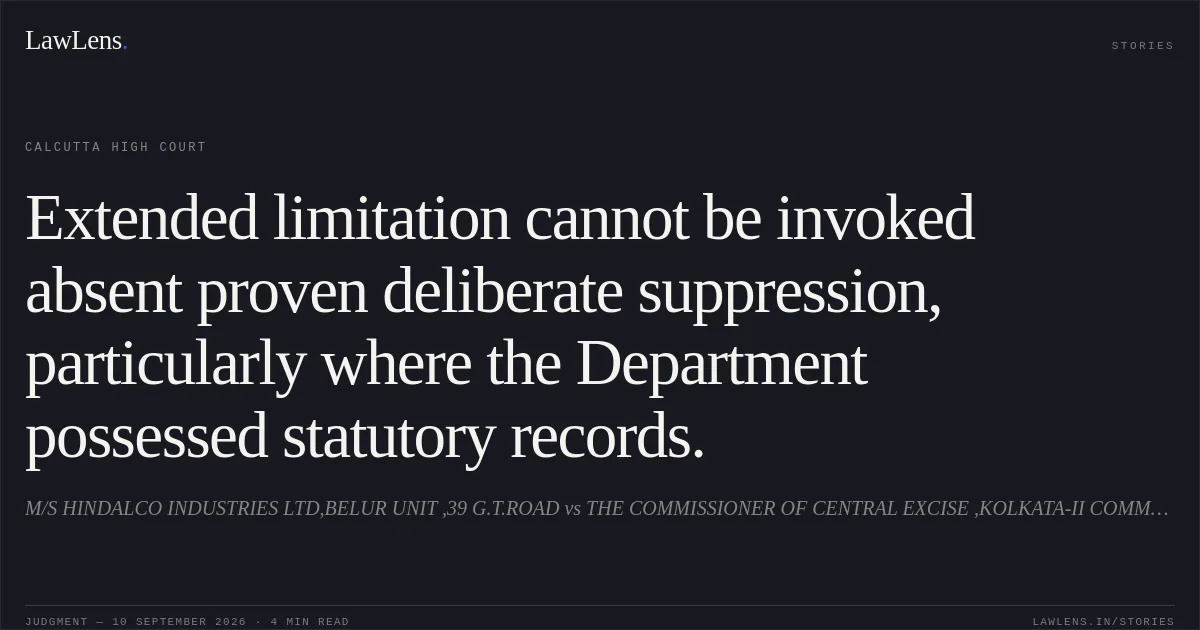
Section 11A(1) of the Central Excise Act, 1944 permits recovery within the ordinary limitation period and permits an extended five-year period only where non-levy or short-levy results from fraud, collusion, wilful misstatement, suppression of facts, or contravention of the Act or Rules with intent to evade duty.
Source reference: para. 9–10The Revenue bears the burden of establishing these ingredients; mere non-payment, discrepancy, or failure to volunteer information does not constitute wilful suppression.
Source reference: para. 10, 16–18Under Pushpam Pharmaceuticals Co. v. CCE, Cosmic Dye Chemical v. CCE, Anand Nishikawa Co. Ltd. v. CCE and Continental Foundation Jt. Venture v. CCE, suppression requires a deliberate withholding of information coupled with the requisite intent.
Source reference: para. 16Larsen & Toubro Ltd. v. CCE requires the show-cause notice to specifically plead the facts constituting fraud or suppression.
Source reference: para. 22Neminath Fabrics Pvt. Ltd. establishes that departmental knowledge cannot shorten the statutory extended period once suppression is established, but also recognises that the extended period is unavailable where suppression is not established.
Source reference: paras. 11–13Information contained in an assessee’s books, financial statements or statutory records ordinarily cannot constitute suppressed information where it was available to, or capable of being examined by, the Department.
Source reference: paras. 18–20Penalty under Section 11AC is conditional upon satisfaction of the ingredients of the proviso to Section 11A(1), as explained in Rajasthan Spinning & Weaving Mills.
Source reference: para. 25Reasoning
The Court held that the Revenue had not proved any positive or deliberate act of suppression or intent to evade duty.
Source reference: para. 19The Cost Audit Report was a statutory document prepared under the Companies Act and the Cost Audit Rules, was required to be preserved and produced, and was expressly capable of being called for by the Department under Rule 22 of the Central Excise Rules, 2002.
Source reference: para. 19The appellant had additionally invited departmental officers to witness the stock verification, and the alleged shortages were recorded in their presence.
Source reference: para. 21The show-cause notices merely alleged non-disclosure of statutory non-compliance without identifying the suppressed fact, the breached disclosure obligation, the act of concealment or the intent to evade.
Source reference: para. 22The Department’s possession of the relevant information from 16 December 2004, followed by an unexplained delay of approximately sixteen months before issuing notice, further supported the absence of deliberate evasion.
Source reference: para. 23The existence of offsetting excesses and shortages also undermined the allegation of concealment.
Source reference: para. 24Accordingly, Neminath Fabrics did not assist the Revenue because it concerned a case where suppression had been admitted and established, unlike the present case.
Source reference: paras. 11–14Since the extended period was unavailable, the notices issued on 3 April 2006 were beyond the ordinary one-year limitation period, and Section 11AC penalty could not be sustained.
Source reference: paras. 26–27Holding
The Court answered Question A in the negative, holding that the extended limitation period could not be invoked because the Department’s knowledge and the statutory nature of the Cost Audit Report negated any deliberate suppression.
Question B was answered in the affirmative: the Tribunal erred in reversing the Commissioner (Appeals) without addressing the Department’s prior knowledge of the relevant facts.
Source reference: para. 29Question C was answered in the negative, as penalty under Section 11AC was unavailable absent the conditions for invoking the extended limitation period.
Source reference: para. 30The appeal was allowed; the Tribunal’s order dated 22 December 2010 was set aside, the four Orders-in-Appeal dated 26 February 2010 were restored, and the demand of Rs. 6,29,920, together with interest and penalty, was set aside as time-barred.
Source reference: para. 31Acts & Sections Cited
2 provisions across 1 statute referred to in this judgment. Each provision opens on LawLens.
Central Excise Act, 19442
Original Court PDF
M/S HINDALCO INDUSTRIES LTD,BELUR UNIT ,39 G.T.ROADvsTHE COMMISSIONER OF CENTRAL EXCISE ,KOLKATA-II COMMISSIONERA
Click to open original judgment
Original judgment, available to read, download and summarize on LawLens.in