Facts
RND Softech Pvt. Ltd., a 100% Export Oriented Unit engaged in providing medical transcription services to doctors in the USA, enabled certain doctors to access dictation recordings hosted by Ecostentel, a US-based “dial and dictate” recording company.
Source reference: para. 2In some cases, the appellant remitted Ecostentel’s charges on behalf of the doctors and recovered the same from them as part of its transcription charges.
Source reference: para. 2The Department alleged that Ecostentel provided “Business Auxiliary Service” to the appellant and that service tax was payable by the appellant under the reverse-charge mechanism under Section 66A of the Finance Act, 1994.
Source reference: paras. 1–2A show-cause notice dated 28 August 2014 invoked the extended limitation period and proposed service tax, interest and penalty for 2009–10 to 2011–12.
Source reference: paras. 1–2The adjudicating authority confirmed the demand and imposed an equivalent penalty under Section 78. The Commissioner (Appeals) upheld that order, leading to the present appeal.
Source reference: para. 1Issues
1. Whether the demand of service tax was wholly barred by limitation under Section 73 of the Finance Act, 1994?
Source reference: para. 8(A)2. If the demand was not barred by limitation, whether the demand, interest and penalty were sustainable on merits?
Source reference: para. 8(B)Law Applied
Section 73(1) of the Finance Act, 1994 prescribed an eighteen-month limitation period for issuing a notice demanding service tax, extendable to five years only where non-payment resulted from fraud, collusion, wilful misstatement, suppression of facts, or contravention of the Act or rules with intent to evade tax.
Source reference: paras. 10–12Section 73(6) determined the relevant date for computing limitation.
Source reference: para. 13The burden lay on the Revenue to establish the taxable service, the alleged service-provider relationship and the circumstances justifying invocation of the extended period.
Source reference: paras. 15–17The Tribunal relied on CCE v. H.M.M. Ltd., Pushpam Pharmaceuticals Co. v. CCE, Stemcyte India Therapeutics Ltd. v. CCE & ST, Uniworth Textiles v. CCE, and Bharat Hotels Ltd. v. Commissioner of Central Excise (Adjudication) for the principle that suppression or intent to evade cannot be presumed merely from non-payment of tax.
Source reference: para. 17It further followed Commissioner of Customs, Central Excise & Service Tax v. Monsanto Manufacturer Pvt. Ltd., Commissioner of Customs, Mumbai v. B.V. Jewels, and E.T.A. General Pvt. Ltd. v. Additional Commissioner of Central Excise for the rule that once a demand is held time-barred, the adjudicating appellate forum should not decide the merits.
Source reference: paras. 18–19Reasoning
The Tribunal found that the appellant’s transactions were recorded in its books and that payments to Ecostentel were made through normal banking channels.
Source reference: paras. 4, 16–17The Revenue produced no evidence of fraud, wilful suppression, misstatement, or any positive act intended to evade service tax.
Source reference: paras. 4, 16–17Consequently, the statutory conditions for invoking the five-year limitation period were not established.
Source reference: paras. 9–17The demand, covering 2009–10 to 2011–12 and raised through the notice dated 28 August 2014, could not be sustained beyond the normal limitation period.
Source reference: paras. 9–17The Tribunal also noted that the show-cause notice failed to identify the specific limb of the statutory definition of “Business Auxiliary Service” under Section 65(19) allegedly attracted, and did not adequately establish the contractual or service relationship between the appellant and Ecostentel.
Source reference: paras. 15–16However, adhering to the principle that a time-barred demand should be disposed of without entering into the merits, the Tribunal refrained from giving a final merits determination.
Source reference: paras. 18–20Holding
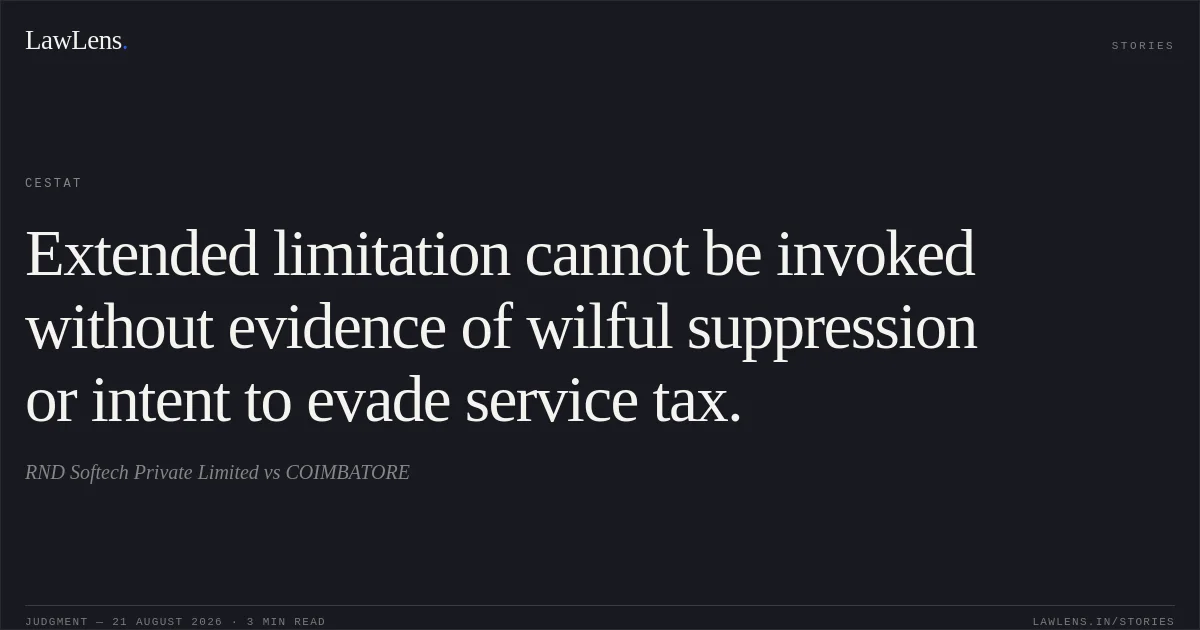
The Tribunal held that the entire service-tax demand was barred by limitation because the Revenue failed to prove fraud, suppression, wilful misstatement, or intent to evade tax necessary for invoking the extended period under the proviso to Section 73(1).
The impugned Order-in-Appeal was set aside, and the appeal was allowed.
Source reference: paras. 20–21The consequential demand of interest and penalty under Section 78 was also set aside, with the appellant made entitled to consequential relief in accordance with law.
Source reference: paras. 20–21Acts & Sections Cited
6 provisions across 2 statutes referred to in this judgment. Linked provisions open on LawLens.
Finance Act, 19945
the Act (alias, unresolved)1
Original Court PDF
RND Softech Private LimitedvsCOIMBATORE
Click to open original judgment
Original judgment, available to read, download and summarize on LawLens.in