Facts
Emerson Process Management (India) Pvt. Ltd. imported raw materials through a Free Trade Warehousing Zone (FTWZ) and transferred them to its DTA manufacturing unit at Pawne, Navi Mumbai, where they were used in manufacturing process-control equipment.
Source reference: p.3, para. 2.2The company claimed exemption from Special Additional Duty of Customs (SAD) under Notification No. 45/2005-Customs dated 16 May 2005, on the basis that VAT/sales tax was payable when the manufactured final products were sold in the DTA.
Source reference: p.3, para. 2.2An undertaking to this effect was furnished to the FTWZ’s Specified Officer.
Source reference: p.3, para. 2.2Following investigation, the Department issued a show-cause notice dated 28 May 2015 demanding SAD of ₹1,79,95,057 with interest for the period 7 April 2012 to 31 July 2013, invoking the extended limitation period under Section 28(4) of the Customs Act, 1962.
Source reference: p.3, para. 2.3The notice also proposed confiscation under Section 111(o) and penalties under Sections 112, 114A and 114AA.
Source reference: p.3, para. 2.3The Principal Commissioner confirmed the demand, confiscation and penalties by Order-in-Original dated 6 November 2015.
Source reference: p.3, para. 1The assessee and its Managing Director appealed against the order, while Revenue appealed seeking a mandatory penalty equal to the duty under Section 114A.
Source reference: p.3, para. 1Issues
Whether the benefit of SAD exemption under Notification No. 45/2005-Customs was available for goods cleared from the FTWZ to the appellants’ DTA unit by way of stock transfer for use in manufacture.
Source reference: p.5, para. 6Whether the Department was entitled to invoke the extended limitation period under Section 28(4) on the allegation of suppression or wilful misstatement.
Source reference: pp.3–4, paras. 2.3, 3.2Whether the consequential confiscation of goods and penalties under Sections 112, 114A and 114AA of the Customs Act, 1962 were sustainable.
Source reference: p.3, para. 2.3Whether Revenue could seek enhancement of the penalty to an amount equal to the duty under Section 114A.
Source reference: p.4, para. 4Law Applied
The Tribunal applied Section 3(5) of the Customs Tariff Act, 1975, concerning SAD, read with Section 25(1) of the Customs Act, 1962 and Notification No. 45/2005-Customs, which exempted goods cleared from an SEZ/FTWZ to another place in India from SAD, subject to the proviso concerning goods exempted from State sales tax/VAT.
Source reference: p.6, para. 9.1The proviso applies where the goods, when sold in the DTA, are exempt from sales tax/VAT; a stock transfer that merely postpones the tax liability is not equivalent to a State tax exemption.
Source reference: p.6, para. 9.1The Tribunal followed CRI Ltd. v. Commissioner of Customs, Final Order No. 75617/2020, affirmed by the Supreme Court, and Commissioner of Central Excise v. Serum Institute of India, 2019 (370) E.L.T. 407 (Tri.-Mum.), holding that the exemption notification must be interpreted according to its own terms and that an administrative circular cannot restrict its scope.
Source reference: pp.4, 6–7, paras. 3.3, 9.1On limitation, the Tribunal applied the principle that extended limitation cannot be invoked in a case involving bona fide interpretational dispute, full disclosure and departmental knowledge of the relevant transactions.
Source reference: pp.6–7, para. 9.1Since the demand was time-barred, the statutory consequences of confiscation and penalty, including the proposed Section 114A penalty, could not survive.
Source reference: p.9, paras. 12–13Reasoning
The Tribunal found the case factually identical to CRI Ltd. and other coordinate-bench decisions granting the SAD exemption for stock transfers from an SEZ/FTWZ to a DTA unit.
Source reference: pp.5–8, paras. 7, 9.1–10.1The relevant notification did not restrict the exempted clearance to a sale; its proviso was attracted only where the goods were exempt from VAT/sales tax.
Source reference: p.6, para. 9.1Here, the imported materials were used in manufacturing, and VAT/sales tax was paid when the finished products were sold in the DTA.
Source reference: p.6, para. 9.1The Tribunal further noted that the issue had generated conflicting governmental interpretations, that the Development Commissioner and FTWZ authorities had approved or facilitated the procedure, and that customs officers had assessed and supervised the clearances.
Source reference: p.8, para. 11These circumstances negatived any deliberate suppression, wilful misstatement or mala fide intention.
Source reference: p.8, para. 11As the entire demand related to the period April 2012 to July 2013 and the show-cause notice was issued beyond the normal one-year period, the extended limitation under Section 28(4) was unavailable.
Source reference: p.8, para. 11The Tribunal therefore held that the demand itself could not be sustained on limitation, making the related confiscation and penalties unsustainable.
Source reference: p.9, paras. 12–13Revenue’s claim for a mandatory Section 114A penalty consequently became untenable.
Source reference: p.9, paras. 12–13Holding
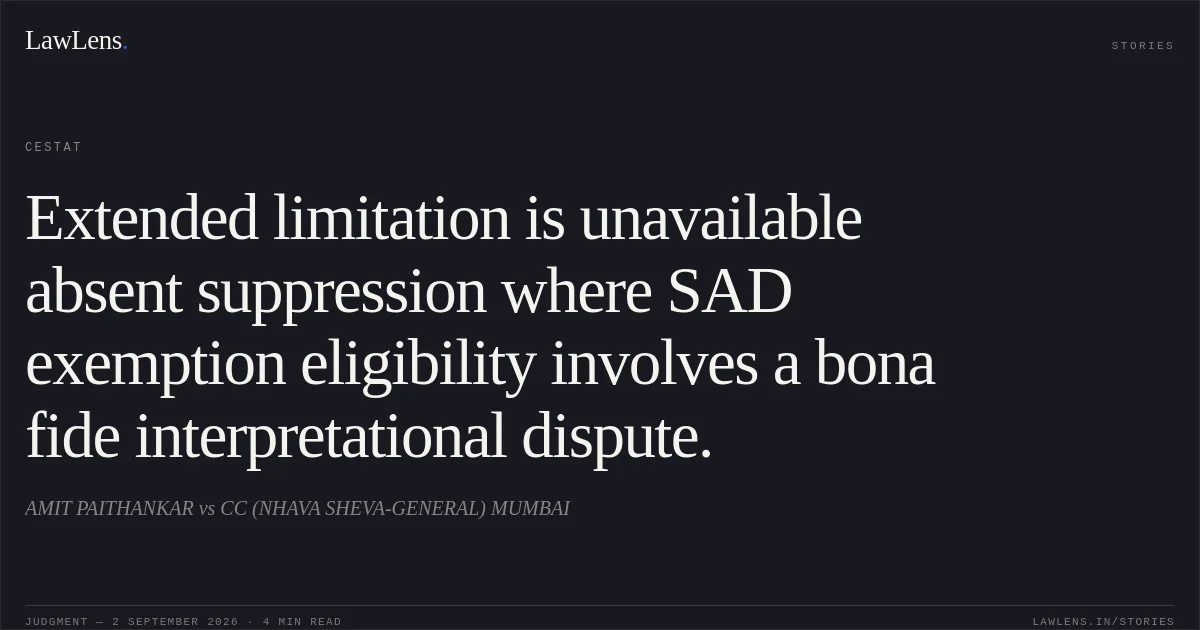
The Tribunal held that the Department could not sustain the SAD demand by invoking the extended limitation period, as the appellants had not suppressed material facts and the dispute arose from a bona fide interpretation of Notification No. 45/2005-Customs.
The Order-in-Original confirming SAD, confiscating the goods and imposing penalties was set aside.
Source reference: p.9, paras. 12–13Customs Appeals Nos. 85270 and 85271 of 2016 filed by the company and its Managing Director were allowed, while Revenue’s Appeal No. 85291 of 2016 seeking enhancement under Section 114A was dismissed.
Source reference: p.9, paras. 12–13Acts & Sections Cited
5 provisions across 2 statutes referred to in this judgment. Each provision opens on LawLens.
Customs Act,19624
Customs Tariff Act, 19751
Original Court PDF
AMIT PAITHANKARvsCC (NHAVA SHEVA-GENERAL) MUMBAI
Click to open original judgment
Original judgment, available to read, download and summarize on LawLens.in