Facts
The review petitioners sought review of the Division Bench judgment dated 28 May 2025 in Writ Appeal No. 1678 of 2024.
Source reference: no citationThe dispute concerned 160 acres at Chalamakunte Village. The land had been sold by the Jodidar, partitioned, attached in civil recovery proceedings, and ultimately sold through execution before being transferred to T. Kemparaju
Source reference: pp. 12–13, paras. 6.1–6.2The petitioners argued that amendments made in 2021–2022 extended the time to apply for occupancy rights and that they had filed a further application under the amended provisions
Source reference: pp. 9–11, paras. 3.1–3.3Issues
1. Whether the subsequent statutory extensions of time to apply for occupancy rights warranted review of the judgment dated 28 May 2025
Source reference: pp. 10–11, paras. 3.1–3.3; p. 13, para. 72. Whether the judgment disclosed an error apparent on the face of the record or another ground for review under Order XLVII Rule 1 CPC
Source reference: p. 16, para. 13Law Applied
Section 114 read with Order XLVII Rule 1 of the Code of Civil Procedure permits review on legally recognised grounds, including an error apparent on the face of the record
Source reference: p. 8; p. 16, para. 13The Court also considered Section 6(1) of the Mysore Alienated Villages (Protection of Tenants and Miscellaneous Provisions) Act, 1950, which required the Deputy Commissioner’s prior approval for dealings with reserved land, and Section 3 of the Mysore (Personal and Miscellaneous) Inam Abolition Act, under which the land vested in the State and was protected from attachment or sale in execution
Source reference: pp. 14–15, paras. 9–10It further referred to Section 10(3)(a) of the Karnataka Inams Abolition (Amendment) Act, 1973, in finding that no application for regrant had been filed
Source reference: p. 13, para. 8Reasoning
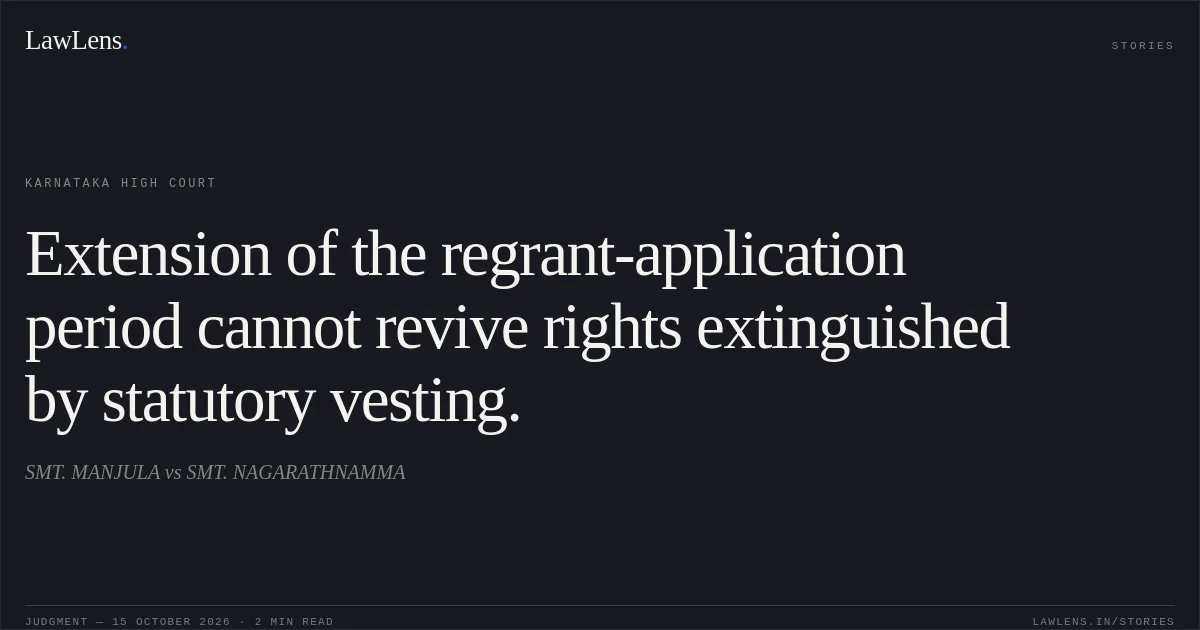
The Court held that the proposed extensions of time did not affect the basis of the judgment under review.
Source reference: no citationThe record showed no application for regrant under Section 10(3)(a); the document relied on by the petitioners was only an impleadment application
Source reference: p. 13, para. 8Independently, the land was reserved land, and the mortgage and resulting execution proceedings had proceeded without the approval required by Section 6(1) of the 1950 Act. The land had vested in the State under Section 3 of the Inam Abolition Act, extinguishing the relevant rights and rendering the sale certificate ineffective
Source reference: pp. 14–15, paras. 9–10Accordingly, the later extensions could not alter the conclusion reached in the original judgment
Source reference: p. 15, para. 12Holding
The Court found no error apparent on the face of the record or other ground warranting review.
It dismissed the review petition, leaving the judgment dated 28 May 2025 in Writ Appeal No. 1678 of 2024 undisturbed
Source reference: p. 16, para. 13Acts & Sections Cited
3 provisions across 3 statutes referred to in this judgment. Each provision opens on LawLens.
Code of Civil Procedure, 19081
Khaddar (Protection of Name) Act, 19501
KARNATAKA (BELGAUM AND GULBARGA AREAS) RELIGIOUS AND CHARITABLE INAMS ABOLITION ACT, 19731
Original Court PDF
SMT. MANJULAvsSMT. NAGARATHNAMMA
Click to open original judgment
Original judgment, available to read, download and summarize on LawLens.in


