Facts
The Petitioner, Secretary of the Social Democratic Party of India (SDPI), challenged an externment order dated December 3, 2025, issued by the Deputy Commissioner of Police, Chembur, and a subsequent appellate order dated March 27, 2026.
Source reference: para. 2The externment was predicated on several FIRs registered against the Petitioner, primarily under Section 188 of the IPC, for organizing agitations, morchas, and dharnas against certain decisions of the Government of India without police permission.
Source reference: paras. 3, 7The State contended that the Petitioner’s acts caused alarm and danger to public property and that slogans were raised despite police refusal of permission.
Source reference: para. 4Issues
1. Whether the externment order passed under Section 56(1)(a) and (b) of the Maharashtra Police Act was based on valid subjective satisfaction and sufficient material.
Source reference: para. 32. Whether organizing political agitations and violating Section 188 IPC constitutes sufficient grounds for externment under the Maharashtra Police Act.
Source reference: para. 73. Whether the externment order violated the Petitioner’s fundamental rights under Articles 19 and 21 of the Constitution.
Source reference: para. 12Law Applied
Section 56(1)(a) and (b) of the Maharashtra Police Act, which permits externment only if a person's movements cause alarm, danger, or harm to person/property, or if they are engaged in specific IPC offenses involving force or violence where witnesses are unwilling to testify.
Source reference: paras. 5, 6The Supreme Court precedent in Deepak v. State of Maharashtra, establishing that externment is an extraordinary measure depriving a citizen of fundamental rights.
Source reference: para. 10The principles from Anuradha Bhasin v. Union of India, holding that state power cannot be used to suppress legitimate democratic grievances.
Source reference: para. 14Mohmmad Kaleem Taufiq Ahmed Siddiqui v. State of Gujarat regarding the illegality of externing citizens for protesting government decisions.
Source reference: para. 15Reasoning
The Court found that the subjective satisfaction of the authorities was vitiated because there was no material evidence on record to prove the Petitioner’s acts caused alarm or danger to person or property as required by Section 56(1)(a).
Source reference: paras. 7, 9The allegations in the FIRs were restricted to organizing political protests and raising slogans without permission, which constitutes an offense under Section 188 IPC (carrying a maximum punishment of one month); the Court held this cannot be a legal ground for an externment order.
Source reference: para. 7The Court determined the action was mala fide, as the state used an extraordinary preventive measure to penalize the Petitioner for exercising his fundamental right to freedom of speech and expression.
Source reference: paras. 8, 12The Court emphasized that since the protests were directed at government decisions, the externment restricted the Petitioner's right to live with dignity and move freely without appropriate legal justification.
Source reference: paras. 11, 12Holding
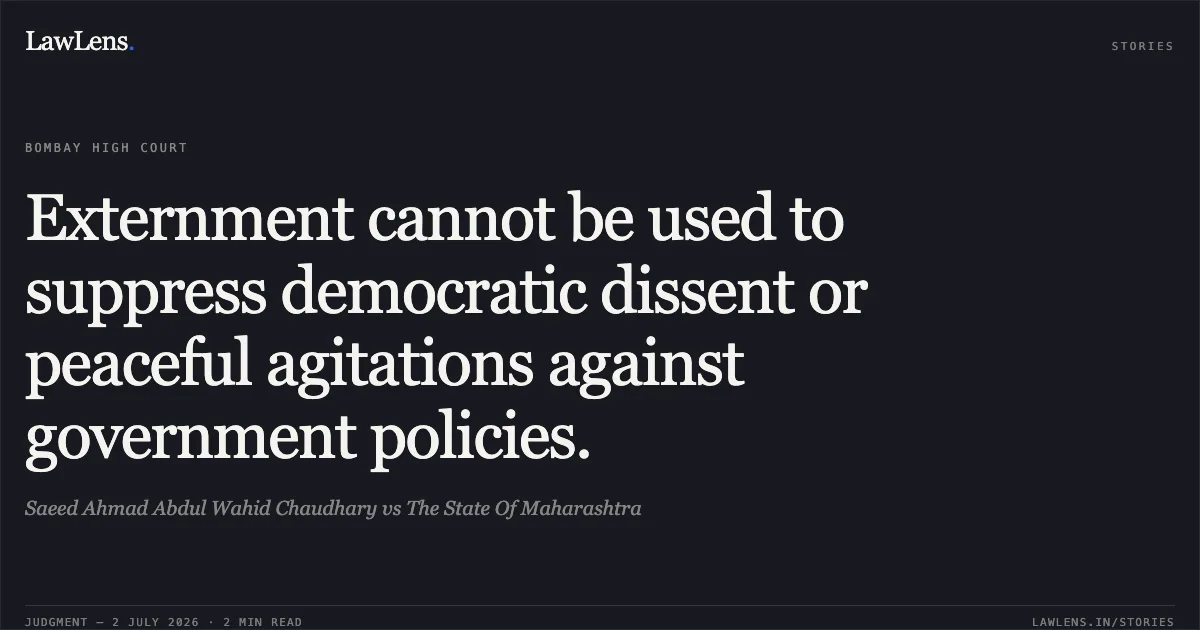
The Court held that the impugned externment orders were without basis and violated the Petitioner's fundamental rights.
Political dissent and minor IPC violations do not satisfy the stringent requirements of the Maharashtra Police Act.
Source reference: para. 7Consequently, the High Court allowed the Writ Petition and quashed the Externment Order dated December 3, 2025, and the Appellate Order dated March 27, 2026.
Source reference: para. 17Acts & Sections Cited
3 provisions across 3 statutes referred to in this judgment. Each provision opens on LawLens.
Maharashtra Police Act.1
Indian Penal Code, 18601
Code of Criminal Procedure, 19731
Original Court PDF
Saeed Ahmad Abdul Wahid ChaudharyvsThe State Of Maharashtra
Click to open original judgment
Original judgment, available to read, download and summarize on LawLens.in


