Facts
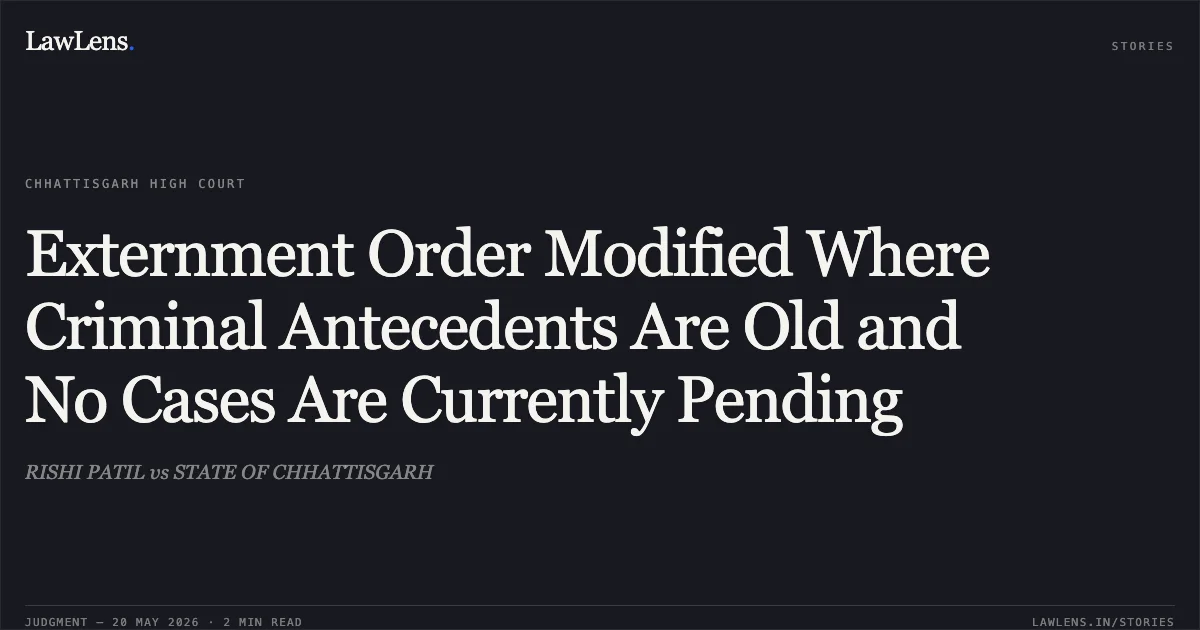
The petitioner, Rishi Patil, was subject to externment proceedings initiated by the District Magistrate (DM), Balodabazar-Bhatapara, following a report from the Superintendent of Police
Source reference: para. 2On 22.09.2025, the DM issued an order under the Chhattisgarh Rajya Suraksha Adhiniyam, 1990, externing the petitioner from Balodabazar-Bhatapara and nine adjoining districts for one year
Source reference: para. 3This order was primarily based on excise offenses registered between 2014 and 2024, in which the petitioner had already been acquitted
Source reference: para. 2, 5, 7The petitioner unsuccessfully appealed this order before the State Government, which dismissed the appeal on 11.12.2025
Source reference: para. 4The petitioner then moved the High Court via a writ petition, contending that no criminal cases were pending at the time proceedings were initiated and that he had already served seven months of the externment period
Source reference: para. 2, 5Issues
1. Whether the externment order and its subsequent affirmation by the appellate authority were legally sustainable given that the criminal antecedents were old and resulted in acquittals
Source reference: para. 5, 72. Whether the duration of the externment period (one year) warranted modification based on the petitioner’s period of compliance and potential for reformation
Source reference: para. 5, 7Law Applied
The court primarily applied Sections 3 and 5(b) of the Chhattisgarh Rajya Suraksha Adhiniyam, 1990, which empowers the District Magistrate to remove persons whose presence is deemed prejudicial to public order or safety
Source reference: para. 2Section 9 of the same Act regarding the appellate process
Source reference: para. 4The bench applied the principle of judicial review in administrative actions, specifically the necessity for a proximate link between the criminal activity and the externment order, while maintaining the court's discretion to modify penalties to facilitate social reformation
Source reference: para. 7Reasoning
The Court observed that the criminal cases cited as the basis for the externment order dated back to 2014–2024 and that the petitioner had been acquitted in all such matters
Source reference: para. 7Crucially, the Court noted that no fresh criminal cases had been registered against the petitioner in 2025, the year the proceedings were initiated
Source reference: para. 5, 7While the authorities had initially determined the petitioner’s presence to be a risk, the Court found that the substantial passage of time (the petitioner being out of the districts for seven months) and the nature of the past offenses (non-heinous) warranted a reassessment
Source reference: para. 5, 7The Court reasoned that reducing the externment period would serve the dual purpose of maintaining law and order while providing the petitioner an opportunity to reform and reintegrate into society
Source reference: para. 7Holding
The Court held that while the initial proceedings were initiated within the statutory framework, the one-year duration was excessive under the circumstances
Consequently, the High Court modified the orders dated 22.09.2025 (DM) and 11.12.2025 (Appellate Authority) by reducing the period of externment from one year to seven months
Source reference: para. 7Since the petitioner had already completed the modified seven-month period, the petition was disposed of, effectively allowing the petitioner to return to the district
Source reference: para. 7, 8Acts & Sections Cited
5 provisions across 2 statutes referred to in this judgment. Linked provisions open on LawLens.
Chhattisgarh Rajya Suraksha Adhiniyam, 19903
Chhattisgarh Excise Act, 19152
Original Court PDF
RISHI PATILvsSTATE OF CHHATTISGARH
Click to open original judgment
Original judgment, available to read, download and summarize on LawLens.in