Facts
On the night of December 11, 2001, the appellant, Vimal Singh, allegedly attacked his wife (Indu) and daughter (Anju) with a hammer in their residence.
Source reference: p.2Following the incident, he made a telephonic call to the Police Control Room (PCR) from a neighbor’s house, confessing to the attack.
Source reference: p.2Both victims were found in critical condition and later succumbed to head injuries caused by a blunt object.
Source reference: p.13The appellant was arrested at the scene; subsequently, a blood-stained hammer was recovered from the roof of his bathroom based on his disclosure, and his blood-stained trousers were seized.
Source reference: p.2-3The Trial Court convicted him under Section 302 of the IPC on August 12, 2002.
Source reference: p.3The appellant challenged the conviction, arguing that the chain of circumstantial evidence was incomplete and that the extra-judicial confession was inadmissible.
Source reference: p.4-5Issues
1. Whether the extra-judicial confession made to the public and the telephonic information given to the PCR are admissible and sufficient to sustain a conviction.
Source reference: p.14 / para. 322. Whether the recovery of the weapon (hammer) under Section 27 of the Evidence Act is valid despite discrepancies between the disclosure statement ("dark corner") and the actual recovery site ("roof of the bathroom").
Source reference: p.23 / para. 433. Whether the prosecution established a complete chain of circumstantial evidence to prove guilt beyond reasonable doubt.
Source reference: p.13 / para. 31Law Applied
The court primarily applied Section 302 of the Indian Penal Code (IPC) for murder and Section 307 for attempted murder (initially).
Source reference: p.2It applied Section 27 of the Indian Evidence Act regarding the admissibility of information leading to the discovery of a fact, following the doctrine of "confirmation by subsequent events" as established in Pulukuri Kottayya v. King Emperor.
Source reference: p.9, 25The court also relied on Section 8 of the Evidence Act regarding the relevancy of conduct.
Source reference: p.28For the evidentiary value of extra-judicial confessions, it cited Subramanya v. State of Karnataka and Sahadevan v. State of T.N., noting that while weak, such confessions can form the basis of conviction if voluntary and corroborated.
Source reference: p.14-17Finally, it applied the "five golden principles" for circumstantial evidence from Sharad Birdhichand Sarda v. State of Maharashtra.
Source reference: p.12Reasoning
The Court found the extra-judicial confession made to PW-4 (a neighbor) and the public to be natural and reliable, as it was made immediately after the crime on a street where the appellant's presence was expected.
Source reference: p.19-21Although confessions to police are barred under Section 25, the court noted the PCR call helped establish the appellant's conduct and identity.
Source reference: p.18-19Regarding the recovery of the hammer, the Court held that "dark corner" in the disclosure statement was a broad description for a secluded spot, and the fact that the police needed a ladder to reach the bathroom roof (where the hammer was found) satisfied the requirement of discovery under Section 27.
Source reference: p.24-27The Court emphasized that forensic evidence (FSL) showed the blood on both the hammer and the appellant’s pants matched the 'B' group of the deceased.
Source reference: p.28-29Additionally, under the principles of Trimukh Maroti Kirkan, since the crime occurred in the privacy of the home, the appellant failed to provide a plausible explanation for the fatal injuries to his family.
Source reference: p.12, 29Holding
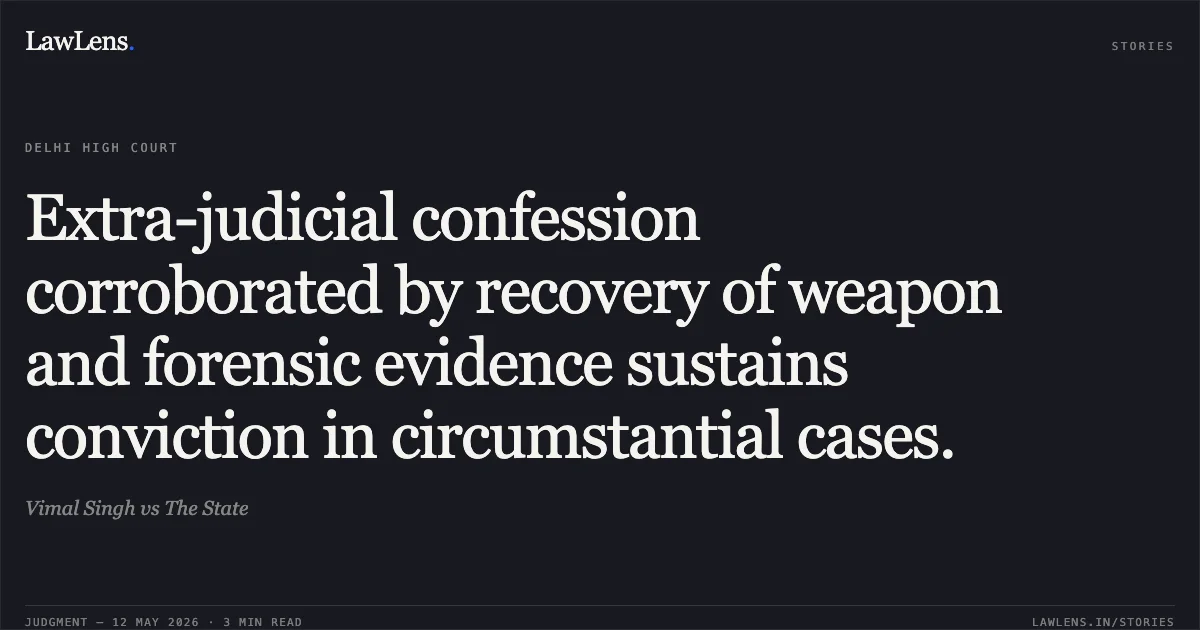
The Court dismissed the appeal and affirmed the conviction and life sentence under Section 302 IPC.
It held that the prosecution successfully proved an unbroken chain of circumstances, including motive, extra-judicial confession, and forensic corroboration.
Source reference: p.29The Court directed the appellant to surrender before the Jail Superintendent within one week to serve the remainder of his sentence.
Source reference: p.30Acts & Sections Cited
3 provisions across 3 statutes referred to in this judgment. Linked provisions open on LawLens.
Indian Penal Code, 18601
Code of Criminal Procedure1
Indian Evidence Act, 18721
Original Court PDF
Vimal SinghvsThe State
Click to open original judgment
Original judgment, available to read, download and summarize on LawLens.in