Facts
The State appealed against the acquittal of the respondent, Jagdish Hirabhai Malam, who was charged under Section 302 of the IPC for the murder of his grandfather, Govabhai.
Source reference: p. 1The prosecution alleged that on March 21, 1996, the accused strangulated and struck the deceased with a stone due to a property dispute regarding the non-allotment of a monetary share from sold land.
Source reference: p. 2The case was primarily based on an extra-judicial confession allegedly made by the accused on November 23, 1996 (eight months after the death) to four witnesses during the funeral ceremony of the accused’s nephew.
Source reference: p. 5, 18-23The Trial Court acquitted the accused on January 1, 2000, finding the evidence insufficient.
Source reference: p. 1-2Issues
1. Whether the findings of the Trial Court acquitting the accused were palpably wrong, manifestly erroneous, or demonstrably unsustainable.
Source reference: p. 11, 122. Whether the extra-judicial confession allegedly made by the accused was voluntary, truthful, and inspired sufficient confidence to form the sole basis of conviction.
Source reference: p. 29, 30Law Applied
Section 378(1)(3) of the Cr.P.C. regarding appeals against acquittal, adhering to the principles in Rajesh Prasad v. State of Bihar and Chandrappa v. State of Karnataka, which mandate that an appellate court should not disturb an acquittal if two reasonable views are possible.
Source reference: p. 8-14Section 302 of the IPC.
Source reference: p. 2The evidentiary standards for extra-judicial confessions established in Sahadevan v. State of Tamil Nadu, which characterize such confessions as a "weak type of evidence" requiring independent corroboration and high credibility.
Source reference: p. 25-29Reasoning
The High Court found that the prosecution's case rested entirely on circumstantial evidence and the alleged extra-judicial confession.
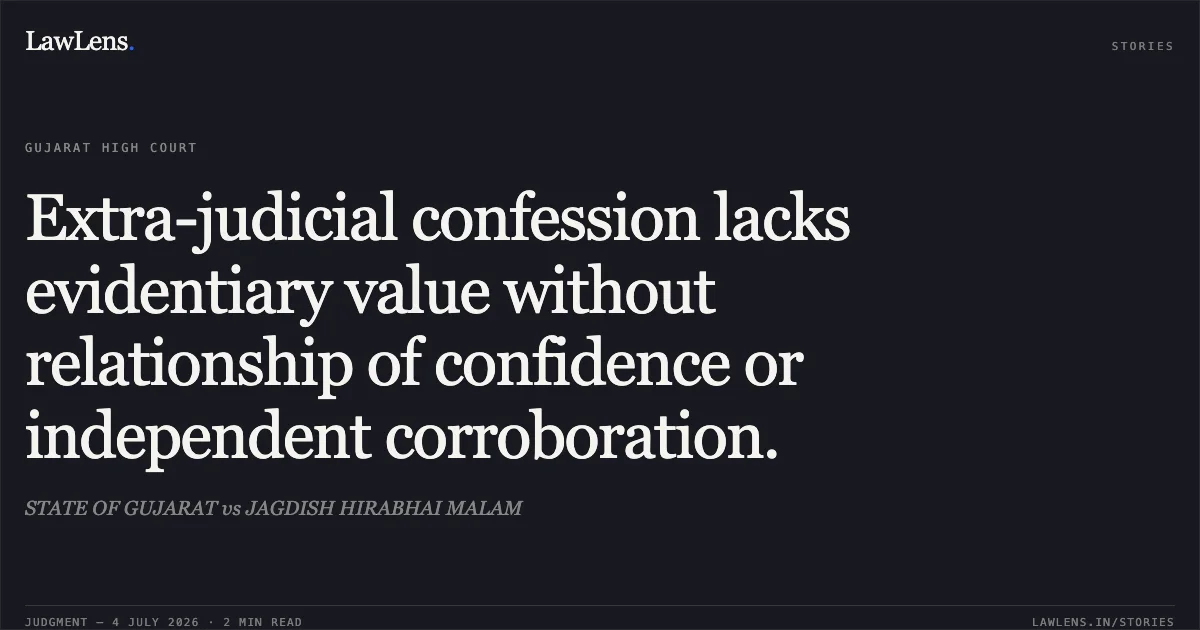
Source reference: p. 7, 29Upon reappreciating the testimony of PW3, PW4, and PW5, the Court observed that these witnesses had no relationship of intimacy or confidence with the accused, making it "inherently improbable" that he would confess three murders to them without reason.
Source reference: p. 30The Court noted material omissions in the police statements and found the sequence of successive confessions at various locations to be "unnatural".
Source reference: p. 31Furthermore, the medical evidence from PW1 was inconclusive, as the doctor admitted the cause of death could be unrelated to the alleged assault and noted an absence of typical signs of strangulation, such as lung congestion.
Source reference: p. 16, 17Consequently, the Court held that the Trial Court’s decision to discard the confession was a plausible and well-reasoned view.
Source reference: p. 31Holding
The Court answered the issues in the negative, holding that the extra-judicial confession was not of "sterling quality" and failed the test of credibility.
The High Court upheld the Trial Court’s judgment, dismissed the State's appeal, and confirmed the acquittal of the respondent. The bail bond was cancelled and record proceedings were ordered to be returned.
Source reference: p. 32Acts & Sections Cited
5 provisions across 2 statutes referred to in this judgment. Each provision opens on LawLens.
Code of Criminal Procedure, 19734
Indian Penal Code, 18601
Original Court PDF
STATE OF GUJARATvsJAGDISH HIRABHAI MALAM
Click to open original judgment
Original judgment, available to read, download and summarize on LawLens.in