Facts
Petitioner No. 1 is a German manufacturer of textile machinery, and Petitioner No. 2 is its Indian subsidiary providing technical support
Source reference: para. 6(i)-(ii)Between June 2014 and May 2017, Petitioner No. 1 sold warp knitting machines to various Indian importers
Source reference: para. 6(iii)The Directorate of Revenue Intelligence (DRI) investigated allegations that these importers mis-declared the goods as "fully fashioned high-speed knitting machines" to illegally claim customs duty exemptions
Source reference: para. 6(iii)Consequently, the Respondents issued show-cause notices (SCNs) between 2020 and 2021 to the Petitioners, alleging they aided and abetted the fraud, and proposed penalties under Sections 112 and 114AA of the Customs Act, 1962
Source reference: para. 7The Petitioners challenged these SCNs primarily on the grounds that the Customs Act did not have extra-territorial jurisdiction over foreign entities for transactions occurring prior to the amendment of Section 1(2) by the Finance Act, 2018
Source reference: para. 2, 4(1)Issues
1. Whether the Customs authorities possessed the jurisdiction to issue show-cause notices and impose penalties on a foreign exporter for transactions that took place prior to the March 29, 2018, amendment to Section 1(2) of the Customs Act, 1962?
Source reference: para. 2, 142. Whether a foreign exporter can be held liable for mis-declaration under Sections 111(m), 112, and 114AA when the statutory obligation for self-assessment and entry of goods rests with the Indian importer?
Source reference: para. 13, 17, 19Law Applied
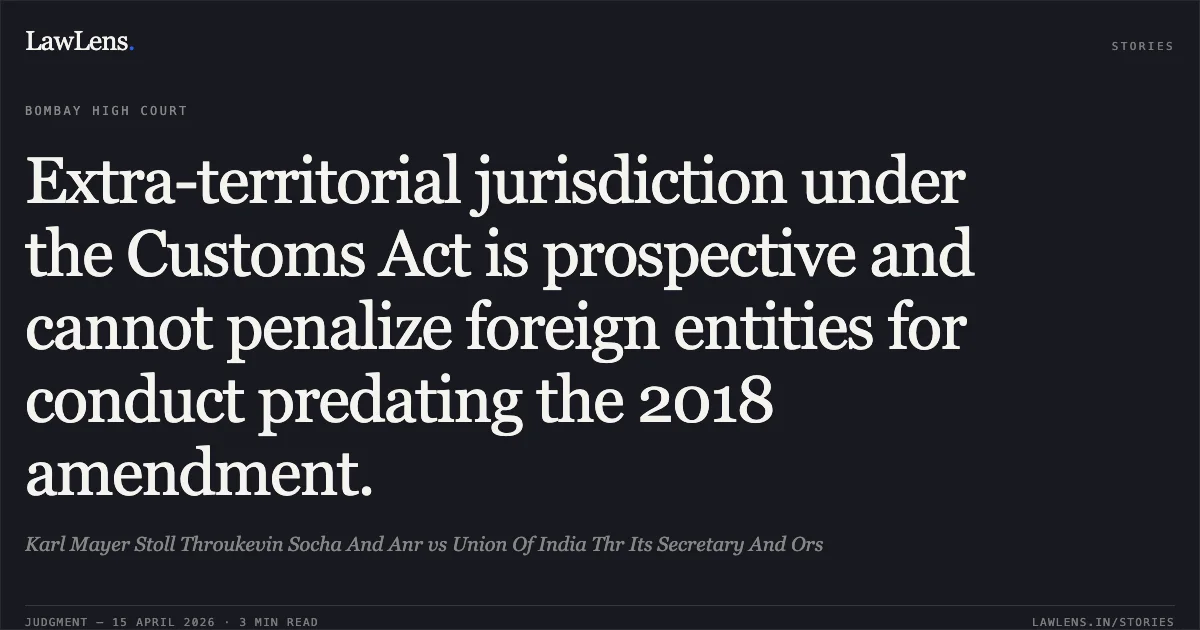
The court primarily interpreted Section 1(2) of the Customs Act, 1962, noting that prior to the Finance Act, 2018 (effective March 29, 2018), the Act did not provide for extra-territorial application to offences committed outside India
Source reference: para. 3, 14It relied on the principle that penal statutes cannot be applied retrospectively to acts occurring before the enlargement of jurisdiction, consistent with Article 20(1) of the Constitution of India
Source reference: para. 10(ii)-(iii)Sections 17 and 46 of the Act mandate that the responsibility for self-assessment and the accuracy of declarations lies solely with the "importer"
Source reference: para. 16The court followed the Division Bench precedent in Ankur Agarwal, Director v. Principal Commissioner, which held the 2018 amendment to be prospective, over the Single Member decision in Prerna Singh v. Commissioner of Customs
Source reference: para. 21Reasoning
The court reasoned that the Respondents lacked jurisdiction because the alleged mis-declarations occurred between 2014 and 2017, whereas the extra-territorial reach of the Customs Act was only introduced via the 2018 amendment
Source reference: para. 14-15The court observed that under the scheme of the Act (specifically Sections 17, 46, and 111(m)), the importer—not the foreign exporter—is responsible for the entry, self-assessment, and truthfulness of declarations made at the time of importation
Source reference: para. 13, 17Petitioner No. 1’s role as a foreign supplier ended upon shipment, and there was no material evidence to establish a "conspiracy" or "abetment" by the German entity
Source reference: para. 13, 19The court rejected the Respondents' reliance on the Prerna Singh case, noting that judicial discipline requires adhering to Division Bench rulings which confirmed that the 2018 amendment cannot apply retrospectively to foist liability on foreign parties for past transactions
Source reference: para. 21Holding
The court held that the impugned show-cause notices were issued without jurisdiction and were legally unsustainable
It ruled that the 2018 amendment to Section 1(2) is prospective and cannot be invoked for pre-2018 conduct
Source reference: para. 15The court further concluded that no ingredients of Sections 112 or 114AA were satisfied against the Petitioners as the duty of declaration rested with the importers
Source reference: para. 19-20Accordingly, the Court made the Rule absolute, quashing and setting aside the SCNs and any related recovery notices in all three Writ Petitions
Source reference: para. 23-24Acts & Sections Cited
14 provisions across 1 statute referred to in this judgment. Each provision opens on LawLens.
Original Court PDF
Karl Mayer Stoll Throukevin Socha And AnrvsUnion Of India Thr Its Secretary And Ors
Click to open original judgment
Original judgment, available to read, download and summarize on LawLens.in