Facts
The petitioners, claiming rights over immovable property via succession, filed a revision before the Board of Revenue, M.P.
Source reference: p. 1-2The revision was dismissed for non-prosecution due to the petitioners' absence.
Source reference: p. 3Subsequently, the petitioners filed a restoration application (Restoration Case No. 1021/Review/15), which was also dismissed for want of prosecution on 30.05.2015.
Source reference: p. 1-3The petitioners approached the High Court under Article 226 of the Constitution in 2025—ten years after the dismissal—citing lack of communication with their previous counsel and their status as rustic villagers from Umaria as reasons for the delay.
Source reference: p. 2-3Issues
1. Whether the High Court should exercise its extraordinary discretionary jurisdiction under Article 226 of the Constitution to set aside an order after an unexplained delay of ten years.
Source reference: para. 5-62. Whether the petitioners’ reasons for non-appearance and delay (lack of communication with counsel and distance) constitute sufficient grounds to overlook gross laches and negligence.
Source reference: para. 6-7Law Applied
The Court applied the doctrine of "delay and laches" governing the exercise of writ jurisdiction under Article 226 of the Constitution of India.
Source reference: para. 5While no statutory limitation period applies to Article 226, the jurisdiction is discretionary and equitable, requiring a litigant to approach the court with due diligence and within a reasonable period.
Source reference: para. 5Procedural rules are intended to advance justice, but they cannot be used to revive matters that have attained finality due to a "consistent pattern of negligence".
Source reference: para. 6Reasoning
The Court observed that the petitioners exhibited a persistent lack of diligence by failing to appear at two critical stages: first during the initial revision and second during the restoration proceedings.
Source reference: para. 4, 6The Court characterized the ten-year delay in filing the writ petition as "extraordinary" and found the explanations provided—such as distance from Gwalior and lawyer-client miscommunication—to be "vague, general in nature and wholly insufficient".
Source reference: para. 5The Court reasoned that entertaining such a belated petition would undermine the principle of finality in judicial and quasi-judicial proceedings.
Source reference: para. 6Consequently, the Court declined to examine the merits of the property dispute, as the threshold of "due diligence" was not met.
Source reference: para. 6Holding
The High Court dismissed the writ petition on the grounds of gross delay and laches.
The Court held that the petitioners' repeated failure to prosecute their case before the Board of Revenue, coupled with an unconvincing ten-year delay in seeking a remedy, precluded the exercise of extraordinary discretionary jurisdiction under Article 226.
Source reference: para. 7No order as to costs was made.
Source reference: para. 8Original Court PDF
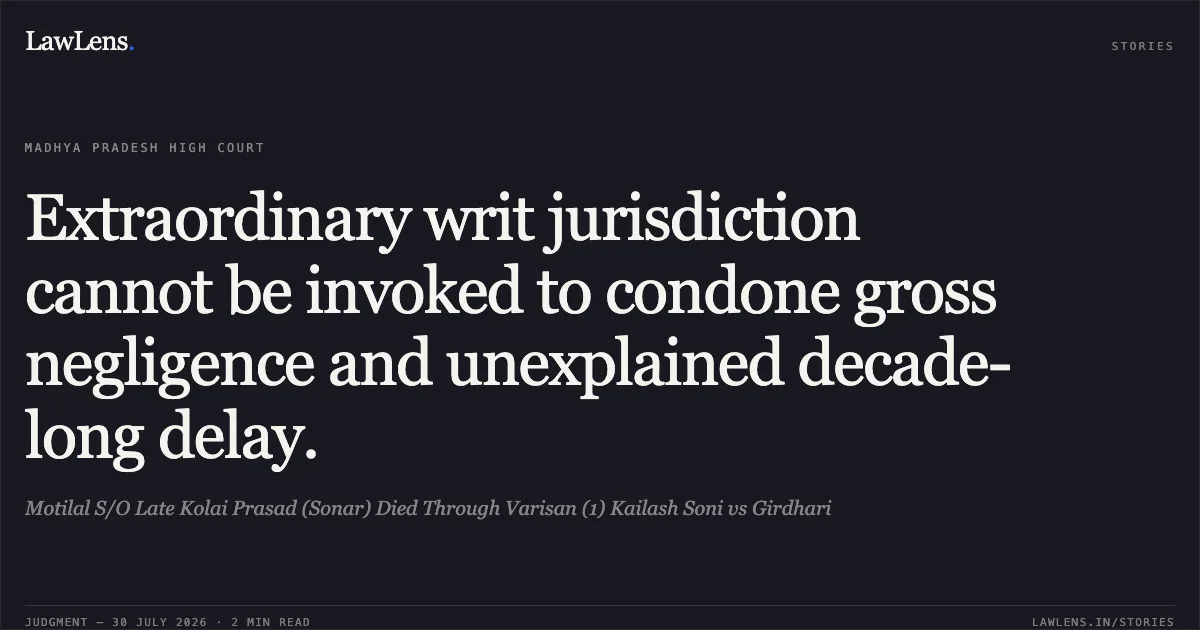
Motilal S/O Late Kolai Prasad (Sonar) Died Through Varisan (1) Kailash SonivsGirdhari
Click to open original judgment
Original judgment, available to read, download and summarize on LawLens.in