Facts
The petitioners were named in an FIR (Crime No. 171/2020) at Police Station Sendri for forming an unlawful assembly and murdering Sunil Tiwari with deadly weapons
Source reference: para 3While a charge-sheet was filed against other accused, the police continued the investigation against the petitioners under Section 173(8) Cr.P.C. and eventually filed a closure report citing CCTV footage and mobile tower records suggesting their absence from the scene
Source reference: para 3-4The Judicial Magistrate First Class (JMFC) rejected the closure report on 19.02.2021, took cognizance based on eye-witness statements under Sections 161 and 164 Cr.P.C., and issued process
Source reference: para 2-3Subsequently, the Sessions Court framed charges under Sections 148, 302/149 of the IPC on 27.10.2023
Source reference: para 2The petitioners challenged these orders, arguing that the investigating agency found no material against them and that co-accused persons had already been acquitted in a separate trial
Source reference: para 4Issues
1. Whether the Magistrate and Sessions Court erred in rejecting the police closure report and framing charges despite scientific evidence suggesting the absence of the accused
Source reference: para 7-82. Whether the acquittal of co-accused in a separate trial entitles the remaining accused to quashing of proceedings or discharge
Source reference: para 9Law Applied
The court applied the principle that the opinion of an investigating agency in a closure report is not binding on a Magistrate, who may independently take cognizance if sufficient grounds exist
Source reference: para 7At the stage of framing charges, the Court must only determine if there is a "strong suspicion" of involvement rather than a meticulous appreciation of evidence
Source reference: para 7Principles from Dharam Pal and Others v. State of Haryana and Another (2014) 3 SCC 306 were cited regarding the jurisdiction of the Magistrate to take cognizance despite a closure report
Source reference: para 4Furthermore, the court emphasized the limited scope of inherent and revisional jurisdictions under Sections 482 and 397/401 Cr.P.C., which cannot be used to conduct a "mini-trial"
Source reference: para 7, 10Reasoning
The High Court observed that the petitioners were specifically named in the FIR and consistently implicated by eye-witnesses in statements recorded under Sections 161 and 164 Cr.P.C.
Source reference: para 8The court reasoned that the scientific evidence relied upon by the petitioners (CCTV and mobile tower data) is a matter of defense to be evaluated during trial, as its authenticity and evidentiary value cannot be adjudicated at the stage of framing charges or quashing
Source reference: para 9The court further noted that the JMFC and the Sessions Judge provided valid reasons for proceeding based on the material in the case diary
Source reference: para 8It was held that the acquittal of co-accused does not automatically result in the discharge of the petitioners when prima facie material exists against them
Source reference: para 9Holding
The High Court dismissed both the Criminal Revision and the M.Cr.C., holding that there was no jurisdictional error, perversity, or manifest illegality in the impugned orders
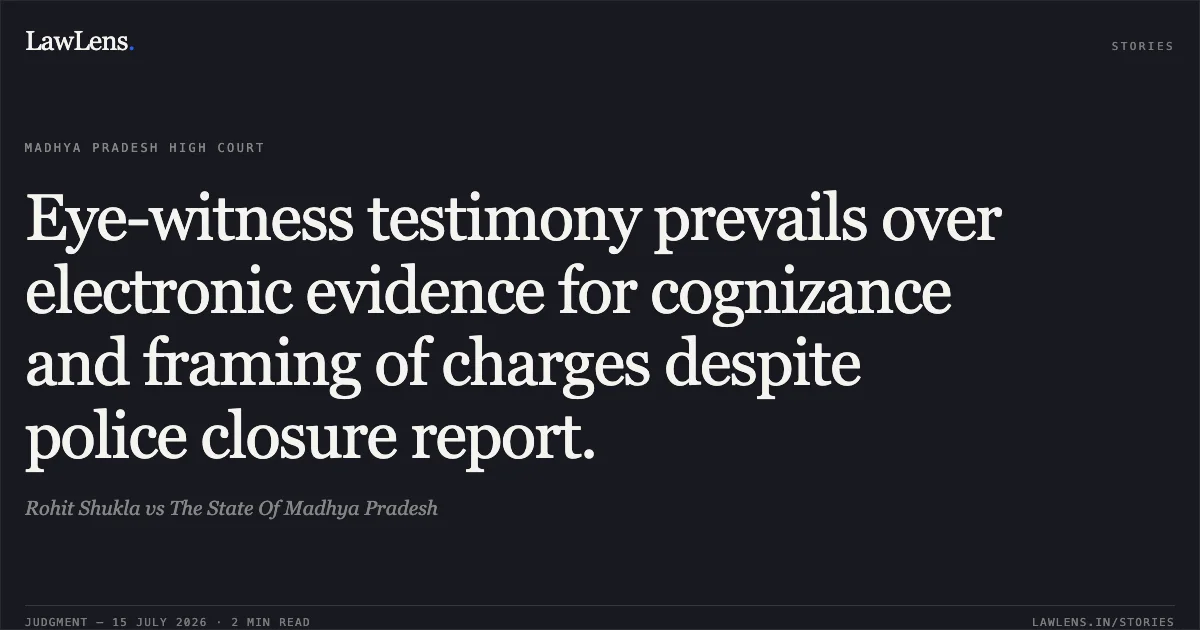
The court answered that the ocular testimony of eye-witnesses justified the rejection of the closure report and the framing of charges
Source reference: para 8-10The trial court was directed to proceed with the trial uninfluenced by the observations made in this order
Source reference: para 11Acts & Sections Cited
9 provisions across 2 statutes referred to in this judgment. Each provision opens on LawLens.
Indian Penal Code, 18603
Code of Criminal Procedure, 19736
Original Court PDF
Rohit ShuklavsThe State Of Madhya Pradesh
Click to open original judgment
Original judgment, available to read, download and summarize on LawLens.in