Facts
The petitioner sought to quash the order dated 4 February 2015 rejecting his application for discharge under Section 227 CrPC in a prosecution arising from Khagaria (Chitragupta Nagar) P.S. Case No. 122 of 2012.
Source reference: p. 1–2The FIR alleged that the petitioner ordered co-accused persons to kill the informant’s family; they allegedly assaulted the informant’s mother, who later died while being taken to Patna for treatment.
Source reference: p. 1–3The petitioner relied on an RTI response stating that the deceased had not been admitted to Sadar Hospital, Khagaria, and on the post-mortem opinion attributing death to cardio-respiratory failure due to COPD.
Source reference: p. 3–4The State relied on two ante-mortem abrasions recorded in the post-mortem report and the informant’s account as an eyewitness.
Source reference: p. 4–5The police had filed a charge-sheet under Sections 147, 148, 341, 504 and 302 IPC.
Source reference: p. 3Issues
Whether the material on record disclosed sufficient ground to frame charges against the petitioner, including under Section 302 IPC, despite his arguments based on the hospital record and post-mortem opinion.
Source reference: p. 3–5Whether the order rejecting discharge under Section 227 CrPC warranted interference by the High Court.
Source reference: p. 1–2, 5–6Law Applied
Section 227 CrPC empowers the court of session to discharge an accused where there is insufficient ground to proceed.
Source reference: p. 2At the charge stage, the court considers whether the record provides sufficient ground to proceed; the judgment refers to the principle that a charge may be framed on the basis of suspicion and that discharge is an exception, while trial is the rule.
Source reference: p. 2The prosecution invoked Sections 147, 148, 341, 504 and 302 IPC, and the High Court assessed whether the material—including the eyewitness account and the post-mortem findings—was sufficient to proceed to trial.
Source reference: p. 3–5Reasoning
The Court found that the informant, who was the deceased’s son, claimed to have witnessed the occurrence and attributed to the petitioner an order directing the co-accused to kill the deceased.
Source reference: p. 2–3, 5The post-mortem report recorded ante-mortem external injuries, which the State relied on as supporting the allegation of assault.
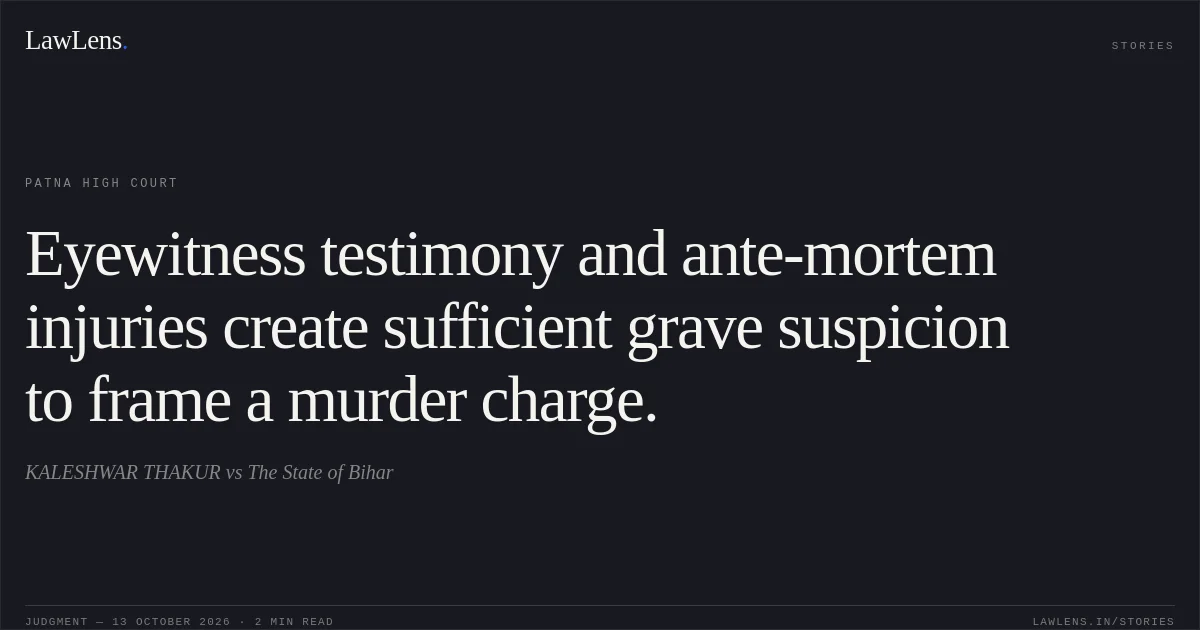
Source reference: p. 4–5Considering this material, the Court held that there was more than grave suspicion sufficient to frame charges.
Source reference: p. 5The petitioner’s reliance on the RTI response and the medical opinion did not justify discharge at that stage.
Source reference: p. 3–6Holding
The High Court held that sufficient material existed to frame charges against the petitioner and that the order rejecting discharge did not warrant interference.
It dismissed the petition as devoid of merit and directed that the judgment be communicated to the trial court with the trial-court record, if any.
Source reference: p. 5–6Acts & Sections Cited
6 provisions across 2 statutes referred to in this judgment. Each provision opens on LawLens.
Indian Penal Code, 18605
Code of Criminal Procedure, 19731
Original Court PDF
KALESHWAR THAKURvsThe State of Bihar
Click to open original judgment
Original judgment, available to read, download and summarize on LawLens.in


