Facts
The Petitioners, who were Directors of M/s Sterne India Pvt. Ltd., challenged a common Order-in-Original dated 31 March 2026 imposing a penalty of ₹27,11,59,404 upon them under Section 122(1A) of the Central Goods and Services Tax Act, 2017 (“CGST Act”).
Source reference: para. 1; p. 2The company was engaged in trading mobile phones and electronic goods and had claimed input tax credit (“ITC”) on invoices issued by various suppliers.
Source reference: paras. 3–4; pp. 2–3During investigation, several suppliers were found to be non-existent, and the authorities concluded that the invoices represented fraudulent ITC transactions without corresponding supplies of goods or services.
Source reference: paras. 4–5; p. 3Documents furnished by the company were also found not to establish genuine payments to the concerned suppliers.
Source reference: para. 6; p. 3Summons were issued to the Petitioners and statements were subsequently recorded during the investigation.
Source reference: paras. 5–9; pp. 3–4A Show Cause Notice (“SCN”) dated 21 March 2025 was issued against the company and the Petitioners individually.
Source reference: paras. 9–10, 12–14; pp. 4–5Issues
Whether the High Court should exercise its writ jurisdiction under Article 226 despite the Petitioners having an alternative statutory remedy of appeal under Section 107 of the CGST Act, on the ground that the SCN and hearing notices were not duly served and that natural justice was violated?
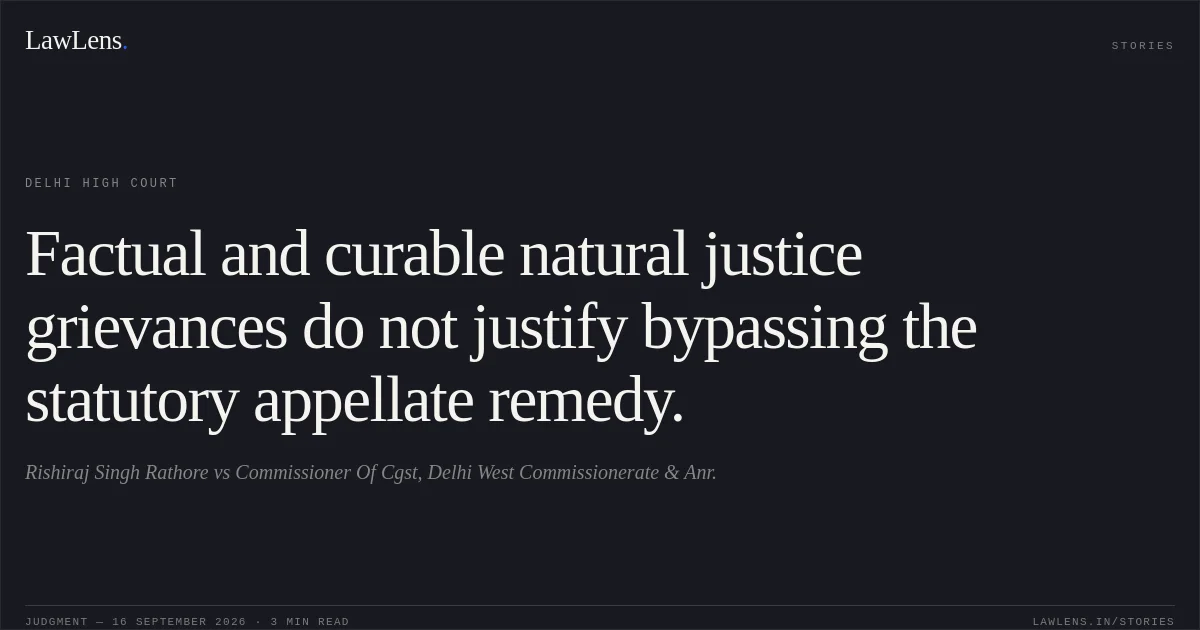
Source reference: paras. 12–19; pp. 5–7Whether the alleged defects in service of notice and denial of personal hearing constituted a jurisdictional error warranting interference in writ proceedings, or were factual and curable issues to be examined by the Appellate Authority?
Source reference: paras. 16–19; pp. 5–7Whether the absence of a power of remand with the Appellate Authority justified bypassing the statutory appellate remedy?
Source reference: para. 20; p. 7Law Applied
The Court applied Article 226 of the Constitution, recognising that the existence of an alternative remedy ordinarily persuades the High Court to decline writ relief, although exceptions may arise in cases involving breach of natural justice or lack of jurisdiction; such exceptions must be invoked sparingly, particularly where the grievance is factual and capable of appellate correction.
Source reference: paras. 15–16; p. 5Section 107 of the CGST Act provides the statutory remedy of appeal against an adjudication order.
Source reference: paras. 12, 15; pp. 5–6Section 122(1A) of the CGST Act was the provision under which the impugned penalty was imposed.
Source reference: para. 1; p. 2The Court further held that the absence of a power to remand does not deprive the Appellate Authority of jurisdiction to decide the appeal on merits after independently appreciating the record.
Source reference: para. 20; p. 7The Petitioners were also permitted to seek exclusion of the period spent in the writ proceedings under Section 14 of the Limitation Act, 1963.
Source reference: para. 22; p. 7Reasoning
The Court found that the SCN expressly named both Petitioners in their individual capacities as Directors and called upon them to show cause against imposition of penalty.
Source reference: para. 17; p. 6Whether the SCN and hearing notices were actually served, in what mode, and whether the Petitioners were effectively denied an opportunity of hearing required examination of the underlying notices, service records, and chronology of proceedings.
Source reference: paras. 17–19; pp. 6–7These were factual matters better suited to appellate determination rather than adjudication for the first time under Article 226.
Source reference: paras. 17–19; pp. 6–7Even assuming that the personal-hearing opportunity was deficient, the Court held that such an infirmity would be curable and would not, on the facts pleaded, amount to a jurisdictional defect requiring bypass of the statutory appeal.
Source reference: para. 19; p. 7The Court also rejected the argument that the alleged absence of remand power made the appellate remedy ineffective, holding that the Appellate Authority could decide the objections and merits independently without necessarily remanding the matter.
Source reference: para. 20; p. 7Holding
The Delhi High Court declined to exercise writ jurisdiction and relegated both Petitioners to the alternative remedy of appeal under Section 107 of the CGST Act.
The Court held that the alleged non-service of the SCN or hearing notices and the alleged denial of personal hearing involved factual and curable issues, not a demonstrated jurisdictional error warranting interference under Article 226.
Source reference: paras. 17–19; pp. 6–7The Petitions and pending applications were accordingly disposed of, with liberty to the Petitioners to seek exclusion of the period spent in the writ proceedings under Section 14 of the Limitation Act, 1963.
Source reference: paras. 22–24; p. 7–8The Court clarified that it had expressed no opinion on the merits, which remained open for consideration by the Appellate Authority.
Source reference: paras. 22–24; p. 7–8Acts & Sections Cited
4 provisions across 3 statutes referred to in this judgment. Each provision opens on LawLens.
Central Goods and Services Tax Act, 20172
Insolvency and Bankruptcy Code, 2016.1
Limitation Act, 19631
Original Court PDF
Rishiraj Singh RathorevsCommissioner Of Cgst, Delhi West Commissionerate & Anr.
Click to open original judgment
Original judgment, available to read, download and summarize on LawLens.in