01Facts
On June 24, 2013, the appellant (son) allegedly assaulted the complainant (father) with an axe.
¶ 3The appellant was charged under Section 307/34 of the IPC and subsequently convicted by the Additional Sessions Judge, Amarwada, on December 30, 2015, receiving a sentence of ten years RI and a fine of ₹2,000.
¶ 2During the pendency of the appeal, the father and son filed for a compromise, verified by the Registrar, stating they had settled the dispute voluntarily.
¶ 1The appellant had served approximately 11 months of his sentence.
¶ 802Issues
i.1. Whether a conviction under Section 307 of the IPC can be compounded based on a compromise between the parties.
¶ 8, 12ii.2. Whether the factum of compromise between a father and son, along with the appellant’s clean record and time served, warrants a reduction in sentence.
¶ 12, 1403Law Applied
The Court applied Section 307 of the Indian Penal Code (IPC) regarding attempt to murder.
¶ 2It strictly adhered to the principle that Section 307 is a non-compoundable offence under the Code of Criminal Procedure, meaning a compromise cannot supersede the conviction.
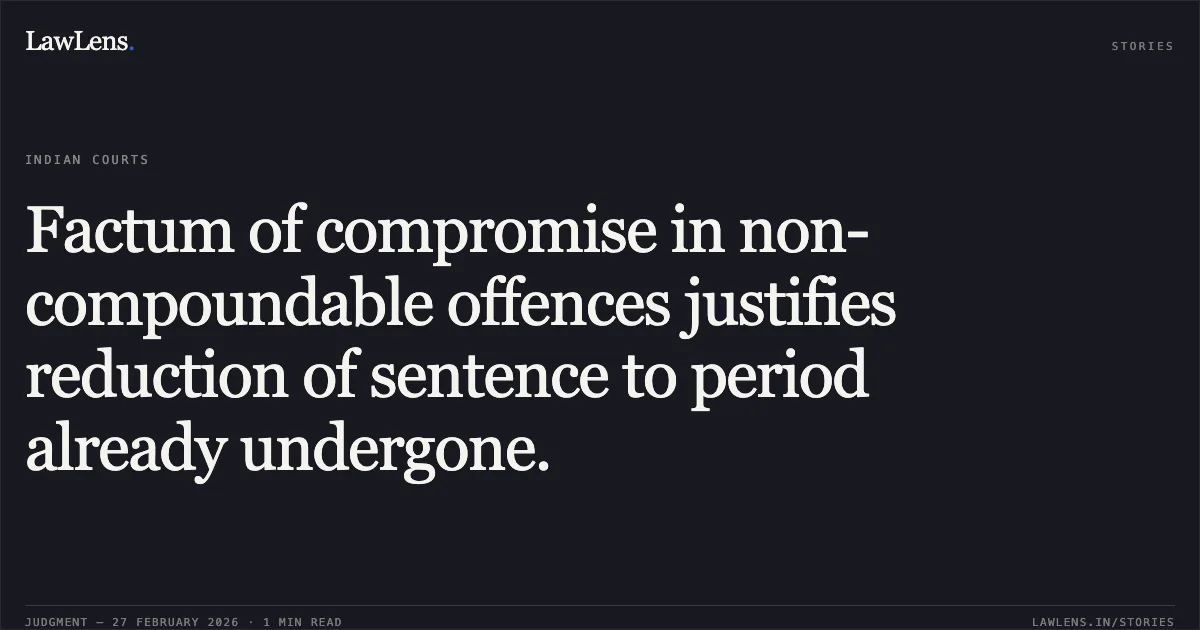
¶ 8, 12However, the Court recognized the judicial principle that a settlement between parties can be a mitigating factor in determining the quantum of punishment.
¶ 12It further referenced Section 395 of the Bharatiya Nagarik Suraksha Sanhita (BNSS), 2023, regarding the payment of compensation to the victim from the fine amount.
¶ 14Provisions in the judgment · 4 · Linked ones open on LawLens
Code of Criminal Procedure, 1973 Section 374
Indian Penal Code, 1860 Section 307Section 34
Bharatiya Nyaya Sanhita, 2023 Section 395
04Reasoning
The Court noted that while the conviction under Section 307 was legally sound and supported by evidence from 12 witnesses, the familial nature of the dispute (father and son) and the successful mediation/compromise were significant.
¶ 6, 13, 1, 8The Court reasoned that since the appellant was 20 years old at the time of the incident, had no prior criminal record, and had been facing trial for 12 years, the ends of justice would be better served by focusing on reformation rather than extended incarceration.
¶ 8, 14Although the compromise application was formally rejected because the offense is non-compoundable, the Court used its discretion to treat the settlement as a mitigating circumstance to reduce the sentence to the period already undergone.
¶ 12, 1405Holding
The High Court affirmed the conviction of the appellant under Section 307 of the IPC but modified the sentence.
¶ 13-14The substantive jail sentence was reduced to the period already undergone (approx. 11 months), and the fine was enhanced from ₹2,000 to ₹10,000.
¶ 14The Court directed that the enhanced fine be paid to the victim as compensation under Section 395 of the BNSS, 2023.
¶ 14The appellant was discharged from his bail bonds subject to the payment of the fine.
¶ 15Original Court PDF
Vishnu Kumar v. The State of Madhya Pradesh [2026:MPHC-JBP:17032]
Click to open original judgment
Original judgment, available to read, download and summarize on LawLens.in