Facts
The petitioner alleged that an employee of Aligarh Muslim University (“AMU”) had admitted, by sworn statement, to preparing and signing forged cash vouchers amounting to ₹9,040.
Source reference: para. 2; pp. 2–3He submitted complaints and representations to AMU seeking an inquiry and action regarding the alleged forgery, fraud and financial irregularities.
Source reference: para. 2; pp. 2–3AMU initially informed him that the complaint was under examination, but subsequently stated, in response to an RTI appeal, that the relevant financial register was misplaced and untraceable.
Source reference: para. 2; pp. 2–3After further representations and a legal notice yielded no effective action, the petitioner submitted a representation dated 24 March 2026 to the Department of Higher Education, Ministry of Education (“Ministry”), seeking an independent inquiry and audit.
Source reference: para. 3; p. 3The writ petition sought only a direction to the Ministry to consider and decide that pending representation, not adjudication of the underlying allegations against AMU.
Source reference: paras. 1, 8; pp. 1, 5Issues
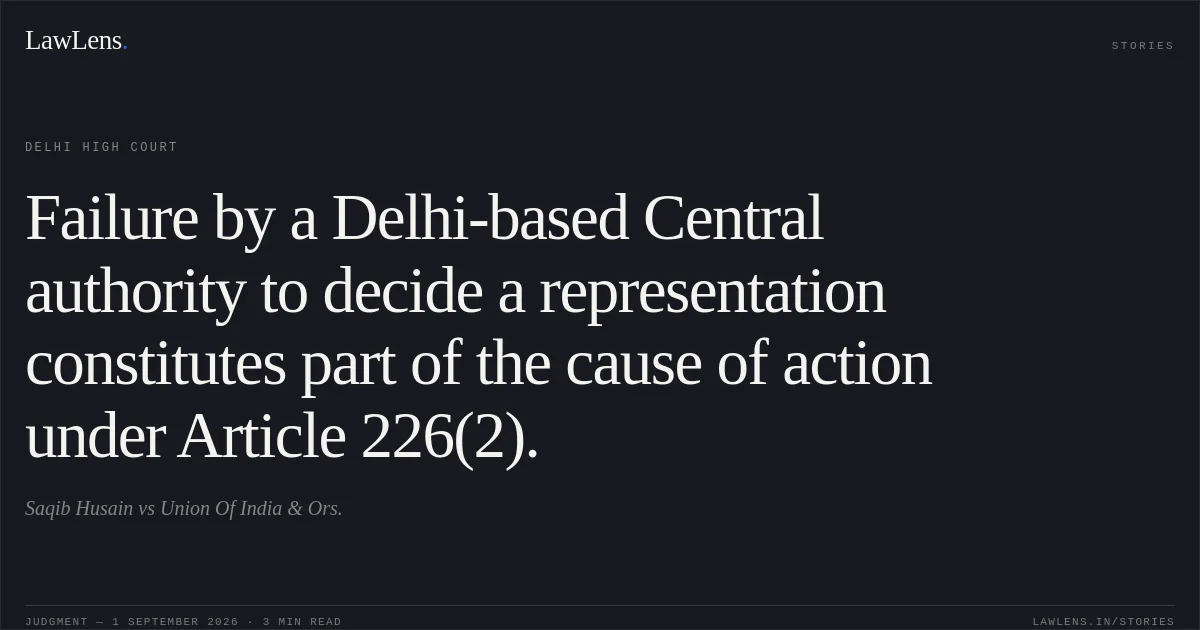
Whether the Delhi High Court had territorial jurisdiction under Article 226(2) of the Constitution to entertain a petition seeking a direction to the Ministry, situated in New Delhi, to decide the petitioner’s representation dated 24 March 2026, although the underlying events occurred at AMU in Aligarh.
Source reference: paras. 4–6, 8–9; pp. 3–5Whether the Ministry should be directed to consider and decide the petitioner’s representation in accordance with law and examine whether any action was warranted within its powers and jurisdiction.
Source reference: paras. 8, 11; pp. 5–6Law Applied
The Court applied Article 226(2) of the Constitution, under which a High Court may exercise writ jurisdiction where the cause of action arises wholly or in part within its territorial jurisdiction.
Source reference: para. 5; p. 3The Court held that, for a petition confined to securing consideration of a representation by a central authority, the non-consideration of that representation by an authority located within the Court’s jurisdiction may constitute a part of the cause of action.
Source reference: paras. 8–9; p. 5The Court did not rely on or cite any specific judicial precedent, statute governing the alleged financial irregularities, or legal provision concerning the merits of the allegations against AMU.
Source reference: paras. 10, 13; pp. 5–6Reasoning
The Court distinguished between the substantive allegations concerning forgery, fraud and missing financial records at AMU and the limited relief actually sought in the writ petition.
Source reference: paras. 8–9; p. 5Since the petition challenged the Ministry’s failure to consider a representation addressed and submitted to an authority situated in New Delhi, the Court found that part of the cause of action arose within its territorial jurisdiction under Article 226(2), notwithstanding that the underlying events occurred in Aligarh.
Source reference: paras. 8–9; p. 5At the same time, the Court expressly declined to examine the truth or merits of the allegations against AMU and confined its consideration to the Ministry’s obligation to deal with the pending representation within the scope of its statutory powers and jurisdiction.
Source reference: paras. 10–11, 13; pp. 5–6Holding
The Court rejected the Ministry’s objection to territorial jurisdiction insofar as the petition sought consideration of the representation dated 24 March 2026.
It directed the Ministry to consider and decide the representation in accordance with the applicable rules, procedure and law, and to examine whether any action was warranted within its powers and jurisdiction, within three months from the date of the order.
Source reference: para. 11; p. 6The decision was to be communicated to the petitioner.
Source reference: para. 11; p. 6The petition and pending application, if any, were disposed of, with the clarification that the ruling on territorial jurisdiction was limited to the relief concerning the Ministry’s consideration of the representation and did not determine jurisdiction over any substantive dispute involving AMU.
Source reference: paras. 12–13; p. 6Original Court PDF
Saqib HusainvsUnion Of India & Ors.
Click to open original judgment
Original judgment, available to read, download and summarize on LawLens.in