01Facts
The prosecutrix, a divorced adult woman residing in Indore, alleged that she became acquainted with Shubham Dharwa through Instagram, after which they exchanged telephone numbers and developed a relationship.
¶ 3–4She alleged that, while she was emotionally vulnerable following her divorce, the petitioner established a physical relationship with her on the false promise of marriage and obtained approximately ₹10 lakh from her.
¶ 4–5When she demanded that he fulfil the promise of marriage, he allegedly quarrelled with and abused her and threatened to make their intimate photographs public.
¶ 6The police registered an FIR and, after investigation, filed a charge-sheet under Sections 376(2)(n), 294 and 506 IPC.
¶ 6The Special Judge framed charges under Sections 376(2)(n) and 506 Part II IPC by order dated 06.09.2024 in Sessions Trial No. 570/2024, leading the petitioner to file the present criminal revision.
¶ 1The petitioner contended that the relationship was consensual, that the prosecutrix was a mature adult, and that an earlier complaint dated 23.12.2023 had referred only to recovery of money and not to any sexual offence.
¶ 7–1002Issues
i.Whether the material on record disclosed a prima facie offence under Section 376(2)(n) IPC, where the parties were educated adults involved in a prolonged relationship allegedly intended to culminate in marriage?
¶ 13–20ii.Whether the allegation that the petitioner threatened to make intimate photographs public disclosed the ingredients of criminal intimidation under Section 506 Part II read with Section 503 IPC?
¶ 15, 21–22iii.Whether the order framing charges suffered from perversity, material irregularity or patent illegality warranting interference in revisional jurisdiction?
¶ 13, 22–2403Law Applied
The Court considered Section 376(2)(n) IPC, which penalises repeated rape of the same woman.
¶ 14It applied Sections 503 and 506 IPC, holding that criminal intimidation requires a threat of injury to a person, reputation or property, coupled with an intention to cause alarm or to compel or prevent an act.
¶ 15On consent and a promise to marry, the Court relied on Pramod Suryabhan Pawar v. State of Maharashtra, (2019) 9 SCC 608, which establishes that a promise to marry vitiates consent only where it was false from the inception, made in bad faith, and had a direct nexus with the woman’s decision to engage in the sexual act.
¶ 16The Court also reiterated that revisional jurisdiction is supervisory and is not ordinarily a forum for detailed reappreciation of evidence.
¶ 13Provisions in the judgment · 5 · Linked ones open on LawLens
Indian Penal Code, 1860 Section 376Section 506Section 294Section 375Section 503
04Reasoning
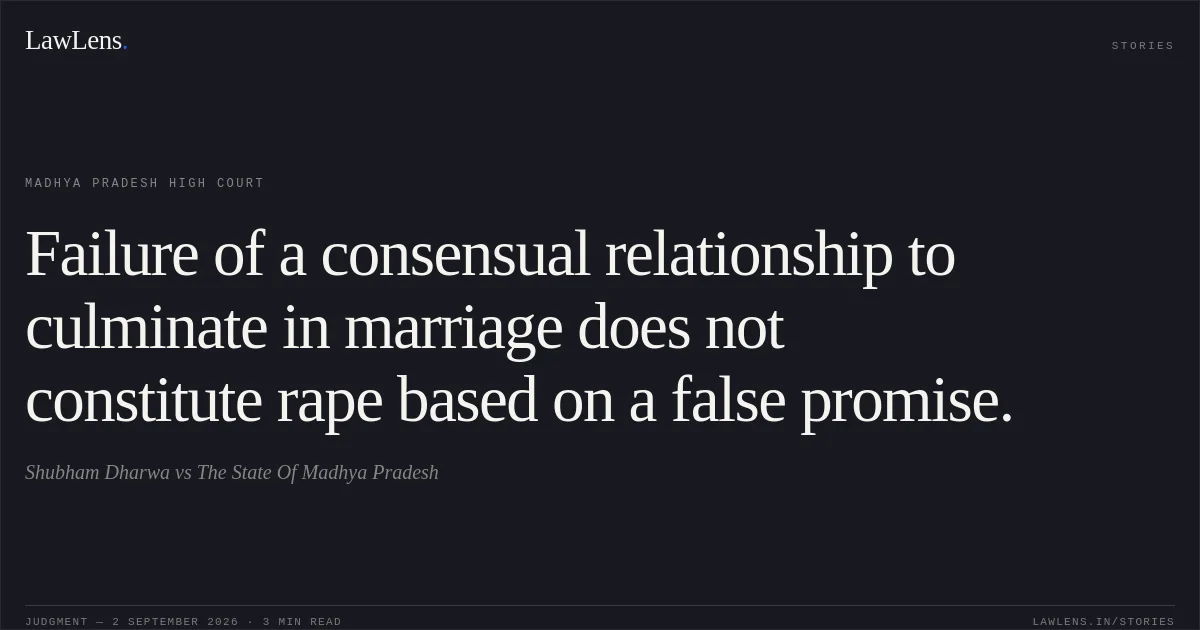
The Court found that the prosecution material itself showed that the petitioner and prosecutrix were educated adults who developed a relationship over a substantial period and, at one stage, genuinely intended to marry.
¶ 17–19Although the relationship ultimately failed because of subsequent differences, the record did not indicate that the petitioner had made a false promise of marriage in bad faith from the very beginning or that the prosecutrix’s consent was obtained solely because of such a promise.
¶ 18–20The Court therefore held that the essential basis for treating the relationship as rape under Section 376(2)(n) IPC was absent.
¶ 18–20In relation to criminal intimidation, the Court held that the consensual relationship and its context negated the requisite intention to cause alarm, and consequently the allegation did not sustain the charge under Section 506 Part II IPC.
¶ 21–22Continuing the trial on these allegations was held to constitute an abuse of process, and the framing of charges was found to suffer from perversity, material irregularity and patent illegality.
¶ 22–2305Holding
The revision was allowed.
¶ 24The High Court set aside the order dated 06.09.2024 framing charges under Sections 376(2)(n) and 506 Part II IPC.
¶ 24The petitioner, Shubham Dharwa, was discharged from those charges, and his bail and surety bonds, if any, were directed to stand discharged forthwith.
¶ 25A copy of the order was directed to be transmitted to the trial court for necessary compliance.
¶ 25Original Court PDF
Shubham DharwavsThe State Of Madhya Pradesh
Click to open original judgment
Original judgment, available to read, download and summarize on LawLens.in