Facts
The deceased, Arup Kalita, went missing on the night of 19.05.2010 after having dinner at PW-12’s house
Source reference: p. 2, 8PW-11, a tenant of the accused’s father, witnessed the appellant assaulting the deceased on the head with a wooden batten at approximately 11:45 p.m.
Source reference: p. 3, 9When PW-11 attempted to intervene, the appellant pushed him away, labeling it a "domestic problem"
Source reference: p. 3On 21.05.2010, the deceased's body was recovered from a pond behind the appellant's house with the legs tied with a rope
Source reference: p. 3, 9The medical report (PW-1) cited an incised injury to the occipital scalp and skull fracture as the cause of death
Source reference: p. 7The Trial Court convicted the appellant under Section 302 IPC while acquitting four co-accused family members due to a lack of specific evidence against them
Source reference: p. 2-3The appellant challenged the conviction on grounds of delayed naming in the FIR and lack of intent
Source reference: p. 3-4Issues
1. Whether the testimony of a sole eyewitness (PW-11) is reliable for conviction despite the non-mention of the appellant’s name in the initial GD Entry and FIR filed by PW-2
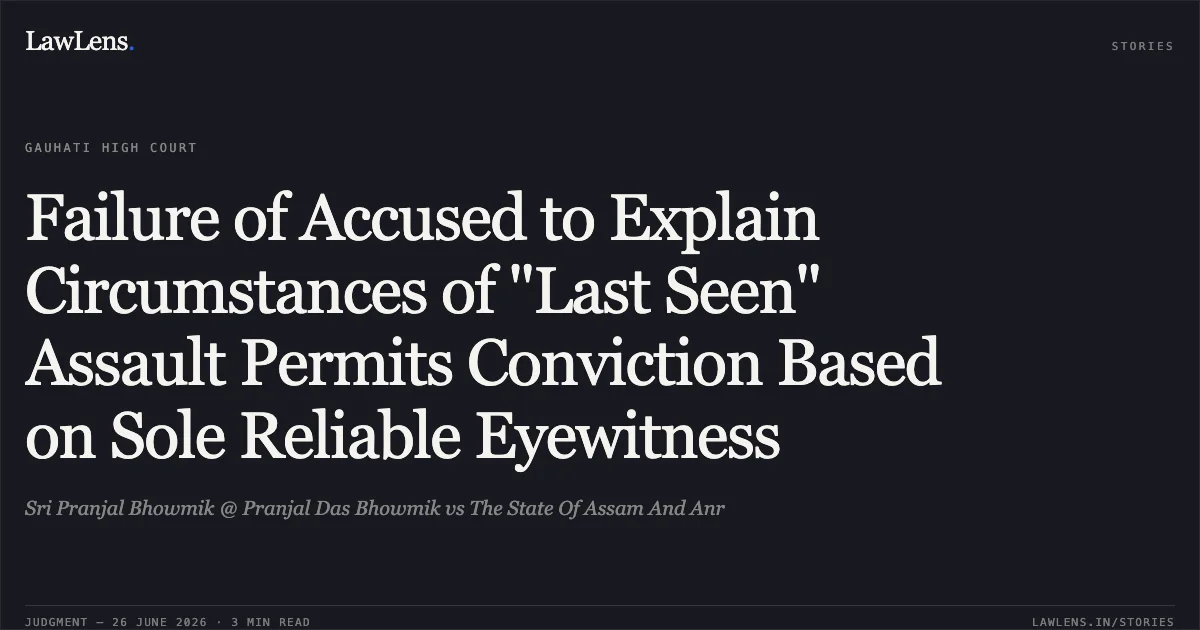
Source reference: p. 142. Whether the "last seen together" theory and Section 106 of the Evidence Act apply to the appellant
Source reference: p. 15-183. Whether the offense should be downgraded from Section 302 (Murder) to Section 304 Part-II (Culpable Homicide) of the IPC due to the use of a wooden batten and a single blow
Source reference: p. 4, 20Law Applied
Section 302 IPC (Punishment for murder) and Section 300 IPC (Definition of murder)
Source reference: p. 7, 20Section 106 of the Indian Evidence Act regarding facts especially within the knowledge of the accused
Source reference: p. 5, 15Precedents cited include Govindaraju @ Govinda v. State on the reliability of a sole witness; Alil Mollah v. State of West Bengal regarding conviction based on a single reliable witness; Rajendra Alias Rajesh v. State (NCT of Delhi) and Satpal v. State of Haryana on the "last seen theory"; and Pulicherla Nagaraju v. State of A.P. regarding the determination of "intention to kill" based on the nature of the weapon and body part targeted
Source reference: p. 14, 15, 15-17, 20Reasoning
The Court found PW-11 to be a highly reliable witness whose presence was natural as a tenant on the premises; his testimony remained unshaken during cross-examination and was corroborated by his Section 164 Cr.P.C. statement
Source reference: p. 14-18The Court dismissed the defense's argument regarding the omission of the appellant's name in the FIR, noting that the informant (PW-2) likely lacked precise details initially, and PW-11 had no motive to falsely implicate the appellant
Source reference: p. 14Applying the "last seen theory," the Court noted that since the appellant was the last person seen assaulting the deceased shortly before death (as established by the presence of undigested food in the stomach), the burden shifted to him under Section 106 of the Evidence Act to explain how they parted company, which he failed to do
Source reference: p. 15-19Regarding intent, the Court held that hitting a vital organ (head) with a sharp-edged wooden batten, followed by tying the victim's legs and throwing him into a pond, demonstrated a clear intention to ensure death, satisfying Section 300 IPC
Source reference: p. 20-21Holding
The Court answered all issues in the affirmative against the appellant and held that the prosecution proved the guilt of the appellant beyond reasonable doubt through credible eyewitness testimony and circumstantial links
The Court refused to modify the conviction to Section 304 IPC, citing the cruel manner of disposing of the body as clear evidence of "intention and knowledge" to kill, dismissed the appeal, and upheld the judgment of the Sessions Judge, Sonitpur, convicting the appellant under Section 302 IPC to life imprisonment
Source reference: p. 21-22Acts & Sections Cited
8 provisions across 2 statutes referred to in this judgment. Each provision opens on LawLens.
Code of Criminal Procedure, 19733
Indian Penal Code, 18605
Original Court PDF
Sri Pranjal Bhowmik @ Pranjal Das BhowmikvsThe State Of Assam And Anr
Click to open original judgment
Original judgment, available to read, download and summarize on LawLens.in