Facts
The appellants, Narayan Singh and Hari Ram, were convicted by the Sessions Judge, Lalitpur, under Sections 307/34 IPC for assaulting Halkai Singh with axes, and each was sentenced to three years’ rigorous imprisonment and a fine
Source reference: para. 1The prosecution alleged that the assault occurred at about 3:00 a.m. on 2 June 1986, during a land dispute
Source reference: para. 2The trial court relied principally on the testimony of Devi Singh (PW-1), the injured witness’s son, and Halkai Singh (PW-2), together with medical and recovery evidence
Source reference: paras. 7–9In appeal under Section 374 CrPC, the appellants challenged the reliability of the prosecution evidence and the finding of guilt
Source reference: paras. 1, 10–12Issues
1. Whether the prosecution proved beyond reasonable doubt that the appellants assaulted Halkai Singh in furtherance of their common intention, thereby sustaining their conviction under Sections 307/34 IPC
Source reference: paras. 21–232. Whether the discrepancies in the evidence and the failure of the injured and other purported eyewitnesses to identify or support the prosecution case entitled the appellants to the benefit of doubt
Source reference: paras. 17, 19, 21–23Law Applied
Section 307 IPC concerns an act done with the intention or knowledge, and in circumstances, that would make the act murder if death resulted; Section 34 IPC imposes joint liability where a criminal act is done by several persons in furtherance of their common intention.
Source reference: no citationThe prosecution must establish guilt beyond reasonable doubt, though the doubt must be reasonable and grounded in the evidence; where two reasonable views are possible, the view favourable to the accused must be adopted (*Yogesh Singh v. Mahabeer Singh*, as quoted at para. 20).
Source reference: para. 20Minor discrepancies do not ordinarily discredit testimony, but inconsistencies that go to the root of the case may create reasonable doubt
Source reference: para. 20A defective investigation alone is not a ground for acquittal; the court must assess the prosecution evidence independently of investigative lapses
Source reference: para. 20Reasoning
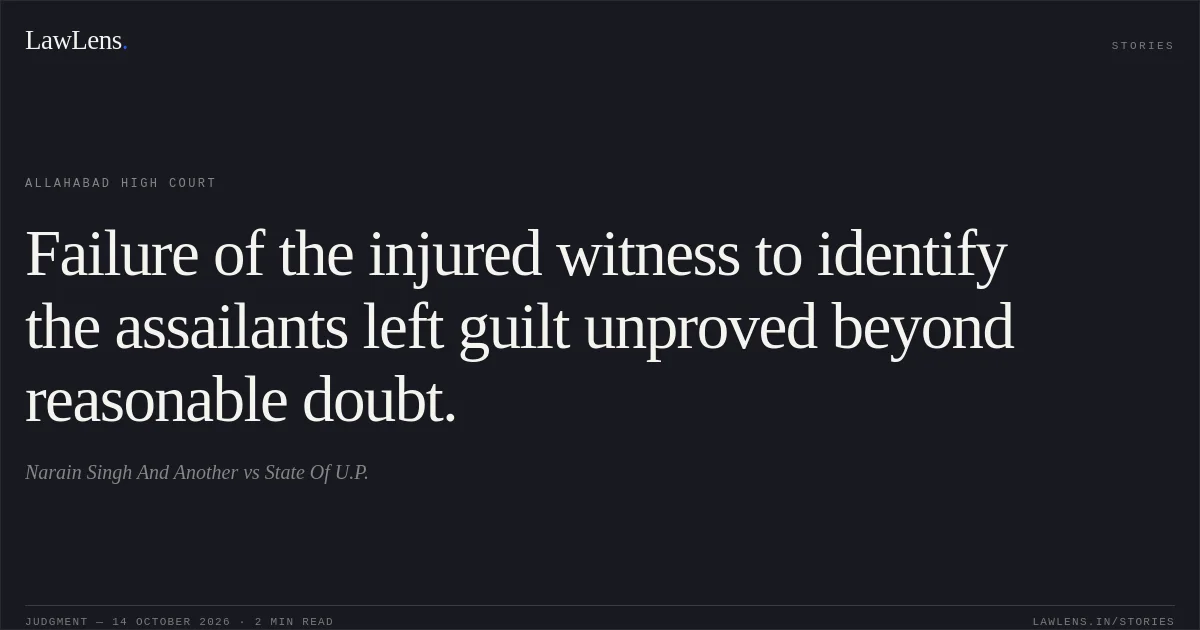
The High Court found that the injured witness, PW-2, did not identify the assailants and stated that he had not seen who attacked him
Source reference: paras. 17, 21(a)The other purported eyewitnesses, PWs 4 and 5, did not support the prosecution, leaving PW-1 as the sole witness identifying the appellants; the court also noted the admitted land enmity and the defence suggestion that PW-1 was not present at the scene
Source reference: paras. 19, 21(b)–(e)Considering these circumstances cumulatively, the Court held that the evidence did not establish the appellants’ participation and common intention beyond reasonable doubt, and that the trial court’s contrary conclusion was against the weight of the evidence
Source reference: para. 22Holding
The Court held that the prosecution failed to prove the charge under Sections 307/34 IPC beyond reasonable doubt and allowed the appeal
It set aside the conviction and sentence and acquitted both appellants; their bail bonds and sureties were discharged, subject to compliance with Section 437-A CrPC to the satisfaction of the trial court
Source reference: para. 24Acts & Sections Cited
6 provisions across 2 statutes referred to in this judgment. Each provision opens on LawLens.
Code of Criminal Procedure, 19734
Indian Penal Code, 18602
Original Court PDF
Narain Singh And AnothervsState Of U.P.
Click to open original judgment
Original judgment, available to read, download and summarize on LawLens.in