Facts
The respondents-plaintiffs (a registered society) filed a suit for declaration of ownership, recovery of possession, and mesne profits regarding a property in Shivganj, claiming title through a 1900 Patta.
Source reference: para 2, 2.1The appellant-defendant contested the suit, raising objections regarding maintainability and lack of title.
Source reference: para 2.2During proceedings, the Trial Court dismissed an application under Order VII Rule 11 CPC but, on its own motion, framed an additional issue regarding whether the suit was barred by law due to the pendency of a previous suit involving the same subject matter and parties.
Source reference: para 4The Trial Court ultimately decreed the suit in favor of the respondents on 13.10.2025.
Source reference: para 1However, it failed to adjudicate or even discuss the additional issue concerning the maintainability of the suit in its final judgment.
Source reference: para 4.1Issues
1. Whether the Trial Court’s failure to adjudicate a framed material issue renders the judgment and decree legally unsustainable?
Source reference: para 5.4, 5.62. Whether a judgment can be considered "complete" under the Code of Civil Procedure if it remains silent on an issue that strikes at the jurisdictional competence of the Court?
Source reference: para 5.4, 6Law Applied
The court primarily applied Order XX Rule 5 of the CPC, which mandates that the Court must state its finding or decision, with reasons, upon each issue framed, unless the determination of one or more issues is sufficient for the disposal of the entire suit.
Source reference: para 5, 5.2The court highlighted that under Order VI, VII, and VIII, the procedural architecture necessitates the separate adjudication of each framed issue to mature into a "judgment" in the eye of law.
Source reference: para 5.1The Court relied on the distinction between a "judgment" (the judicial reasoning and determination of controversies) and a "decree" (the formal expression of that adjudication) as defined in the CPC.
Source reference: para 5.1, 5.5Reasoning
The High Court observed that the Trial Court framed a specific additional issue regarding the maintainability of the suit in light of prior litigation, but this issue remained entirely unaddressed in the final judgment.
Source reference: para 4.1, 6The Court reasoned that a judgment is not merely a conclusion but the "soul of the adjudicatory process," requiring a conscious application of mind to all material points of controversy.
Source reference: para 5.1While a court may skip ancillary issues if a foundational issue (like limitation or res judicata) settles the suit, it must explicitly state that the remaining issues are unnecessary to decide.
Source reference: para 5.2, 5.3In this case, the Trial Court’s silence on a foundational issue regarding a legal bar to the suit constituted a manifest infirmity.
Source reference: para 6Since the decree draws its life from the judgment, the failure to adjudicate a vital issue rendered the entire judgment incomplete and the resulting decree legally vulnerable.
Source reference: para 5.5, 5.6Holding
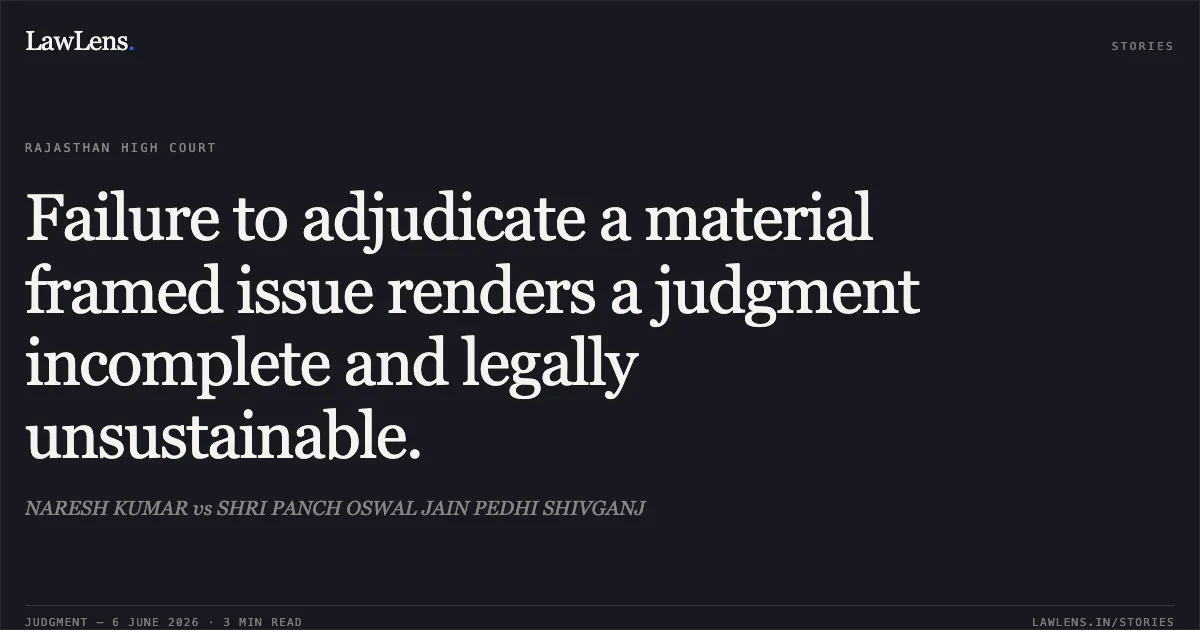
The Court held that the omission to decide a material framed issue strikes at the root of the adjudicatory process.
The appeal was partly allowed, setting aside the impugned judgment and decree and remanding the matter to the Trial Court for fresh adjudication.
Source reference: para 7, 7(i)The Trial Court was directed to allow parties to lead evidence specifically on the additional issue and then pass a cumulative judgment considering both the old and new evidence.
Source reference: para 7(ii), 7(iii)The Court ordered the refund of the court fee to the appellant as the remand was necessitated by an error of the Court and directed proceedings to be concluded within 12 months.
Source reference: para 8, 11Acts & Sections Cited
2 provisions across 1 statute referred to in this judgment. Each provision opens on LawLens.
Code of Civil Procedure, 19082
Original Court PDF
NARESH KUMARvsSHRI PANCH OSWAL JAIN PEDHI SHIVGANJ
Click to open original judgment
Original judgment, available to read, download and summarize on LawLens.in