Facts
The appellant, claiming to be a social worker, RTI activist, advocate and elected councillor of Prantij Nagarpalika, challenged the municipal proceedings and resolutions passed in the general body meeting held on 29 January 2021.
Source reference: para. 3–5His case was that the agenda notice, allegedly served on him on 27 January 2021, did not provide the seven clear days’ notice mandated by Section 51(3) of the Gujarat Municipalities Act, 1963.
Source reference: para. 3–5The Regional Commissioner had rejected his representation under Section 258(1) on 23 August 2021.
Source reference: para. 2–3The Commissioner of Municipalities subsequently rejected his statutory appeal under Section 258(3) on 2 August 2022.
Source reference: para. 2–3The appellant’s writ petition challenging the latter order was dismissed by the learned Single Judge on 8 June 2026.
Source reference: para. 2–3He thereafter filed the Letters Patent Appeal with a delay of 20 days.
Source reference: para. 1Issues
Whether the 20-day delay in filing the Letters Patent Appeal should be condoned?
Source reference: para. 1Whether the learned Single Judge erred in refusing to interfere with the municipal proceedings and the order rejecting the appellant’s challenge to the general body meeting dated 29 January 2021?
Source reference: para. 2–5, 9Whether the appellant was entitled to relief under Section 51(3) of the Gujarat Municipalities Act, 1963 on the ground that seven clear days’ notice had not been given?
Source reference: para. 3–6Law Applied
The Court applied Section 51(3) of the Gujarat Municipalities Act, 1963, which requires the prescribed notice, including seven clear days’ notice, for convening a general body meeting of a municipality.
Source reference: para. 3–6It also considered the statutory scheme under Section 258(1) and Section 258(3), concerning the Regional Commissioner’s and Commissioner of Municipalities’ consideration of challenges to municipal proceedings and resolutions.
Source reference: para. 2–5The Court further applied the principles that a party seeking judicial review must establish an actionable legal infirmity and resulting prejudice, and that discretionary writ and appellate relief may be refused where there is unexplained delay, absence of interim protection, failure to challenge a foundational order, or no practical prejudice.
Source reference: no citationNo judicial precedent was cited or relied upon in the judgment.
Source reference: no citationReasoning
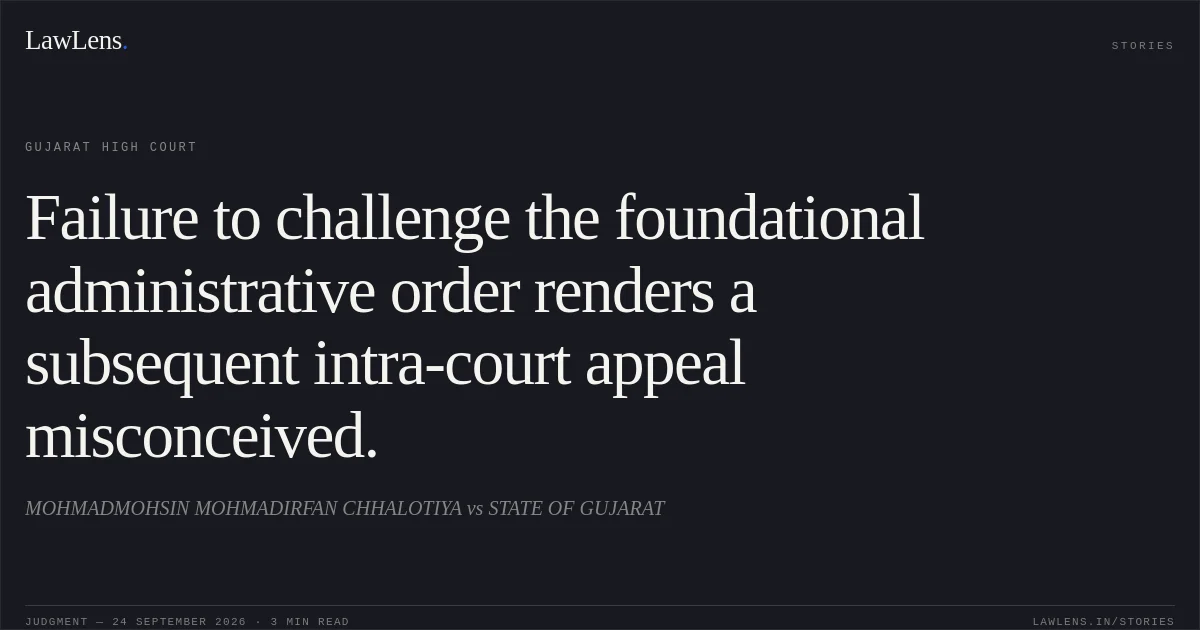
The Court found that the appeal was misconceived.
Source reference: para. 5–6Although the appellant alleged breach of Section 51(3), he did not disclose the business transacted at the meeting or demonstrate any prejudice caused to him or the public by the resolutions.
Source reference: para. 5–6The Court also noted that the agenda had apparently been prepared and circulated on 22 January 2021, and that the writ petition did not state whether the appellant participated in the meeting after receiving notice.
Source reference: para. 7The challenge was further weakened because the appellant had not challenged the Regional Commissioner’s earlier order dated 23 August 2021, which had refused to suspend execution of the municipal resolutions.
Source reference: para. 9Since the writ petition had remained pending for approximately four years without any interim order staying the resolutions, the Court declined to disturb the municipal proceedings at that stage.
Source reference: para. 8The Court also took note that the appellant’s tenure as councillor had expired and that he had not been re-elected.
Source reference: para. 10In these circumstances, no ground for appellate interference with the Single Judge’s decision was established.
Source reference: para. 9–11Holding
The Court condoned the 20-day delay in filing the appeal.
However, it dismissed the Letters Patent Appeal, holding that it was misconceived, unsupported by proof of prejudice, and amounted to an abuse of the process of the Court.
Source reference: para. 11The appellant was directed to deposit costs of ₹10,000 with the Registrar General within three weeks; failing such deposit, the amount was to be recovered as arrears of land revenue.
Source reference: para. 12The deposited amount was directed to be transferred to the Gujarat High Court Legal Services Authority.
Source reference: para. 12Acts & Sections Cited
2 provisions across 1 statute referred to in this judgment. Each provision opens on LawLens.
Gujarat Municipalities Act, 19632
Original Court PDF
MOHMADMOHSIN MOHMADIRFAN CHHALOTIYAvsSTATE OF GUJARAT
Click to open original judgment
Original judgment, available to read, download and summarize on LawLens.in