Facts
The appellants claim ownership of suit properties in Coimbatore, originally belonging to Eswaramurthy Gounder.
Source reference: para 3.1Eswaramurthy and his sons sold the properties to C.R. Palanisamy Gounder and R. Manickavasagam via sale deed on 21.02.1976.
Source reference: para 3.1The appellants subsequently purchased these properties from the legal heirs of the 1976 buyers on 31.12.1997.
Source reference: para 3.1Eswaramurthy died in 1983.
Source reference: para 3.2In 2009, 26 years later, Respondent 1 (Eswaramurthy’s daughter) sought probate for an unregistered Will dated 09.01.1976, impleading only her sisters and omitting her brothers and the appellants.
Source reference: para 3.2, 6.1Eight days later, Respondent 1 filed a title suit (O.S. 110/2009) alleging her father was coerced into the 1976 sale.
Source reference: para 6.2The District Court granted probate in 2009, but later revoked it in 2020 upon an application by the appellants under Section 263 of the Indian Succession Act (ISA), citing suppression of facts and non-citation of interested parties.
Source reference: para 3.4, 3.5, 3.6The High Court of Madras set aside the revocation, holding that probate jurisdiction is limited to the Will’s genuineness and not property title.
Source reference: para 3.8Issues
1. Whether the appellants and the omitted legal heirs (brothers) were "interested parties" entitled to citations in the probate proceedings under the Indian Succession Act.
Source reference: para 9, 222. Whether the grant of probate was liable for revocation under Section 263 of the ISA for "just cause," specifically due to the suppression of material facts and fraudulent concealment of prior property transfers.
Source reference: para 8, 24Law Applied
The court primarily applied Section 263 of the Indian Succession Act, 1925, which allows revocation of probate for "just cause," including instances where the grant was obtained fraudulently by concealing material facts or without citing parties who ought to have been cited.
Source reference: para 7(i), 8It relied on Basanti Devi v. Ravi Prakash Ram Prasad Jaiswal, affirming that probate is a judgment in rem and aggrieved persons without knowledge of the proceedings may seek revocation.
Source reference: para 10, 11It further applied the principle from Krishna Kumar Birla v. Rajendra Singh Lodha and G. Gopal v. C. Bhaskar, establishing that any person with even a slight "caveatable interest" in the estate must be served citations.
Source reference: para 12, 13Finally, it followed the doctrine from Banwarilal v. Kusum Bai, holding that an alienee (purchaser) who acquires interest in the estate prior to the probate petition is a person who "ought to have been cited".
Source reference: para 15, 19, 20Reasoning
The Court observed that Respondent 1 was fully aware of the 1976 sale deeds executed by her father, as evidenced by the averments in her parallel title suit filed mere days after the probate petition.
Source reference: para 21Despite this knowledge, she failed to implead her brothers or the current owners (the appellants) in the probate proceedings.
Source reference: para 21The Court reasoned that since the appellants purchased the property in 1997—long before the 2009 probate petition—they possessed a clear caveatable interest.
Source reference: para 20, 21The High Court erred by focusing solely on the "title" aspect; the Supreme Court clarified that while a probate court does not decide title, it must ensure the process is free from fraud.
Source reference: para 24Obtaining a judgment in rem (probate) by suppressing the fact that the testator himself had alienated the property during his lifetime constitutes "just cause" for revocation under Section 263, Explanation (b).
Source reference: para 8, 24Holding
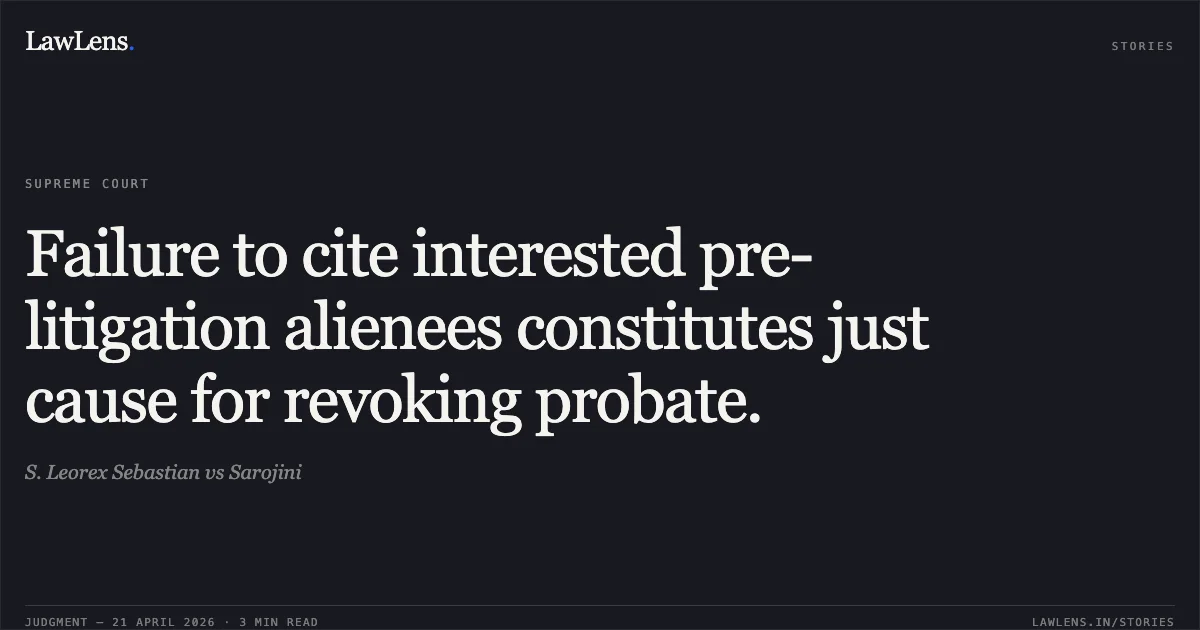
The Supreme Court answered the issues in the affirmative, holding that the appellants were necessary parties and the grant of probate was obtained through material suppression.
The Court set aside the High Court’s judgment and restored the District Court's order revoking the probate of the Will dated 09.01.1976.
Source reference: para 25, 26The appeal was allowed, with a clarification that the pending civil suits regarding title should be decided independently on their merits.
Source reference: para 27, 28Acts & Sections Cited
8 provisions across 2 statutes referred to in this judgment. Each provision opens on LawLens.
Indian Succession Act, 19257
Transfer of Property Act, 18821
Original Court PDF
S. Leorex SebastianvsSarojini
Click to open original judgment
Original judgment, available to read, download and summarize on LawLens.in