Facts
The four petitioners, arraigned as accused Nos. 1–4, sought regular bail in a case registered under Section 22(c) of the NDPS Act.
Source reference: pp. 5–7Police apprehended them near a car on 31 December 2025 and allegedly seized a total of 78.03 grams of contraband, which tested positive for methamphetamine.
Source reference: pp. 5–7The recovery materials recorded that 29.36 grams had been recovered from accused No. 1’s pant pocket.
Source reference: pp. 5–7The police filed a charge sheet; the Trial Court rejected bail on 17 July 2026, after which the accused petitioned the High Court under Section 483 of the BNSS.
Source reference: pp. 5–7The High Court observed that the Section 50 notice did not state that the accused could elect to be searched before a Gazetted Officer or the nearest Magistrate.
Source reference: p. 7Issues
1. Whether the Section 50 notice adequately informed the accused of their right to be searched before a Gazetted Officer or the nearest Magistrate.
Source reference: p. 72. Whether, in light of the alleged non-compliance with Section 50, the rigour of Section 37(1)(b) of the NDPS Act applied, and whether the petitioners should be granted regular bail.
Source reference: p. 8Law Applied
Section 50 of the NDPS Act requires that a person subject to a personal search be informed of the right to be searched before a Gazetted Officer or the nearest Magistrate; the Court relied on Vijaysinh Chandubha Jadeja v. State of Gujarat, (2011) 1 SCC 609, on that requirement.
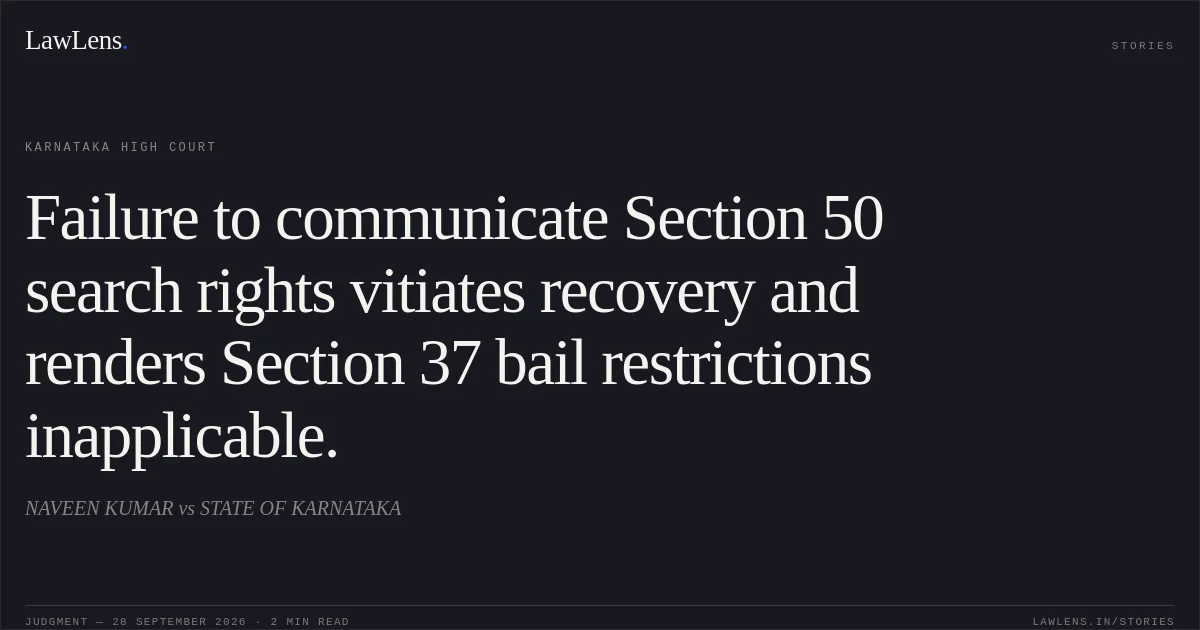
Source reference: p. 8The Court treated non-compliance with Section 50 as vitiating the recovery and concluded that, in the circumstances of this case, the restrictions under Section 37(1)(b) did not apply.
Source reference: p. 8The petitions were considered under Section 483 of the BNSS.
Source reference: p. 5Reasoning
The Court noted that the alleged recovery from accused No. 1 was from his pant pocket, making compliance with Section 50 necessary.
Source reference: pp. 7–8It found that the notice did not communicate the right to be searched before a Gazetted Officer or the nearest Magistrate and, applying Vijaysinh Chandubha Jadeja, treated the recovery as vitiated.
Source reference: pp. 7–8On that basis, it held that Section 37(1)(b)’s restrictions were not applicable.
Source reference: pp. 7–8The investigation was complete, a charge sheet had been filed, and the petitioners had been in custody for a substantial period; the Court therefore considered bail appropriate.
Source reference: pp. 7–8Holding
The High Court allowed all four petitions and directed that the petitioners be released on regular bail in Special Case No. 206 of 2026, subject to conditions.
Each petitioner was required to execute a personal bond of ₹1,00,000 with two sureties for the same amount, attend hearings unless exempted, refrain from threatening or tampering with prosecution witnesses, avoid similar offences, and remain within the Trial Court’s jurisdiction without permission until disposal of the case.
Source reference: pp. 9–10Acts & Sections Cited
5 provisions across 3 statutes referred to in this judgment. Each provision opens on LawLens.
Code of Criminal Procedure, 19731
Bharatiya Nagarik Suraksha Sanhita, 20231
Narcotic Drugs and Psychotropic Substances Act, 19853
Original Court PDF
NAVEEN KUMARvsSTATE OF KARNATAKA
Click to open original judgment
Original judgment, available to read, download and summarize on LawLens.in