Facts
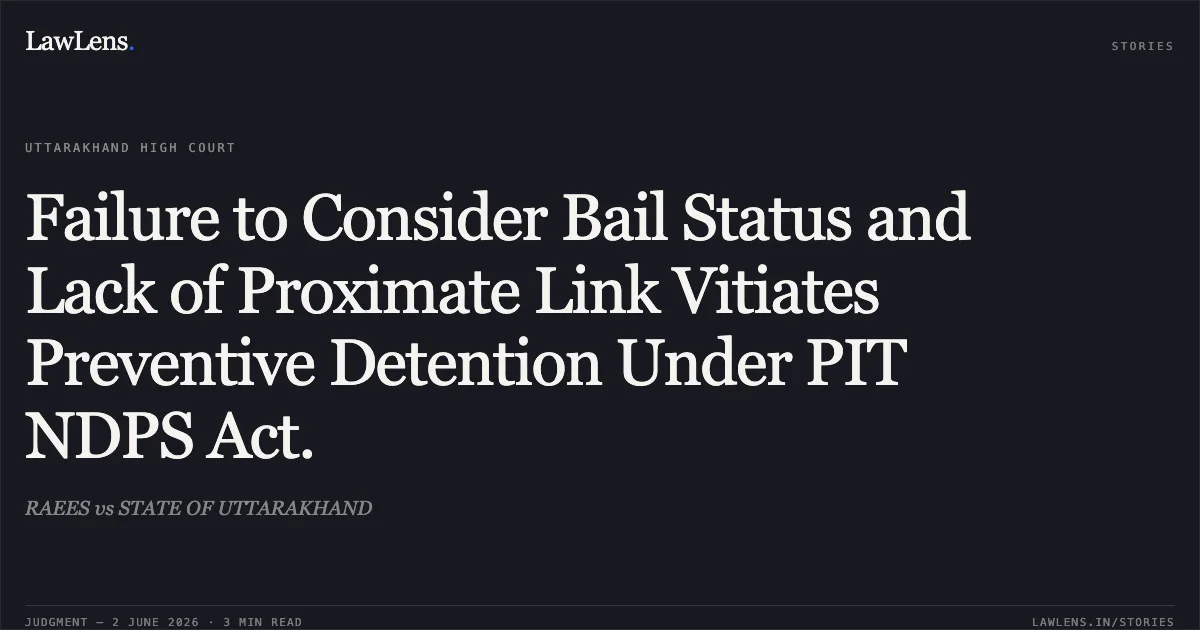
The petitioner challenged a detention order passed by the State of Uttarakhand under Section 3(1) of the Prevention of Illicit Traffic in Narcotic Drugs and Psychotropic Substances Act, 1988 (PIT NDPS Act).
Source reference: para. 1The State recorded satisfaction that detention was necessary based on four pending criminal cases under the NDPS Act (2021–2024).
Source reference: para. 3While the sponsoring authority (SSP/DIG) mentioned in the proposal that the petitioner was on bail in all five cases, the detaining authority passed the order without explicitly considering the factum of bail or whether ordinary law was sufficient.
Source reference: para. 10, 19, 24Furthermore, there was a delay of approximately two and a half months between the police recommendation (24.11.2025) and the detention order (06.02.2026).
Source reference: para. 8, 29Issues
1. Whether the failure of the detaining authority to consider the fact that the detenue was already on bail in all predicate offences vitiates the subjective satisfaction required under Section 3(1) of the PIT NDPS Act?
Source reference: para. 7, 242. Whether an unexplained delay of two and a half months between the recommendation and the detention order breaks the "live and proximate link" between the activities and the detention?
Source reference: para. 8, 313. Whether the detention order is valid if signed electronically before the formal recording of the grounds of detention?
Source reference: para. 9, 33Law Applied
Section 3(1) of the PIT NDPS Act, 1988, which requires the detaining authority to record a subjective satisfaction for preventive detention.
Source reference: para. 15Article 22 of the Constitution of India regarding safeguards in preventive detention.
Source reference: para. 13Sushanta Kumar Banik v. State of Tripura (2022), which holds that withholding or ignoring vital facts like the grant of bail vitiates the detention order.
Source reference: para. 7, 20Ameena Begum v. State of Telangana (2023), establishing that if ordinary law suffices, preventive detention is illegal, and there must exist a "live and proximate link" between past conduct and the need to detain.
Source reference: para. 17, 26Reasoning
The Court observed that while the sponsoring authority disclosed the petitioner's bail status, the detaining authority’s order failed to show that this material fact was actually considered, which is a condition precedent for valid subjective satisfaction.
Source reference: para. 19, 22Applying the Ameena Begum standard, the Court noted that since the petitioner was granted bail even in cases involving commercial quantities (meeting the rigours of Section 37 of the NDPS Act) and the State had not sought cancellation of such bails, the recourse to extraordinary preventive law was unjustified.
Source reference: para. 23-24Regarding the timeline, the Court found the two-and-a-half-month delay between the SSP's recommendation and the final order unexplained, thereby severing the "live and proximate link".
Source reference: para. 31The Court noted a fatal procedural infirmity: electronic timestamps showed the detention order was signed at 12:21 PM, while the grounds for detention (the basis for the order) were signed later at 12:23 PM, indicating a mechanical exercise of power without prior application of mind.
Source reference: para. 33-34Holding
The Court answered the issues in the affirmative, holding that the detention order was legally unsustainable due to non-consideration of material facts, unexplained delay, and procedural irregularities.
The Court quashed the satisfaction recorded under Section 3(1) and the consequential detention order dated 09.02.2026 and directed that the petitioner be released forthwith if not required in any other case.
Source reference: para. 38, 39Acts & Sections Cited
9 provisions across 3 statutes referred to in this judgment. Each provision opens on LawLens.
Prevention of Illicit Traffic in Narcotic Drugs and Psychotropic Substances Act, 19881
Narcotic Drugs and Psychotropic Substances Act, 19857
Code of Criminal Procedure, 19731
Original Court PDF
RAEESvsSTATE OF UTTARAKHAND
Click to open original judgment
Original judgment, available to read, download and summarize on LawLens.in