Facts
The petitioner institute, which already held recognition for other teacher-education courses, applied to the Eastern Regional Committee (ERC) for recognition to conduct an M.P.Ed. course.
Source reference: para. 3–11On 1 October 2026, the ERC refused recognition, recording that no reply had been submitted and identifying infrastructure deficiencies. No inspection of the institute had been conducted.
Source reference: para. 3–11, 20The institute challenged the refusal under Article 226, while the respondents objected that an appeal under Section 18 of the NCTE Act was available.
Source reference: para. 3–11, 20Issues
1. Whether the refusal order was liable to be set aside because the ERC failed to duly consider the institute’s replies and supporting material, thereby violating natural justice.
Source reference: para. 14–172. Whether the availability of an appeal under Section 18 of the NCTE Act precluded the High Court from exercising its jurisdiction under Article 226.
Source reference: para. 18–19Law Applied
A decision adverse to an institution must duly consider its response to a show-cause notice and the accompanying material, and the resulting order must demonstrate that consideration.
Source reference: para. 14Article 226 jurisdiction is not ousted merely because an alternative statutory remedy is available; exhaustion is a self-imposed restriction, and a writ petition may be entertained, among other recognised exceptions, where principles of natural justice have been violated.
Source reference: para. 18The Court relied on Rikhab Chand Jain v. Union of India, 2025 SCC OnLine SC 2510, which reiterated that the rule of alternative remedy does not constitute an absolute bar and distinguished maintainability from entertainability.
Source reference: para. 18Reasoning
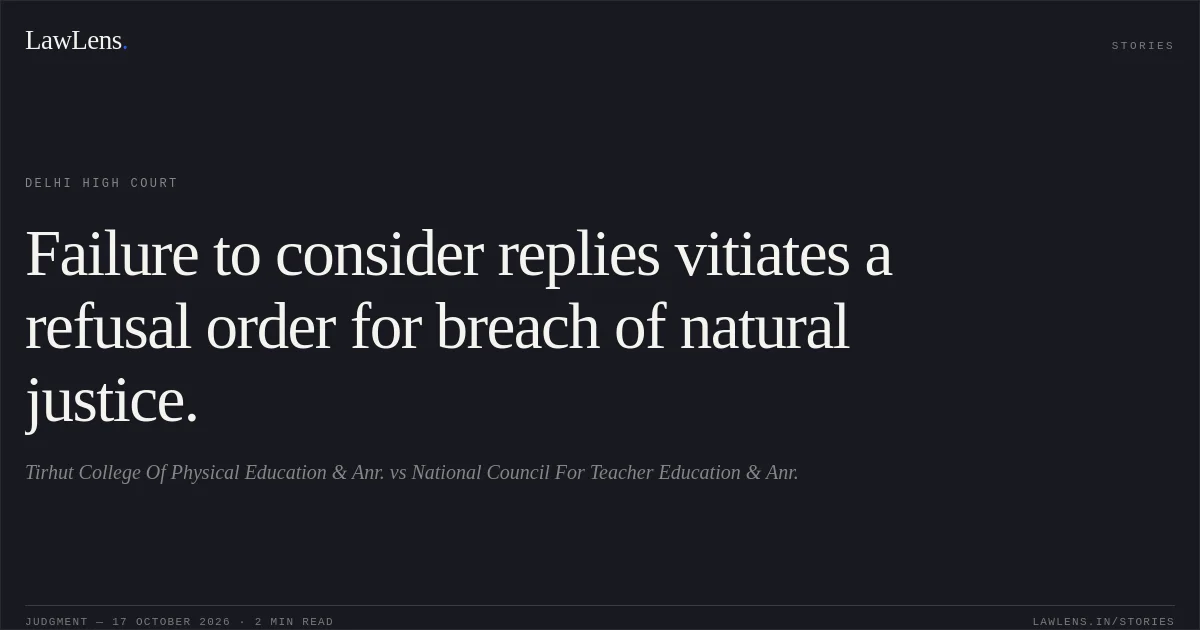
The ERC’s records were inconsistent: the final show-cause notice stated that no reply to the initial notice had been received, while the refusal order stated that a reply had been considered; the refusal order also recorded that no response had been submitted to the final notice.
Source reference: para. 14–17The Court found that the order gave no reasons showing consideration of the replies or supporting documents. These inconsistencies, together with the absence of an inspection despite the order’s reliance on physical-infrastructure deficiencies, indicated that the relevant material had not been duly considered and that the decision-making process violated natural justice.
Source reference: para. 14–17Because that violation brought the case within a recognised exception to the alternative-remedy rule, the Section 18 appeal did not prevent the Court from hearing the petition.
Source reference: para. 18–19Holding
The Court held that the refusal order dated 1 October 2026 could not be sustained and quashed it.
It remanded the matter to the ERC, directing it to inspect the institute within four weeks and furnish the inspection report to the institute. The ERC was then directed to consider the replies, documents, and inspection findings, communicate any further requirements to the institute, and issue a reasoned order on the application within three months.
Source reference: para. 20–23Acts & Sections Cited
1 provisions across 1 statute referred to in this judgment. Each provision opens on LawLens.
National Council for Teacher Education Act, 19931
Original Court PDF
Tirhut College Of Physical Education & Anr.vsNational Council For Teacher Education & Anr.
Click to open original judgment
Original judgment, available to read, download and summarize on LawLens.in