Facts
The petitioner-college had an approved intake of 60 BAMS seats and had received Letters of Permission (LoPs) for the academic years 2023–24 to 2025–26.
Source reference: pp. 5–7Following a surprise inspection on 23 January 2026, the Medical Assessment and Rating Board for Indian System of Medicine (MARBISM) recorded deficiencies.
Source reference: pp. 5–7After an online hearing and the college’s responses, MARBISM declined to issue an LoP for 2026–27 by order dated 2 July 2026; the National Commission for Indian System of Medicine (NCISM) dismissed the college’s appeal on 30 July 2026.
Source reference: pp. 5–7The college challenged both orders, sought permission for 60 seats, and contended that its appeal was under Section 9(5), not Section 29(5), of the National Commission for Indian System of Medicine Act, 2020.
Source reference: pp. 7–11A further appeal to the Central Government was stated to be pending while counselling had commenced.
Source reference: pp. 7–11Issues
Whether the writ petition was maintainable while a further appeal to the Central Government was stated to be pending, including whether such an appeal lay against the impugned decision.
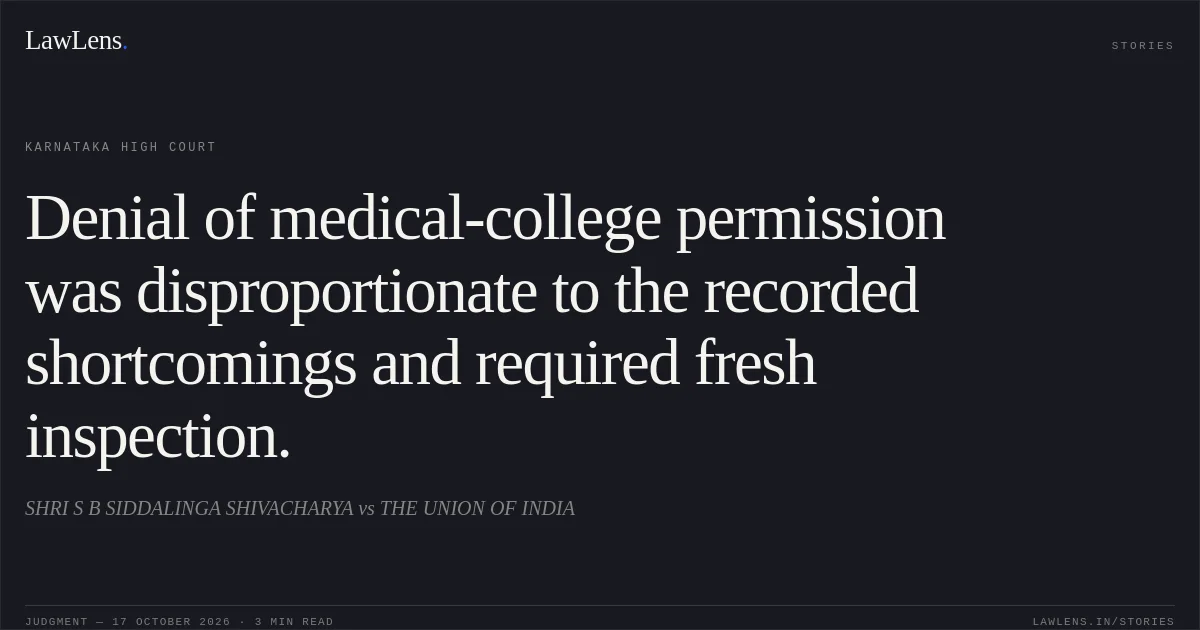
Source reference: pp. 8–14, paras. 4–11Whether the denial of an LoP for the 2026–27 academic year was disproportionate and liable to be set aside in judicial review.
Source reference: pp. 15–21, paras. 12–19Law Applied
Section 9(5) of the National Commission for Indian System of Medicine Act, 2020 provides for an appeal to NCISM against a decision of the Commission, while Section 29(5)–(6) provides appeal rights in relation to schemes for establishing a new medical institution, starting a postgraduate course, or increasing seats under Section 29(1).
Source reference: pp. 11–14Regulation 55(13) of the 2024 Regulations confines the opportunity to rectify defects under Section 29 to new institutions seeking an LoP and excludes existing institutions.
Source reference: p. 14The Court relied on the Division Bench ruling in W.P. No. 3595/2023, which held that an appeal cannot be inferred where the statute does not provide one, and treated the college’s appeal as arising under Section 9(5).
Source reference: pp. 8–11On proportionality, the Court applied the principle that judicial review is not an appeal on the merits, but intervention may be warranted where a regulatory penalty is disproportionate to the deficiencies and shocks the Court’s conscience; it also referred to its decisions in W.P. Nos. 107436/2026 and 108267/2026.
Source reference: pp. 15–19, paras. 13–15Reasoning
The Court held that Section 29 concerns the specified applications for new institutions, postgraduate courses, or increased seats, whereas this case concerned the continuation of permission for an existing college.
Source reference: pp. 10–14, paras. 8–11Reading Section 29 with Regulation 55(13), it concluded that the appeal to NCISM was under Section 9(5); applying the Division Bench’s reasoning, it rejected the objection that the writ petition was premature because of a further appeal to the Central Government.
Source reference: pp. 10–14, paras. 8–11On the merits, the college had submitted clarifications after the inspection, but the Board did not decide the matter until its meeting of 18 May 2026 and issued the impugned order later.
Source reference: pp. 19–21, paras. 16–18The appellate authority acknowledged that some deficiencies had been addressed but nevertheless confirmed the denial.
Source reference: pp. 19–21, paras. 16–18Given the resulting loss of all 60 seats for the academic year and the potential prejudice to students and the seat matrix, the Court found the sanction disproportionate and the orders unsustainable.
Source reference: pp. 19–21, paras. 16–18Holding
The writ petition was held maintainable.
The Court set aside MARBISM’s order dated 2 July 2026 and NCISM’s appellate order dated 30 July 2026, and remanded the matter to MARBISM for a fresh surprise inspection and reconsideration within 15 days.
Source reference: pp. 20–21, paras. 18–19If counselling concluded within that period, the State was directed to notify the college’s seat matrix and permit participation, with any admissions made subject to the inspection outcome.
Source reference: pp. 21–23, paras. 20–23The college was directed to pay the inspection fee and costs of ₹3,00,000; it was also made responsible for making good any loss to students if permission was ultimately not granted.
Source reference: pp. 21–23, paras. 20–23Acts & Sections Cited
6 provisions across 1 statute referred to in this judgment. Each provision opens on LawLens.
National Commission for Indian System of Medicine Act, 20206
Original Court PDF
SHRI S B SIDDALINGA SHIVACHARYAvsTHE UNION OF INDIA
Click to open original judgment
Original judgment, available to read, download and summarize on LawLens.in