Facts
ICICI Bank conducted a SARFAESI e-auction on 10 October 2025 for secured property, and the petitioner’s bid of ₹40,25,000 was accepted.
Source reference: pp. 2–4After paying ₹10,06,250, she informed the Bank that she did not wish to proceed because an encumbrance certificate disclosed a registered agreement to sell relating to the property.
Source reference: pp. 2–4The Bank forfeited the amount and later issued a further auction notice.
Source reference: pp. 2–4The petitioner sought, among other relief, execution of a sale deed upon payment of the balance or a refund with interest.
Source reference: pp. 1, 5–6The Bank objected that the petition was not maintainable and that the petitioner had an alternative remedy under Section 17(1) of the SARFAESI Act.
Source reference: pp. 1, 5–6Issues
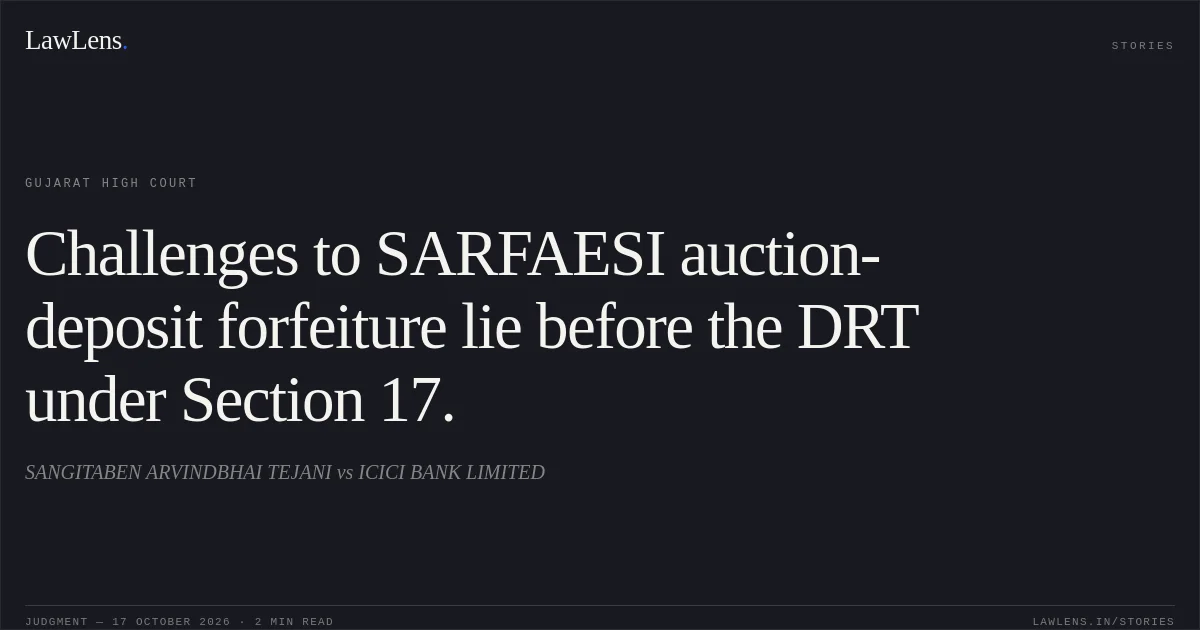
1. Whether the petitioner could challenge the Bank’s forfeiture of the deposit by applying to the Debts Recovery Tribunal under Section 17(1) of the SARFAESI Act.
Source reference: paras 6, 8–9, pp. 5–72. Whether the High Court should entertain the petition under Article 226 when that statutory remedy was available.
Source reference: para. 9, p. 7Law Applied
Section 17(1) of the SARFAESI Act permits “any person” aggrieved by a secured creditor’s measures under Section 13(4) to apply to the Debts Recovery Tribunal.
Source reference: para. 8, pp. 6–7In Agarwal Tracom Private Limited v. Punjab National Bank Limited, (2018) 1 SCC 626, the Supreme Court held that this includes actions under the Rules relating to Section 13(4) measures and that an auction purchaser may challenge forfeiture of deposited money before the DRT.
Source reference: para. 8, pp. 6–7Reasoning
Relying on Agarwal Tracom, the Court held that a challenge to forfeiture falls within the scope of Section 17(1), and that the petitioner could pursue that remedy before the DRT.
Source reference: para. 8, pp. 6–7It therefore considered it appropriate to relegate the petitioner to the statutory forum rather than examine the merits of the title-dispute or forfeiture claims in the writ petition.
Source reference: para. 9, p. 7The Court expressly did not rule on the petition’s maintainability.
Source reference: para. 9, p. 7Holding
The Court declined to entertain the petition and directed the petitioner to pursue an appropriate application under Section 17(1) of the SARFAESI Act.
It clarified that the time spent pursuing the writ petition should be considered by the appropriate forum, in accordance with law, when addressing any question of delay.
Source reference: paras 9–10, pp. 7–8The petition was disposed of and the Rule discharged.
Source reference: paras 9–10, pp. 7–8Acts & Sections Cited
2 provisions across 1 statute referred to in this judgment. Each provision opens on LawLens.
Securitisation and Reconstruction of Financial Assets and Enforcement of Security Interest Act, 20022
Original Court PDF
SANGITABEN ARVINDBHAI TEJANIvsICICI BANK LIMITED
Click to open original judgment
Original judgment, available to read, download and summarize on LawLens.in