Facts
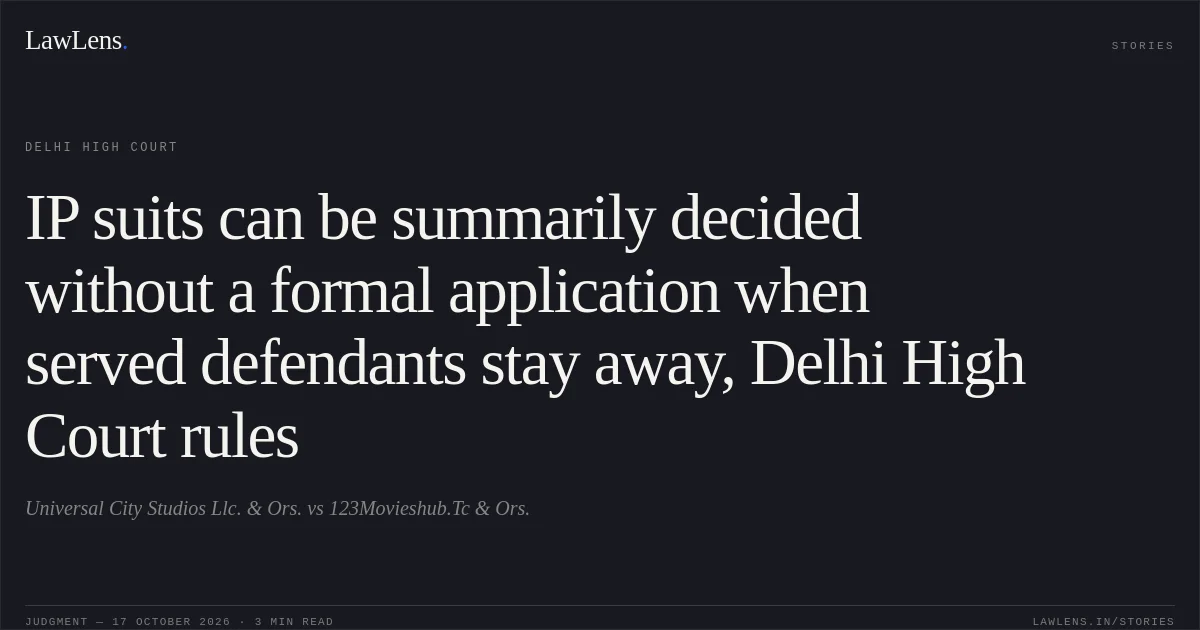
Six film and audiovisual-content companies sued 34 websites alleged to host or stream their copyrighted works without authorisation, along with Internet Service Providers (ISPs), the Department of Telecommunications and the Ministry of Electronics and Information Technology.
Source reference: para. 3–10The plaintiffs sought permanent injunctions and website-blocking directions; further websites were later impleaded, and interim blocking directions had been granted.
Source reference: para. 3–10The website defendants did not appear or file written statements despite service.
Source reference: para. 1, 9–10On 4 May 2026, the Court had allowed the plaintiffs time to apply for summary judgment, but no application was filed.
Source reference: para. 1, 9–10The plaintiffs nevertheless sought final adjudication on the pleadings and documents, without oral evidence.
Source reference: para. 1, 9–10Issues
Whether the Court could pass summary judgment in an IPD suit without an application under Order XIIIA CPC.
Source reference: para. 2Whether, on the facts of this case, the plaintiffs had to lead oral evidence before the suit could be decreed.
Source reference: para. 2Law Applied
Rule 27 of the Delhi High Court Intellectual Property Rights Division Rules, 2022 permits the Court to pass summary judgment without a specific application, applying principles akin to Order XIIIA CPC.
Source reference: para. 14Under Order XIIIA Rule 3, summary judgment is appropriate where the defendant has no real prospect of successfully defending the claim and there is no compelling reason to require oral evidence.
Source reference: para. 11, 15Bright Enterprises Private Ltd. v. MJ Bizcraft LLP requires notice and an adversarial opportunity, and identifies the period before issues are framed as the permissible window for summary judgment; Rule 27 dispenses with the application requirement in IPD cases.
Source reference: para. 12–15, 19Order VIII Rule 5(2) CPC permits judgment on the plaint’s facts where no pleading is filed, subject to the Court’s discretion to require proof.
Source reference: para. 21Under UTV Software Communication Ltd. v. 1337X.to, relevant, non-exhaustive indicators of a rogue website include a primary purpose of facilitating infringement, masked registrant details, inaction after takedown notices, and the provision of means to infringe.
Source reference: para. 27–29Reasoning
The Court held that Rule 27 applied because the suit concerned copyright infringement over the internet and fell within the IPD Rules.
Source reference: para. 19–20Unlike the circumstances in Bright Enterprises, summons had been served, the defendants had notice of the claims and supporting material, and issues had not been framed; the plaintiffs’ failure to file the application did not remove the Court’s power to act under Rule 27.
Source reference: para. 19–20The uncontroverted pleadings and investigator’s affidavit and documents supported the allegations that the websites facilitated copyright infringement, including through anonymity, continued infringement and failure to respond to legal notices.
Source reference: para. 21–22, 25–31Since the defendants neither appeared nor contested the evidence, the Court found no compelling reason to require oral evidence, which would largely repeat the material already on record.
Source reference: para. 21–22, 25–31Holding
The Court answered the first issue in the affirmative and the second in the negative.
It held that defendants 1–34 and 47–75 were rogue websites with no real prospect of successfully defending the copyright-infringement claim.
Source reference: para. 20, 25, 31The suit was decreed by permanently restraining those defendants and persons claiming through them from infringing the plaintiffs’ copyrighted works, and directing defendants 35–43 to block access to the identified websites.
Source reference: para. 33The plaintiffs were granted liberty to apply to implead mirror, redirect or alphanumeric websites that merely provide new means of accessing the enjoined websites; the decree applies to each plaintiff’s works in which it holds copyright.
Source reference: para. 34–35The suit and pending applications were disposed of.
Source reference: para. 37Acts & Sections Cited
9 provisions across 3 statutes referred to in this judgment. Each provision opens on LawLens.
Copyright Act, 19577
Code of Civil Procedure, 19081
Delhi High Court Act, 19661
Original Court PDF
Universal City Studios Llc. & Ors.vs123Movieshub.Tc & Ors.
Click to open original judgment
Original judgment, available to read, download and summarize on LawLens.in