Facts
The appellant sued her brother and sister for partition, possession, rendition of accounts and permanent injunction concerning properties and assets allegedly left by their deceased parents.
Source reference: pp. 3–10, paras. 4–24She claimed the parents died intestate; her brother relied on Wills and other documents said to affect the properties.
Source reference: pp. 3–10, paras. 4–24The Trial Court directed the appellant to value each relief separately and pay the requisite court fee. Her proposed amendments were rejected, and the plaint was ultimately rejected under Order VII Rule 11(b) and (d) CPC for deficient valuation/court fees and limitation.
Source reference: pp. 10–13, paras. 27–39The appellant challenged that decision in this appeal.
Source reference: pp. 13–15, paras. 40–47Issues
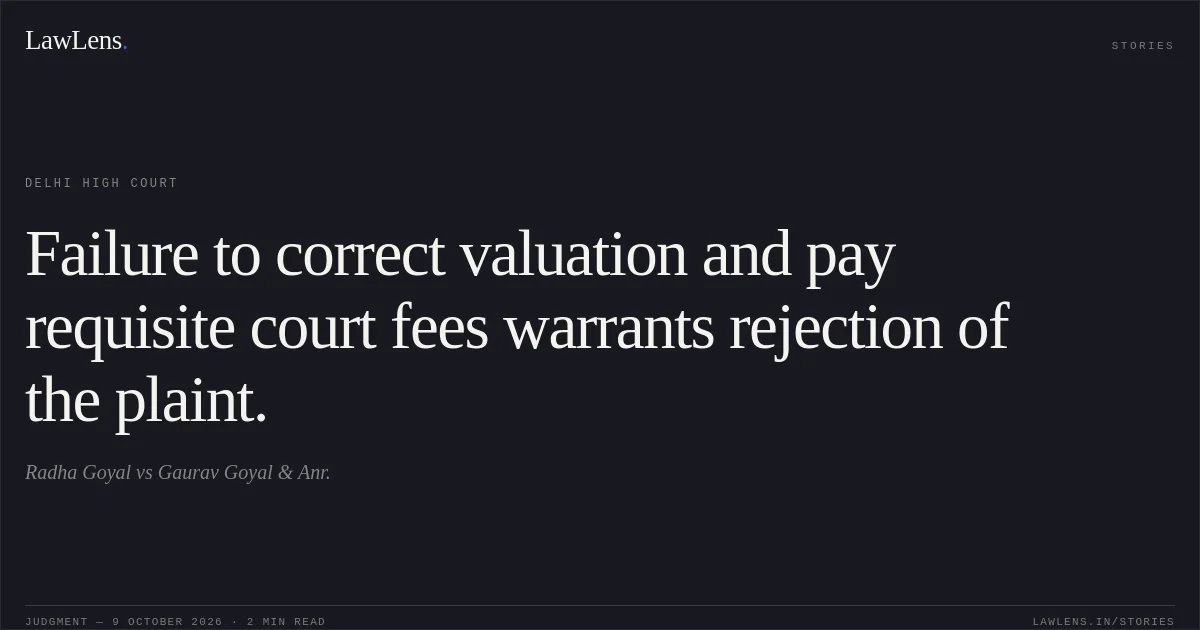
1. Whether the Trial Court was justified in rejecting the plaint under Order VII Rule 11(b) CPC for failure, despite repeated opportunities, to value the reliefs properly and pay the requisite court fees?
Source reference: p. 16, para. 552. Whether the partition suit, as framed, was maintainable when the appellant knew of the Wills and related documents affecting the properties but had not sought declaratory relief against them, and whether the claim was time-barred?
Source reference: pp. 19–20, paras. 65–66Law Applied
Order VII Rule 11(b) CPC permits rejection of a plaint where the relief is undervalued and the plaintiff, after being required by the court to correct the valuation within the time fixed, fails to do so; the court also relied on Order VII Rule 11(d) CPC in relation to a suit barred by law.
Source reference: pp. 19–20, paras. 63–68In a partition suit, the applicable court fee depends on the plaintiff’s possession: the judgment referred to Article 17(vi) of the Court Fees Act, 1870, for fixed court fees where the plaintiff is in joint possession, and Section 7(iv)(b) for ad valorem court fees where the plaintiff is not in possession.
Source reference: pp. 10, 19, paras. 27, 34A partition claim cannot be maintained as framed where an instrument affecting the claimed title remains unchallenged; any declaratory challenge must be brought within the applicable limitation period.
Source reference: p. 20, paras. 65–66Reasoning
The plaint did not establish that the appellant was in physical or joint possession of the properties; the court therefore held that ad valorem court fees were required.
Source reference: p. 19, para. 62Although the appellant was repeatedly directed to value each relief separately and clarify the court fees payable, her amendments continued to avoid that requirement, including by undertaking to pay fees only after the decree.
Source reference: pp. 16–19, paras. 55–62The court found that the statutory consequence under Order VII Rule 11(b) followed from her failure to comply.
Source reference: p. 19, paras. 63–64It also held that she had known of the Wills and related documents since 2014 but had not sought appropriate declaratory relief against them; the Trial Court’s conclusion that the declaratory claim was time-barred disclosed no reason for appellate interference.
Source reference: p. 20, paras. 65–66Holding
The High Court held that the Trial Court rightly rejected the plaint under Order VII Rule 11(b) and (d) CPC.
Finding no merit in the appeal, it dismissed RFA 656/2024 and disposed of the pending applications accordingly.
Source reference: p. 21, paras. 67–69Acts & Sections Cited
6 provisions across 4 statutes referred to in this judgment. Each provision opens on LawLens.
Code of Civil Procedure, 19082
Suits Valuation Act, 18872
Code of Criminal Procedure, 19731
Court-Fees Act, 18701
Original Court PDF
Radha GoyalvsGaurav Goyal & Anr.
Click to open original judgment
Original judgment, available to read, download and summarize on LawLens.in