Facts
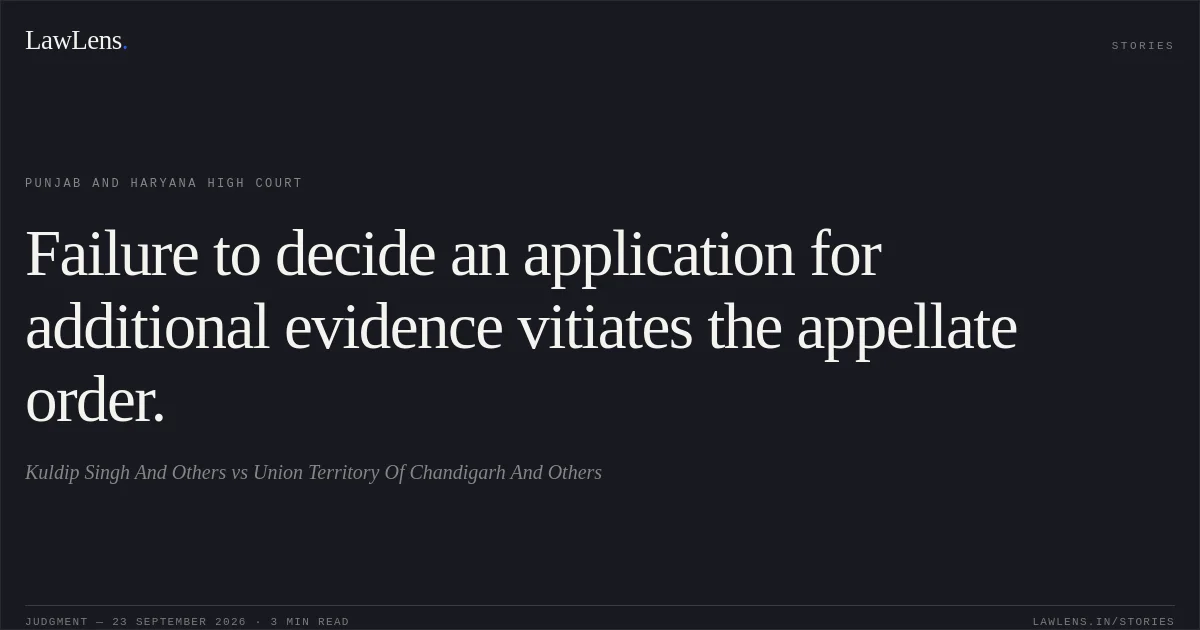
The petitioners challenged the order dated 07.09.2026 passed by the Secretary Home-cum-Commissioner (Revenue), U.T. Chandigarh, dismissing their appeal concerning approximately 103 bighas and 13 biswas of land situated in the revenue estate of Village Hallo Majra.
Source reference: para. 1-2The petitioners claimed ownership and possession as co-sharers under Section 11(1) of the Punjab Village Common Lands (Regulation) Act, 1961, relying on earlier revenue records.
Source reference: para. 1-2The proceedings had been pending since 1998 and had undergone multiple rounds of adjudication and remand.
Source reference: paras. 2-5The Assistant Collector Grade-I ultimately rejected the petitioners’ claim by order dated 13.04.2026, but, according to the petitioners, failed to record a categorical finding on their individual cultivating possession before the relevant cut-off date.
Source reference: para. 6In the subsequent appeal, the petitioners filed an application for leading additional evidence, including historical revenue records allegedly showing their independent cultivating possession.
Source reference: paras. 7-10The appellate authority did not consider that application and nevertheless observed that no additional evidence had been produced.
Source reference: paras. 7-10The respondents conceded that the application for additional evidence had not been considered.
Source reference: para. 10Issues
Whether the Secretary Home-cum-Commissioner (Revenue), U.T. Chandigarh, acted unlawfully in dismissing the appeal without considering the petitioners’ application for additional evidence, particularly when the proposed evidence went to the root of the dispute.
Source reference: paras. 8, 10-12Whether the impugned order dated 07.09.2026 was liable to be set aside for failure to properly adjudicate the applicability of Section 2(g)(viii) of the Punjab Village Common Lands (Regulation) Act, 1961 and the question of the petitioners’ individual cultivating possession.
Source reference: paras. 5-9What consequential directions ought to be issued in view of the prolonged litigation and the failure to consider the relevant revenue record.
Source reference: paras. 12-14Law Applied
The Court exercised jurisdiction under Articles 226 and 227 of the Constitution to review the legality of the impugned appellate order.
Source reference: para. 1Section 11(1) of the Punjab Village Common Lands (Regulation) Act, 1961 provides the statutory basis for seeking a declaration concerning rights in land claimed to be Shamlat Deh.
Source reference: para. 2Section 2(g)(viii) of the Act was material to determining whether the land fell within the statutory definition of Shamlat Deh or within an applicable exception based on individual cultivating possession before the relevant cut-off date.
Source reference: paras. 5-9The Court applied the principles of natural justice, fair adjudication, and the duty to pass a reasoned order: an appellate authority must consider an application for additional evidence where the proposed material is relevant and goes to the root of the controversy.
Source reference: paras. 8, 10-12A decision based on the erroneous assumption that no additional evidence was filed is contrary to the record and cannot be sustained.
Source reference: paras. 8, 10-12Reasoning
The Court found that the petitioners’ application for additional evidence was directly relevant to the central statutory question—whether their alleged historical individual cultivating possession attracted Section 2(g)(viii) and affected the classification of the land as Shamlat Deh.
Source reference: paras. 5-9Since the appellate authority neither considered the application nor the documents accompanying it, its observation that the petitioners had produced no additional evidence was factually incorrect.
Source reference: paras. 8, 10This omission was material rather than technical because the proposed revenue records could affect the outcome of the ownership and Shamlat Deh dispute.
Source reference: no citationThe respondents also admitted the non-consideration of the application.
Source reference: para. 10Accordingly, the impugned order was held erroneous for failure to consider relevant evidence and for not providing a lawful adjudication of the pending appeal.
Source reference: para. 12The Court expressly refrained from deciding the merits of the ownership claim or the applicability of Section 2(g)(viii).
Source reference: para. 13Holding
The writ petition was allowed.
The order dated 07.09.2026 was set aside.
Source reference: para. 13The Commissioner (Revenue), U.T. Chandigarh, was directed to rehear and decide the appeal afresh, after hearing all parties and specifically considering the petitioners’ application for additional evidence, without being influenced by either the impugned order or the High Court’s order on the merits.
Source reference: para. 13The fresh decision was directed to be passed within four months.
Source reference: para. 13The Commissioner was further directed to requisition the relevant revenue record from the State or appropriate custodian before deciding the appeal.
Source reference: paras. 13-14Until the fresh decision, status quo was ordered to be maintained, and the petitioners were not to be denied access to the land.
Source reference: para. 14Acts & Sections Cited
2 provisions across 1 statute referred to in this judgment. Linked provisions open on LawLens.
Punjab Village Common Lands (Regulation) Act, 19612
Original Court PDF
Kuldip Singh And OthersvsUnion Territory Of Chandigarh And Others
Click to open original judgment
Original judgment, available to read, download and summarize on LawLens.in