Facts
The petitioner-society invited tenders for construction work, which was awarded to the respondent through a Letter of Award dated 16 December 2020, signed by the Society’s President and Secretary.
Source reference: p.1The agreement and tender document contained arbitration clauses.
Source reference: p.1The respondent invoked arbitration, and the arbitrator was appointed by the High Court on 26 April 2022.
Source reference: p.2Before the arbitrator, the Society challenged the validity of the agreement and the tribunal’s jurisdiction, alleging, inter alia, that the contract was unregistered, lacked General Body approval, had been executed without authority, and was collusive.
Source reference: pp.2–3The arbitrator held that the award of work and the agreement, insofar as they concerned additions/extensions to flats, violated Rule 105 of the Delhi Cooperative Societies Rules, 2007 and were null and void.
Source reference: p.3Nevertheless, relying on Sections 65 and 70 of the Indian Contract Act, 1872, the arbitrator partly allowed the respondent’s claims and awarded ₹97,71,174 with interest at 10% per annum.
Source reference: pp.3–4The respondent did not challenge the award.
Source reference: p.1The Society challenged it under Section 34 of the Arbitration and Conciliation Act, 1996.
Source reference: p.1Issues
1. Whether the arbitrator could adjudicate and partly allow the respondent’s claims after holding the underlying agreement to be null and void.
Source reference: pp.3–4, 62. Whether the arbitrator failed to determine the jurisdictional objection that the agreement was not executed by an authorised person and was not in fact an agreement between the parties, thereby violating the requirement of a reasoned award under Section 31(3) of the Arbitration and Conciliation Act, 1996.
Source reference: pp.4–63. Whether the arbitration clause could independently survive under Section 16 of the Arbitration and Conciliation Act, 1996 despite the agreement being declared void.
Source reference: p.5Law Applied
Section 31(3) of the Arbitration and Conciliation Act, 1996 requires an arbitral award to contain intelligible and adequate reasons, particularly on issues going to the tribunal’s jurisdiction.
Source reference: p.5In Dyna Technologies Pvt. Ltd. v. Crompton Greaves Ltd., (2019) 20 SCC 1, the Supreme Court held that the reasons must be intelligible and adequate, although an arbitral award need not resemble a detailed court judgment.
Source reference: p.5In Som Datt Builders Ltd. v. State of Kerala, (2009) 10 SCC 259, it was held that merely recording submissions or referring to documents is not a substitute for reasons.
Source reference: p.5Section 16 provides that an arbitration clause is independent of the other contractual terms and that a finding that the contract is null and void does not, by itself, invalidate the arbitration clause.
Source reference: p.5However, the existence of an agreement between the parties and the authority of the person who executed it are foundational jurisdictional questions.
Source reference: p.6Sections 65 and 70 of the Indian Contract Act, 1872 may govern restitution or compensation in appropriate cases, but they do not independently confer arbitral jurisdiction.
Source reference: p.6Violation of these jurisdictional and reasoning requirements may constitute patent illegality warranting interference under Section 34.
Source reference: p.6Reasoning
The arbitrator found that the contract was void for want of compliance with Rule 105 of the Delhi Cooperative Societies Rules, 2007, but nevertheless proceeded to adjudicate the respondent’s claims under Sections 65 and 70 of the Contract Act.
Source reference: pp.3–4, 6The High Court held that those provisions could not confer jurisdiction on the arbitrator once the contractual basis of the claims had been declared void.
Source reference: p.6Although Section 16 permits an arbitration clause to survive the invalidity of the substantive contract, the Society’s specific objection was not merely that the contract was void; it was that the document had not been executed by an authorised person and was not an agreement between the Society and the respondent at all.
Source reference: p.6That question directly affected whether an arbitration agreement existed and whether Section 16 could be invoked.
Source reference: p.6Since the arbitrator did not decide this foundational jurisdictional objection or provide reasons on it, the award failed to satisfy Section 31(3) and was vitiated by patent illegality.
Source reference: pp.5–6Holding
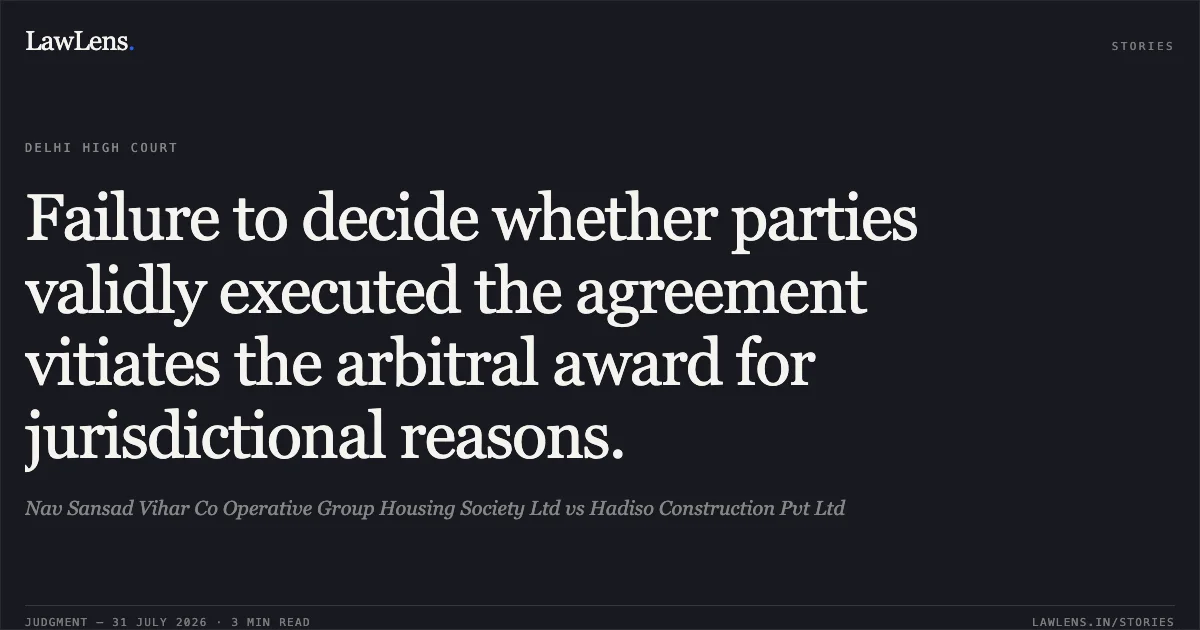
The High Court allowed the petition and set aside the arbitral award dated 29 April 2023 because it was unreasoned on a material jurisdictional issue and the arbitrator had proceeded to adjudicate the claims without establishing the basis of his jurisdiction.
The Court found it unnecessary to examine the other issues.
Source reference: p.6All pending applications were disposed of, and the parties were left at liberty to pursue remedies available in law for any surviving grievance.
Source reference: pp.6–7Original Court PDF
Nav Sansad Vihar Co Operative Group Housing Society LtdvsHadiso Construction Pvt Ltd
Click to open original judgment
Original judgment, available to read, download and summarize on LawLens.in


