Facts
The applicants (accused) purchased coal from the respondent (complainant) between May 2016 and June 2017 worth ₹58,80,639
Source reference: p. 2The respondent alleged that while ₹27,56,628 was paid, the applicants failed to pay the balance of ₹31,24,011, issued 21 cheques but prevented their deposit until they expired, and issued death threats
Source reference: p. 2Conversely, the applicants contended that the coal was found to be of inferior quality (Indian Lignite) rather than the promised Indonesian coal, leading them to file a cross-FIR against the complainant
Source reference: p. 3The complainant filed several police applications over two years, which were initially closed as commercial disputes, before finally lodging the present FIR on 07.11.2020
Source reference: p. 3-4Issues
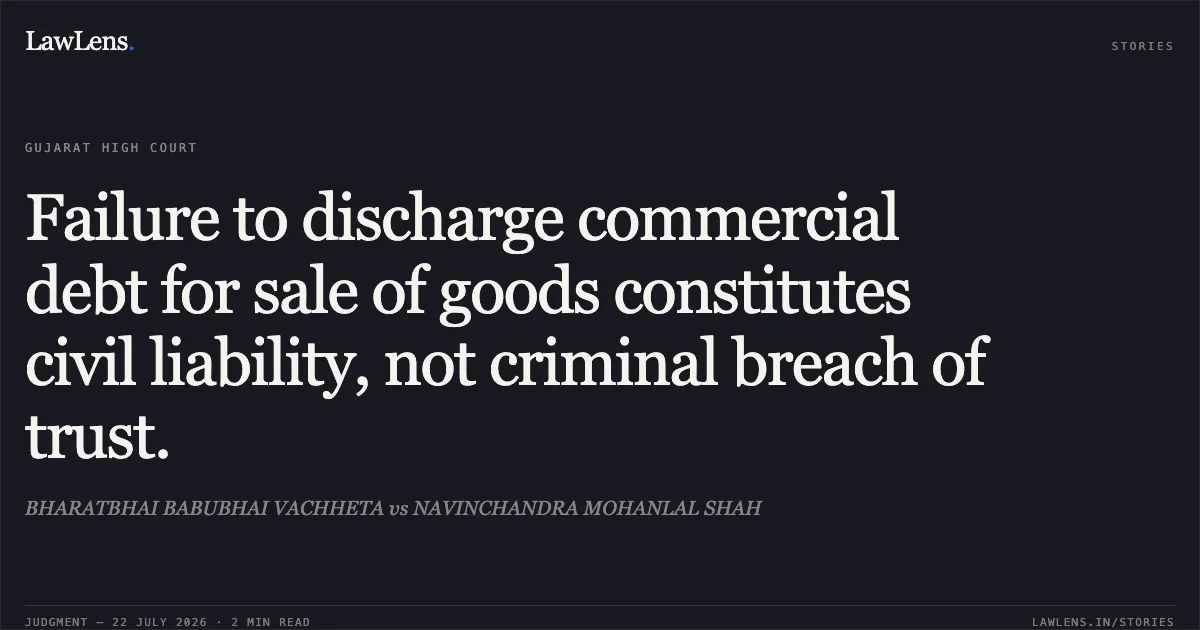
1. Whether the allegations in the FIR, arising from a commercial transaction, prima facie constitute the criminal offences of cheating and breach of trust
Source reference: p. 102. Whether the criminal proceedings are an abuse of the process of law given the purely civil nature of the dispute and the inordinate delay in filing the FIR
Source reference: p. 11Law Applied
The Court applied Section 482 of the CrPC regarding inherent powers to quash proceedings to prevent abuse of process, guided by the categories in State of Haryana v. Bhajan Lal
Source reference: p. 8-9It distinguished between "Criminal Breach of Trust" (Section 406 IPC), requiring entrustment of property, and "Cheating" (Section 420 IPC), requiring fraudulent intent from the inception, as clarified in Delhi Race Club (1940) Ltd. v. State of Uttar Pradesh and S.W. Palanitkar v. State of Bihar
Source reference: p. 12-16The Court noted that in a sale of goods, property passes upon delivery (Sections 20 and 24 of the Sale of Goods Act, 1930), thereby negating "entrustment" for the purposes of Section 406 IPC
Source reference: p. 18-19Reasoning
The Court observed that the dispute was a commercial transaction involving the sale and purchase of coal
Source reference: p. 10It held that the charge of cheating under Section 420 failed because the applicants had paid nearly 50% of the dues and issued cheques for the remainder, negating any dishonest intention from the inception of the contract
Source reference: p. 11Regarding Section 406, the Court reasoned that since this was a sale, ownership transferred to the applicants upon delivery; therefore, there was no "entrustment" of property belonging to another, making criminal breach of trust inapplicable
Source reference: p. 19The court noted an unexplained delay of over three years in filing the FIR and found the allegations of criminal intimidation under Section 506(2) to be bald statements lacking the necessary intent to cause alarm
Source reference: p. 11, 21Consequently, the dispute was determined to be predominantly civil, and criminal law was being used as a cloak
Source reference: p. 11Holding
The Court answered the issues in the affirmative, holding that the FIR failed to satisfy the statutory ingredients of the alleged offences and constituted an abuse of process
The Court allowed the application and quashed FIR No. 11191023201627 of 2020 registered at Vadaj Police Station against the applicants, along with all consequential proceedings
Source reference: p. 21-22It clarified that the parties remain free to pursue independent civil remedies
Source reference: p. 22Acts & Sections Cited
11 provisions across 3 statutes referred to in this judgment. Each provision opens on LawLens.
Code of Criminal Procedure, 19733
Indian Penal Code, 18606
Sale of Goods Act, 19302
Original Court PDF
BHARATBHAI BABUBHAI VACHHETAvsNAVINCHANDRA MOHANLAL SHAH
Click to open original judgment
Original judgment, available to read, download and summarize on LawLens.in