Facts
On November 8, 2018, the deceased, Domendra Yadav, left home to buy gutkha and was allegedly assaulted with a stick and knife by the appellants
Source reference: para. 3The prosecution relied on the "last seen" testimonies of the deceased’s sister (PW-6) and neighbor (PW-9), the recovery of a bamboo stick and blood-stained clothes under Section 27 of the Evidence Act, and FSL reports showing human blood on the seized items
Source reference: paras. 3, 5, 22, 43The Trial Court (1st ASJ, Rajnandgaon) convicted the appellants under Sections 302/34 IPC, sentencing them to life imprisonment
Source reference: para. 2The appellants challenged the conviction on the grounds that the chain of circumstantial evidence was broken and the recovery was tainted
Source reference: para. 11Issues
1. Whether the death of the deceased was homicidal in nature?
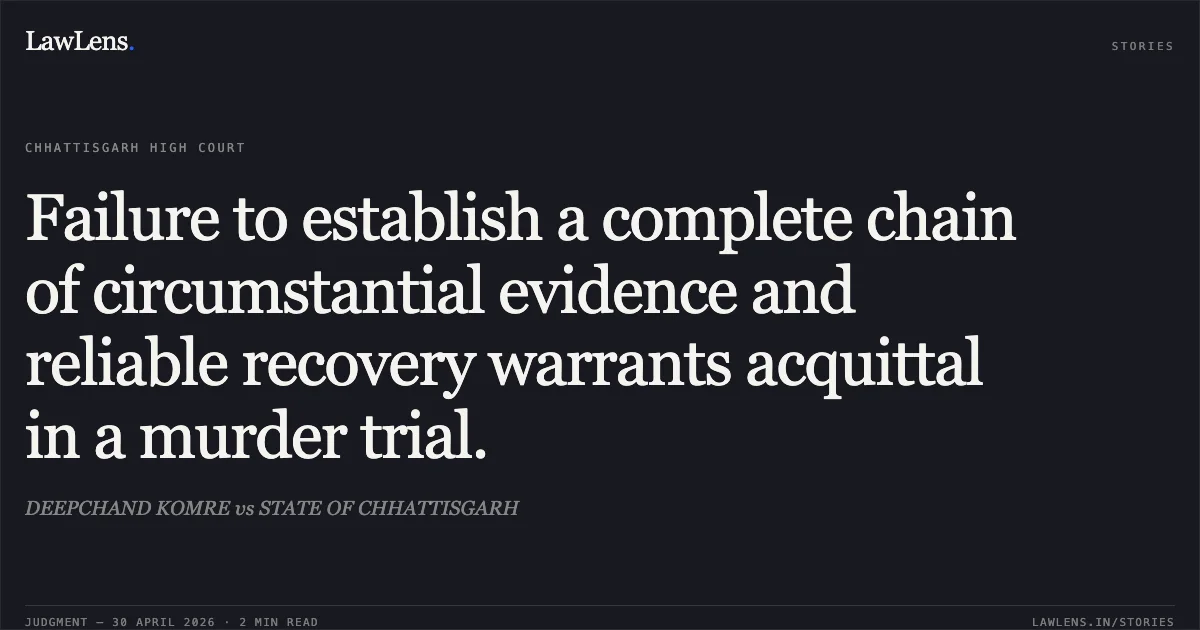
Source reference: para. 152. Whether the prosecution established a complete chain of circumstantial evidence and proved that the appellants, sharing common intention, caused the death of the deceased?
Source reference: para. 18Law Applied
The court applied Section 302 read with Section 34 of the Indian Penal Code (IPC) for murder and common intention
Source reference: para. 2It adhered to the evidentiary standard for convictions based on circumstantial evidence, requiring a chain of events so complete as to rule out any hypothesis of innocence
Source reference: para. 19It applied Section 27 of the Indian Evidence Act regarding discovery of facts based on information received from the accused
Source reference: para. 12Furthermore, it relied on Balwan Singh v. State of Chhattisgarh (2019) and Raghav Prapanna Tripathi v. State of U.P. (1963) to hold that mere presence of bloodstains without proof of blood group or origin matching the deceased is insufficient for conviction in cases of tainted investigation
Source reference: paras. 65-67Reasoning
The court found that while medical evidence (PW-12) confirmed the death was homicidal due to head and abdominal injuries, the circumstantial chain was fundamentally flawed.
Source reference: paras. 16-17The "last seen" theory failed because the alleged eyewitnesses (PW-6 and PW-9) admitted in cross-examination they did not witness the actual assault and their families had prior enmity with the accused
Source reference: paras. 24-26, 31, 33, 41Regarding the recovery under Section 27, the independent witness (PW-10) turned hostile, admitting he signed documents at the police station without understanding the contents and that no memorandum statement was recorded in his presence
Source reference: paras. 47-51Finally, the court held that the FSL report (Ex. P-37/38) was inconclusive because the prosecution failed to match the blood group of the deceased with the stains found on the common articles (sticks/clothes), rendering the forensic link weak under the Balwan Singh precedent
Source reference: paras. 56-63, 70Holding
The Court answered the first issue in the affirmative but the second in the negative.
The High Court allowed the appeal, set aside the judgment dated February 9, 2022, and acquitted the appellants of all charges. The appellants were directed to furnish bail bonds under Section 437-A CrPC (now Section 481 BNSS) to remain effective for six months.
Source reference: paras. 77-80Acts & Sections Cited
7 provisions across 3 statutes referred to in this judgment. Each provision opens on LawLens.
Code of Criminal Procedure, 19734
Indian Penal Code, 18602
Bharatiya Nagarik Suraksha Sanhita, 20231
Original Court PDF
DEEPCHAND KOMREvsSTATE OF CHHATTISGARH
Click to open original judgment
Original judgment, available to read, download and summarize on LawLens.in